Showing posts with label novel. Show all posts
Sunday, 17 September 2017
Conflict
Nobody likes conflict or confrontation. I tell a lie. Some people thrive on it - but they don't have many friends.
However if you're a writer and you avoid conflict, your story will be a pretty boring read. Nothing spectacular needs to happen. Chapter One doesn't have to start with a terrible car accident or a fight, but we do need to introduce conflict as early as possible in order to grab our reader's attention. It can be external, brought about by other people or a situation that affects our protagonist, or it can be internal due to our character's thoughts. Conflict can simply arise from having different values. For example, Pride & Prejudice's Elizabeth Bennet valued her family, honesty, humility, intelligence and kindness. Her conflict with Mr. Darcy was based on her values. She believed him to be dishonest, prideful, rude, and as she says, he “ruined the happiness of a most beloved sister.”
Just to confuse matters, your antagonist shouldn't be all bad. My first novel, Lies and Linguine, was critiqued by the Romantic Novelists' Association's New Writers' Scheme. My reader highlighted that my 'baddy' had no redeeming qualities to make him appear human. He had almost become a caricature of a rogue. I've now revised my first book and given him some virtues which hopefully counterbalance his villainous tendencies.
I endeavour to introduce conflict to my opening few paragraphs but find myself re-visiting my first page many times while writing my books because although people read the blurb on the back before buying, many also read the first page of Chapter One. Like me, they want to discover the voice of the author and establish whether the story grabs them sufficiently to want to buy the book. Here are a few examples of the opening paragraphs of three of my novels. I really hope they make you want to read on, so please leave a comment. I value constructive criticism so don't be afraid to say if you think something needs improving. (Unfortunately Blogspot doesn't allow me to set out my writing correctly.)
A Hill In France.
‘Wait! Stop!’
Arlette turned towards the voice. She saw her friend, Francine, running up Montverre Hill with her hair swinging from side to side and her clogs scuffing the parched ground. As Arlette was leading a cow from the farmyard to the field, the rhythmical choff-choff sound of hooves meant that she couldn’t hear what Francine was now shouting.
Her friend hurried across the farm entrance, scattering a cluster of chickens before stopping and leaning forwards with hands on her hips, trying to catch her breath.
‘Qu’est-ce qui se passe?’ asked Arlette.
‘C’est Pétain.’
‘Pétain? What about him?’
Arlette knew that when their fathers talked about the French leader, usually over a glass of pastis, the conversation usually became heated and resulted in insults being directed towards the man.
‘He’s abandoned Paris to the Germans.’
Arlette gave a high-pitched laugh and continued to lead the beast across the lane, its huge bulk swaying and slewing as it walked. ‘Don’t be silly.’
Francine followed. ‘It’s true.’
‘No one gives away a city as if it were a bag of apples.’
‘Pétain has, and not just Paris. Maman heard it on the wireless.’
Arlette’s smile wavered. ‘When?’
‘Just before she’d finished cleaning the mayor’s office.’
‘No. I mean when was Pétain supposed to have done this?’
‘This morning.’
‘But, why?’
Francine held out her hands, palms upturned. ‘I’ve no idea. Papa says he’s a coward.’
Arlette reached the gate to the field and unhooked the lock before slipping the cord from the cow’s neck. ‘Allez!’ She slapped its rump and watched it amble towards the herd. Holding on to the top bar of the sun-warmed gate in a daze, her eyes scanned the landscape, half expecting to see a line of German soldiers marching across its fields. The war. That vague, far off entity that was spoken of in hushed tones for fear of it becoming a reality for them, had arrived.
Magnolia House.
Rowan Forrester believed that she’d never see Catherine again, so with the gentle strains of Bing Crosby’s White Christmas playing in the background and a batch of mince pies in the oven, she answered the knock on the apartment door still humming to herself. Caught off-guard at seeing her standing there, Rowan quickly composed herself, hoping that Catherine hadn’t noticed that she’d gripped her coffee cup a little tighter.
‘I’ve got nothing to say to you,’ said Rowan, and began to push the door to.
Catherine pressed her palm flat against the glossed paintwork. ‘There’s something you need to know.’
The sweet spicy aroma of baking wafted from the kitchen and Rowan didn’t know whether to check on the mince pies or listen to what Catherine had to say.
‘You have one minute to apologise, then I never want to see you again,’ said Rowan.
Tomorrow's Not Promised.
Paris had fallen. It was unthinkable. It was terrifying.
Matilde Pascal leant out of her second floor apartment window, the stone lintel grazing her elbows as she leant forwards to get a better view. She looked at the sky. The weather was showing its allegiance to the citizens of Paris by offering an equally cold reception to the German troops. She watched squat black tanks roll into view, grumbling along the Rue de Rivoli, followed by a line of armoured trucks and motorbikes with sidecars. Along the avenue she could see people watching in silence as the enemy paraded into their capital city. The reverberation of the slow, deliberate invasion made a knot of anxiety tighten in her stomach.
A pall of black smoke had hung over the rooftops for days. Although people spoke openly about civil servants destroying records so that the Germans didn’t have access to them, she had been told that it wasn’t the burning of paperwork that was causing the dark cloud. It came from oil depots that had been set alight by retreating French troops. If the people of France were unable to make use of the fuel, then they’d make sure the Germans wouldn’t get their hands on it either.
Matilde chewed her bottom lip and decided that the darkened skies seemed like a fitting apocalyptic note for Paris as the city prepared to receive the invaders. She felt her husband’s breath on her neck as he leant over her shoulder. Xavier had said he wouldn’t give the filthy Boches the satisfaction of an audience, but his curiosity must have proven too strong. They heard a pulse of rhythmical footfall as row upon row of soldiers marched beneath their window. Matilde swallowed hard. France was occupied by a foreign power. It was appalling, yet fascinating to watch.
She squashed an ant on the stone mullion ledge with her forefinger.
Friday, 7 October 2016
Hemingway, Research and the Bull Sh*t Detector.
It was Ernest Hemingway who said that writers should develop a built-in bullsh*t detector. Perhaps because he knew that readers have their own BS indicators. They can tell when writers are either winging it or finding convenient ways for protagonists to escape from hardships. For example, your hero wins the lottery which sorts out all his financial problems, or somebody else steps in to give your characters a hand. Readers have to feel satisfied and although they don’t have to believe the story really happened, they do need to believe it could have happened. Planning and research for fiction is paramount; here are a few thoughts on the subject.
1) There's no such thing as too much research. In the military, it's often said that time spent gathering intelligence is seldom wasted. The same concept applies when writing a novel. You never know what little detail will give a scene the ring of authenticity. I've been researching about life in Paris during WW2. Only yesterday I discovered that the glass covers on street lamps were painted blue in order to aid the blackout. Adding these little pieces of information takes a reader deeper into a storyline and the world you're creating.
2) All writers are told to write about what they know. (I agree with this to a certain extent, but I do believe imagination is a fantastic tool for any writer.) Experience is often the purest form of research. I've visited Paris several times, so describing buildings, street scenes and French customs makes conveying them in my book, more accurate. Things you’ve done in life can enrich your writing in surprising ways, even if your characters aren’t doing those same things.
3) You can do research on the cheap. If you can’t travel abroad, you can pick up the phone and ask questions. What's the worst that can happen? They hang up. Then you just call somebody else. It's amazing the number of people who are more than happy to answer your questions. You can visit a museums, museums' website or libraries. Develop an eye for small details. These details aren't padding your story, they're enhancing it.
4) You can find anything on the internet. I've watched some wonderful reels of film from the Pathé News archives. These collections of news films and movies are fully digitised and available online. To actually see the invading German army marching down the Avenue des Champs-Élysées as it occupies Paris, makes writing about it, incredibly realistic and richer for the description.
5) You can find information or ideas from anywhere. You’re a writer, so keep something to record your thoughts close by, be it the good old pen and paper, or like I do, use the notes app on your phone. You might get an idea from a news story on television, a song on the radio, or just need to record a thought that occurs to you. I watched a film last night and wrote down a line from the theme song. I liked the words. I thought that perhaps it could be changed to be a book title or perhaps something one of my characters could say. Of course no one wants accusations of plagiarism, so build on an idea or change the wording.
6) You can use your senses. During the war, the citizens of France ate meagre, tasteless rations; as did the rest of Europe. We've all eaten bland cabbage occasionally and I'm sure we could all find a few choice words to describe it! We all know the smell of bonfires and garlic. The sight of blood and devastation. The sound of waves, thunder and gunfire. We've all felt the hug from a loved one and know how it feels to miss someone. As you write a scene, include your character's senses and you'll add more depth to your scene and make your writing sound more authentic.
7) Avoid information dumps. As my grandmother used to say, 'Don't over-egg the pudding.' As vital as research is, you’ll find more material than you need and no reader wants a history lesson. In my own writing, I could bore you to death with the details of aircraft, weapons, German uniforms, curfews, ways of sabotaging German vehicles and methods of Gestapo torture. Sometimes less is more. Let the reader use some of their imagination after you've given a taste of what's happening.
I started my blog post with a literary quote so I’ll end it with another. Ezra Pound, the American poet and critic (and Hemingway's friend) said that literature is 'news that stays news'. He believed that a novelist has almost the same obligation for accuracy as a news writer. Writers' fictional worlds must ring true. Even fantasy writers can't completely escape reality; the old Star Trek episodes sometimes referred to real science, which made them more believable within their context. Though we invent stories that didn’t really happen, we must drape them over a framework of real-life facts.
Thursday, 15 January 2015
A short preface for Arlette's War.
Nine strides from the kitchen door, a mulberry tree stands sentinel. Time has twisted its gnarled trunk, but each Eastertide its blossoms still blush pink with pleasure. A wide bough leans to one side as if weary. Upon this branch can be found two small ridges worn into the bark. These grooves lay testimony to the hours Arlette and Gilbert spent kicking their legs high on a rope swing; blinking at the jigsaw shapes of fractured blue sky between the tree’s branches. They swung high. Eyes closed. Faces upturned. Toes pointed.
Each autumn the spirit of the mulberry tree watched them toss yellow leaves high in the air amidst squeals of laughter. It shaded them from the summer sun as they ate its bulbous fruit, staining their fingers and lips a delicious fuchsia. Each winter it watched them through the glow of the kitchen window, occasionally sending a withered leaf to tap on the glass in greeting. It watched them grow. It watched them fall in love. Somewhere on its trunk has been etched a heart, inside which is scratched a name. Francine.
A secret known only to Gilbert and the spirit of the tree.
But during one bitter night in January 1944, the mulberry tree witnessed a chilling and macabre scene. What led to the ground being dug in darkness and what was placed beneath the black earth is a secret?
A secret known only to Arlette and the spirit of the tree.
Monday, 4 November 2013
Bromley House Library
'If you have a garden and a library, you have everything you need.'
Marcus Tullus Cicero (106-43 BC)
I've lived in Nottingham for most of my life. I thought I knew every park, every bookshop, every corner, every alleyway.
So it was with astonishment and delight that I was introduced to Bromley House Library last week by a friend and neighbour. Hidden away between two uninspiring shops stood the large wooden door to Bromley House, a Grade 2 listed town house, built in 1752.
As I climbed the stone stairs, over-looked by ornate cornices, I slid my hand along the polished curved banister wondering how many thousands of people had passed through this stairwell searching for escape into another world through the port hole of a book. I reached the library's door and what a treasure trove lay behind it! Rooms full of Georgian features, shelves groaning under the weight of books old and new, a reading room with armchairs ready to cushion weary thighs, an old spiral staircase leading to a gallery of more delicious bookshelves, a meridian line sparkling gold in the midday sun, welcoming resting places on which to relax and read whilst over-looking a hidden gem of an original walled garden.
Bromley House had an amazing atmosphere too; a sense of history, knowledge, friendships past and present, sanctuary, contemplation and peace. I took a few photographs so I can share with you all, this remarkable building.
The reading room full of books, oil paintings and comfortable furniture in which to relax and read, and a large table for studying at.
Oil paintings, a grandfather clock and a very old ornate wrought iron spiral staircase leading to a gallery and further rooms.
An operational meridian line which runs through one of the reading rooms.
The library has been operating continuously since 1816. It has a collection of 40,000 books with new acquisitions each month.
The library is a rich resource for research, whether you want to study history or just read a contemporary novel or non-fiction book.
There's also a room available for making refreshments where a variety of newspapers are available to read. Bromley House is also a venue for talks, book launches and exhibitions. It was here that the first photographic studio in Nottingham operated from 1841.
If you'd like to find out more about the library or arrange a visit, you'll find more information here.
Marcus Tullus Cicero (106-43 BC)
I've lived in Nottingham for most of my life. I thought I knew every park, every bookshop, every corner, every alleyway.
So it was with astonishment and delight that I was introduced to Bromley House Library last week by a friend and neighbour. Hidden away between two uninspiring shops stood the large wooden door to Bromley House, a Grade 2 listed town house, built in 1752.
As I climbed the stone stairs, over-looked by ornate cornices, I slid my hand along the polished curved banister wondering how many thousands of people had passed through this stairwell searching for escape into another world through the port hole of a book. I reached the library's door and what a treasure trove lay behind it! Rooms full of Georgian features, shelves groaning under the weight of books old and new, a reading room with armchairs ready to cushion weary thighs, an old spiral staircase leading to a gallery of more delicious bookshelves, a meridian line sparkling gold in the midday sun, welcoming resting places on which to relax and read whilst over-looking a hidden gem of an original walled garden.
Bromley House had an amazing atmosphere too; a sense of history, knowledge, friendships past and present, sanctuary, contemplation and peace. I took a few photographs so I can share with you all, this remarkable building.
The reading room full of books, oil paintings and comfortable furniture in which to relax and read, and a large table for studying at.
Oil paintings, a grandfather clock and a very old ornate wrought iron spiral staircase leading to a gallery and further rooms.
An operational meridian line which runs through one of the reading rooms.
The library has been operating continuously since 1816. It has a collection of 40,000 books with new acquisitions each month.
The library is a rich resource for research, whether you want to study history or just read a contemporary novel or non-fiction book.
There's also a room available for making refreshments where a variety of newspapers are available to read. Bromley House is also a venue for talks, book launches and exhibitions. It was here that the first photographic studio in Nottingham operated from 1841.
If you'd like to find out more about the library or arrange a visit, you'll find more information here.
Monday, 1 April 2013
A Room Of One's Own
Virginia Woolf once said that every woman should have a room of one's own to write fiction. I've shared a bedroom with my sister whilst growing up and then with my husband Paul and although I've shared quite happily, I'm very excited about having a room of my own. Paul is building me a writing room in the garden and I'm going to blog about its construction and its positioning onto an over-grown and neglected area at the front of the house. I hope to keep some greenery around the room to soften the edges, although it looks pretty bare at the moment thanks to our freezing Easter weather.
.jpg)
Writing spaces are so individual and it's fascinating to read about where writers feel most comfortable. Every month I buy Writing Magazine and Writers' Forum and love to read about writers' work spaces. Martin Baum has his Bournemouth beach hut, Terry Pratchett has an office with four computer screens in front of him and JK Rowling wrote Harry Potter in a cafe down the road from the university where she worked.
A writing space is definitely a luxury and not essential, after all, writers write; it doesn't matter if we're on a bus, in bed, tucked at one corner of the kitchen table or sitting on a park bench. If the ideas are flowing and a story demands to be written, then we reach for a notebook and we're off. But having said that, it would be wonderful to have my own space? A place to concentrate and escape into the make-believe lives and characters I write about. I could hang up my pin board full of facts and character traits, without cluttering up the kitchen. I could have a book-case to store the myriad of writing text books and vast collection of notebooks I've bought but don't want to deface any of them with a single word! I could also find a home for all these 'writerly' niks-naks I've accumulated and want to find a home for.
.jpg)
.jpg)
Here are the first photographs of my writing room under construction. The shell is up, the roof timbers have begun to be lifted in to place and the first-fix electrics have been put in. Thankfully it's fully insulated so I can write and read in it all year round. I thinks it's the best present ever!
.jpg)
.jpg)
.jpg)
Please keep popping back to check on progress as I up-date my blog.
Saturday, 9 February 2013
Me Before You by Jojo Moyes
Me Before You is a story about Louisa Clark, a bright young woman who is growing bored of her fitness-obsessed boyfriend and is fed up when the café in which she's worked for years, closes down. Reluctantly she accepts a temporary six month post as a carer to a young man who has been left in a quadriplegic state following a road accident two years earlier. It was either that, or work at a local chicken factory!
Will Traynor used to have an exciting well paid job, buying and selling businesses. He’s travelled the world, skiing, parachuting, diving and climbing. In the blink of an eye, his life was turned up-side down one morning as he crossed the road to hail a taxi. Will is bitter and angry, especially when his glamorous girlfriend moves on and dates a mutual friend of theirs. His family are at the end of their tether and shortly after Louisa is taken on as his carer, she hatches a desperate plan to try to convince Will that his life is worth living.
This storyline may sound a bit grim and depressing - I thought the same when I read the blurb, but I’m so pleased I overlooked my initial misgivings. Jojo Moyes writes with sensitivity and humour. She tackles the subject of quadriplegia and the rights of disabled people with great perception and compassion. The descriptions of Will's day to day existence which involves relying on others for almost every aspect of his personal care, was written with warmth and understanding.
Jojo Moyes has written a novel which has left me emotionally exhausted, inspired and incredibly impressed. Me Before You gripped me like a spiny teasel clings to clothing. I resented being drawn away from the story by household chores and the necessity of sleep and work. I frowned at the dogs as I sensed the hues outside the window become darker because a dog walk would tear me from Will and Lou. It took three days to finish Me Before You due to daily commitments, but even at work or trudging around the village green, with my spaniels, the story never left my thoughts. I found myself grinning inanely at a page one minute and wiping tears from my cheeks the next. It was an emotional, uplifting, life-affirming read. I became emotionally involved with the characters and in the storyline.
Jojo Moyes has written a book which will stay with me for a long time.
Monday, 7 January 2013
Take Note
Happy New Year
Now that the last mince pie has been eaten and we're trying to squeeze all that extra re-cycling into the bursting wheelie bin, it's time for getting into that writing routine again. Some of you will have my unstinting admiration for having written every day throughout the festivities, but although I've snatched the odd twenty minutes to read, I've not written - and I've missed it sorely! It was only when a friend asked me how much I'd managed to write over Christmas, that I realised I hadn't followed one of the basic rules I'd learnt when I first started out as a writer. That is to write every day.
We all have to start somewhere when we decide to become a writer. We're not born with the know-how so we must search for it. I'm fairly new to writing, having woken up one morning seven years ago with the idea for a book. I love deciding the fate of my characters and knowing it's me who can save them. They become my friends as if they were real people and I care what happens to them. It's me who can help them out of their difficulties and lead them to an achievement or to someone special. If I were to have one regret in life, it'd be that I didn't discover my passion earlier.
So back to some basic rules, or should I call them helpful hints? I've tried to learn as much as I can about writing techniques through reading 'how to' books, searching the internet, attending workshops and master classes, buying monthly writing magazines, joining a writing group and of course, reading other people's books. There are always a handful of tips which I read time and time again which I thought I'd highlight to all new writers.
Writing can be a lonely pastime. Develop a circle of writer-friends who can encourage you when you're struggling and celebrate with you when you're on a roll. Whether it's a local writing group or joining twitter and facebook, a network of friends can be invaluable at those moments when you doubt your ability.
Read. Keep up with latest trends and developments or your writing could begin to sound dated. By reading, you see what's selling. By understanding market awareness, you could sway a commissioning editor's opinion in your favour.
Keep feeding your imagination. Go for a walk, visit a gallery, sit in a cafe and people-watch or visit somewhere for the first time. Don't just see the day - smell it, listen to it and touch it. Look for inspiration and stock up on creative ideas.
Find time to write every day. Modern life pulls us in all directions but if we truly want to become a successful writer, we need to give ourselves time. Whether you're an early bird or a night owl, find a time that suits you and your family and make it your writing time. Forget the pile of ironing. If one thing is certain - it'll still be there waiting for you after you've finished a chapter! John Braine wrote Room At The Top from his hospital bed on a busy ward so unless both arms are in a sling, even 100 words will keep the grey cells working and the fingers flexible on those keys!
Keep a notebook and pen to hand. How many times have you thought of a perfect sentence, book title, idea or name whilst driving or lying in bed, only to later rack your brain for the forgotten information?
If you have any tips which help you and you'd like to share them, I'm all ears!! I hope you all find writing success in 2013.
Saturday, 1 December 2012
What's In A Name?
I'm excited! My second book is with my agent and I'm preparing the outline of my third novel. I've notebooks, magazines, books, newspaper cuttings and a million scraps of paper with scribblings on them in piles on my desk. My next novel is going to be set in two eras. An object will be gifted to a governess in the late 19th Century and this object will play an important part in someone's life over a hundred years later. I've only written short historical stories so far so I'm really looking forward to the challenge of getting to work.
Before I started organising my notes, I needed to choose names for my characters which were believable, strong and of the correct era. Using the right names of the period can add authenticity to a story. Whether you call your character Sky or Autumn, born in the flower-power 60's, or Hashtag (yes, seriously) in 2012, their names will influence the characters themselves. Would you call your handsome hero Nigel? (sorry Nigels) Seriously, Nigel and Juliet really doesn't work!
I've had great fun searching through Victorian forenames and surnames. Many names were taken from the politicians, religious leaders and celebrated military heroes of the time, such as William, Victoria and George. Girls were also given virtuous names such as Hope or Charity but it wasn't uncommon for mothers to give their daughters their maiden name as a second given name, such as Louisa Jennings Jones. Readers automatically associate names with people they know; names which have stereotypes attached to them. Kylie would conjure up a petite Australian singer, whereas Russell would create an image of a long-haired comedian. Best to avoid these where possible.
What do you think of the names I've chosen for my characters? I'd really appreciate feedback and would change them if you think one didn't suit. My 19th Century governess and protagonist is called Esther Jefferson, daughter of Dr Charles Jefferson. The groom and love interest is called Silas Dredge and Esther's friend, the cook's help, is called Hetty Mallory. Esther goes to work for Mrs Elspeth Fortesque to teach the children, George and Mary.
There have been some amazing names given to fictional characters over the years. Names which conjure up a different time, fear, longing, hatred and desire. For a bit of fun, here are my personal top five. I'd love to hear what your top five would be.
5. In fifth place is Abel Magwitch. A perfect name for a fugitive who'd escaped from a prison ship in Great Expectations.
4. Bathsheba Everdene comes in fourth. An strong woman who doesn't want to give up her independence, even for love, in Far From The Madding Crowd.
3. Coming in third is Flashman. I remember watching Tom Brown's School Days as a child and Flashman was such an intimidating bully of a character. I clearly remember the scene where Flashman ordered his 'friends' to hold Tom against an open fire.
2. And the runner up is Gabriel Oak. What an amazing character name for the kind young shepherd in Far From The Madding Crown and the future love of Bathsheba. Hardy came up trumps with two great fictional names!
1. First place goes to the incredibly sexy Rupert Campbell-Black. I can almost smell the sweet grass on his jodhpurs and the earthy scent from his boots as he strides into the hall to sweep me off my feet and..... Okay. You get the idea. He isn't called Nigel!!
Before I started organising my notes, I needed to choose names for my characters which were believable, strong and of the correct era. Using the right names of the period can add authenticity to a story. Whether you call your character Sky or Autumn, born in the flower-power 60's, or Hashtag (yes, seriously) in 2012, their names will influence the characters themselves. Would you call your handsome hero Nigel? (sorry Nigels) Seriously, Nigel and Juliet really doesn't work!
I've had great fun searching through Victorian forenames and surnames. Many names were taken from the politicians, religious leaders and celebrated military heroes of the time, such as William, Victoria and George. Girls were also given virtuous names such as Hope or Charity but it wasn't uncommon for mothers to give their daughters their maiden name as a second given name, such as Louisa Jennings Jones. Readers automatically associate names with people they know; names which have stereotypes attached to them. Kylie would conjure up a petite Australian singer, whereas Russell would create an image of a long-haired comedian. Best to avoid these where possible.
What do you think of the names I've chosen for my characters? I'd really appreciate feedback and would change them if you think one didn't suit. My 19th Century governess and protagonist is called Esther Jefferson, daughter of Dr Charles Jefferson. The groom and love interest is called Silas Dredge and Esther's friend, the cook's help, is called Hetty Mallory. Esther goes to work for Mrs Elspeth Fortesque to teach the children, George and Mary.
There have been some amazing names given to fictional characters over the years. Names which conjure up a different time, fear, longing, hatred and desire. For a bit of fun, here are my personal top five. I'd love to hear what your top five would be.
5. In fifth place is Abel Magwitch. A perfect name for a fugitive who'd escaped from a prison ship in Great Expectations.
4. Bathsheba Everdene comes in fourth. An strong woman who doesn't want to give up her independence, even for love, in Far From The Madding Crowd.
3. Coming in third is Flashman. I remember watching Tom Brown's School Days as a child and Flashman was such an intimidating bully of a character. I clearly remember the scene where Flashman ordered his 'friends' to hold Tom against an open fire.
2. And the runner up is Gabriel Oak. What an amazing character name for the kind young shepherd in Far From The Madding Crown and the future love of Bathsheba. Hardy came up trumps with two great fictional names!
1. First place goes to the incredibly sexy Rupert Campbell-Black. I can almost smell the sweet grass on his jodhpurs and the earthy scent from his boots as he strides into the hall to sweep me off my feet and..... Okay. You get the idea. He isn't called Nigel!!
Saturday, 3 November 2012
Making The Cut Less Painful
It's been a while since I've visited my blog because I've been editing my novel at every opportunity I can find. In August I sent my completed manuscript of 104,500 words to my agent and having read it, she suggested several helpful ideas; such as moving some chapters around, making it obvious that one of my characters was 'in' on the secret and also making another character more unstable without turning them into a psychotic caricature of a mad stalker! The trouble is, the characters make appearances throughout my novel so it's been a slow process to change dialogue and emotions without missing a crucial scene and confusing the reader.
I've also renamed my book, The Bandstand. The bandstand in question is in Clapham Common, London, and plays a part in several chapters of my book. I felt as if my original title - In Hindsight, gave too much away - protagonist looks back and wonders why she hadn't noticed....
So I thought that for this post I'd talk about editing. There's a huge amount of global competition when it comes to writing, so the sharper our manuscript is, the less likely we are to be over-looked. If we take time to learn how to edit effectively, the improvement can be profound. Every tweak and cut polishes our chapters. Even after we've read and re-read our work numerous times, the odd tpyo (see what I did there?) slips through, which is why copy editors are in employment! Sometimes we are just too close to our work and need an objective eye to cast a glance over it.
But what can we do for ourselves?
If you can bear it, put your manuscript out of sight in a safe place for several weeks or even months. When you come back to it, all sorts of mistakes will become apparent. Spelling, grammar, sentences that don't flow, speech marks in the wrong place, missing words, fluffy/wordy descriptions and paragraphs of information which waffle on and become tedious. The reader wants to be able to flow through your story seamlessly without becoming irritated by little flaws.
Personally I find the most effective way to edit is to print out a hard copy of my novel. I'll sit with a red pen and start to read. It's quite unbelievable how many red squiggles and lines will decorate my pages afterwards, even when I think I've done a good job editing on my computer. Also reading the printed pages out loud will make it obvious if I'm stumbling with the rhythm of my sentences.
Cut out repeated words, dull or superfluous detail, any overuse of adjectives and adverbs and all weak words like 'but' 'quite' and 'rather.' I use 'that' and 'just' too often and I
Look out for occasions when you've stated the blindingly obvious: 'He shouted loudly,' or 'she whispered quietly.' Don't rely on spell check. The misuse of it's and its or there and their won't be highlighted as a mistake. Some authors prefer to edit one aspect of their work at a time, for example, punctuation, spelling or deleting unnecessary information. Personally I opt for doing an overall edit as I'm reading.
Whichever way you decide, try to be ruthless.
Sunday, 1 July 2012
777
Thank you so much Megan Taylor for choosing me to carry on the 777 challenge. For those of you who don't know about it, writers are invited to share seven sentences from page seven of their work in progress. They then choose seven other writers to do the same.
My second novel, In Hindsight, is almost complete bar a little editing. The seven sentences come from an opening scene where my characters,Rowan and her husband Tom, are viewing a three storey Georgian house in Clapham. They decide to buy the house at auction and name it Magnolia House as it has a magnolia tree heavy with bulbous blossoms decorating the tiny front garden. As I couldn't choose seven sentences but had to take them from page 7, they're not the most exciting of lines, but describe what my characters find as they view a house they're hoping to buy.
Rowan finds herself widowed early on in the story and decides to divide the house into three separate storeys. She takes in two lodgers for company and to help with her finances. In Hindsight is a story about how she claws back from the depths of grief with the help of new friends. But nothing is ever plain-sailing is it? My novel is full of deceit, mystery, friendship, jealousy, an obsessive compulsion, romance and hope.
Tom and Rowan followed the agent into the kitchen where they discovered several cupboard doors hanging from their hinges, exposed pipe-work and an oven which had created its own biosphere of living organisms. Strange amorphous splodges were sprouting fungus and threading their way around each of the gas rings.
They traipsed around tumbledown rooms where ceilings were decorated with damp patches, floorboards were broken and strips of ripped wallpaper hung like clusters of catkins. Although some rooms were in better condition than others, all had retained their ornate cornices, ceiling roses and wide floor boards which shone with an aged patina. On the top floor, the view of roof tops and neighbouring small manicured gardens was amazing. They lingered for five minutes, moving from one sash window to the next, gasping with surprise and pointing out distant landmarks.
‘Look over there. Can you see the church spire?’
Rowan followed Tom’s finger with her eyes. The church’s conical tower tapered towards the bare cyan sky.
Here are the seven writers I've chosen to join in the fun of 777. I look forward to reading all your excerpts!
Natalie James (@Nat_TOALB) http://theonealwaysleftbehind.wordpress.com/
Kathryn Brown (@crystaljigsaw) http://www.crystaljigsaw.blogspot.co.uk/
Wendy Sparrow (@WendySparrow) http://ladybugsroar.blogspot.co.uk/
Jessica (@serenitywriter) http://serenitywriter.wordpress.com/
Friederike Schmoe (123writer) http://schreibenundschreiben.blogspot.co.uk/
Gina (@ginad129) http://ginadenny.blogspot.co.uk/
L. M. Stull (@lmstull) http://lmstull.com/
Monday, 5 March 2012
Learning Lessons The Hard Way
My second novel, In Hindsight, tells the story of a young woman called Rowan and her attempt at getting her life back on track after the unexpected death of her husband. Of course things don't go smoothly when she eventually re-surfaces to face the world again. She finds out that her husband wasn't the man she thought he was. But it's my take on grief in my novel which needs editing, now that I'm experiencing it in reality.
I had my heroine suffering with Hollywood angst but not possessing the ability to carry on with everyday tasks. I had her in floods of tears and being cared for by her best friend like a child. Since dad died in January, I've learned the lesson of writing about grief the hard way.
It's a deep clawing sadness. It's a feeling that everything in your life is different - but nothing in your life has changed. It's catching your breath when the image of their smile floods your thoughts. It's love, loss, anguish, silence and madness. It's alternating between silently begging and bargaining with God to be a better person if only He could make you wake up and find you'd had a nightmare; that dad was still here. It's staring into the middle distance but seeing nothing. It's about continuing with life but weaving your memory of them into every task. It's smiling - even laughing - but then feeling that sharp prick of guilt that you've done so. It's painful. It's about swollen eyes and bitten nails. It's about watching the red digits flashing 3am. It's longing, anger, futility and tears. It's about seeing their likeness in a stranger and for one desperate second wanting to call their name - until you remember. It's about gazing at their photograph and willing the touch of the paper to feel warm like their skin; for the image to breathe once more. It's about holding your family closer. It's about clutching their clothing as if it were them. It's about standing silently in their bedroom and feeling their spirit about you.
It's the hardest thing I've ever done.
Friday, 6 January 2012
Where Do New Writers Begin?
Whilst talking recently with my teenage niece, she expressed the view that she couldn't possibly write a novel. I asked why she believed this and she replied that she wouldn't know where to start and wouldn't know what to write about.
My humble advice to her and all new writers, young and old, would be to start with what you know. If you're a student, set your short story or novel in a college, local youth club or even your house. If you're a nurse, have your story pan out in a hospital or doctor's surgery. When you become more confident in your writing, you can develop your ideas further afield. If you're happy to jump in and write about imaginery places immediately, go for it! Overall, it's so much easier to write about what you know to begin with; and that includes your backdrop. A college or a hospital has to be built somewhere, and where better than the place you know best - the area in which you live. Of course it doesn't have to be identical and you can re-name the town. And remember that when it comes to writing, you're in charge of your own imagination. If you live near an incinerator or rubbish dump and want to replace it with a luxury spa or a department store - you can!
I set my first novel in Car Colston, Nottingham, England. That's where I live. It's a small village without a single shop, but it does have a delightfully old-fashioned pub and a magnificent manor house. I re-named the village Larkston in my book. I placed my hero in the manor house after my narrative described how he'd inherited it on the death of his parents. My protagonist set up home in a small rented cottage in a nearby lane. Writing about the village green, The Royal Oak, the cricket pitch, the shop in the next village and a myriad of other local places, my writing flowed much more easily because I could 'see' and describe things that were in my minds' eye. I'm sure many writers would tell you the same thing. It helps to write what you know. Before long I'd caused crime, jealousies, deception, romance and lies to kick off in quiet little Larkston!
Car Colston village
Next choose what genre you'd like to write about. What are your interests? If you like sport, you don't have to play a particular game to include it in your writing. If you like science fiction or history, of course you're not able to hop aboard the US Enterprise or jump in Doc's DeLorean, like Marty did in Back To The Future. That's where research comes in. And how much easier has this been made for us since search engines have been invented? And remember, it'll be fun because you're going to research something that interests you.
I also told my niece that the first chapter, preferably the first few pages, should contain a hook. A hook, for all new writers, is something that makes your reader want to continue reading your book. Something should happen which literally 'hooks' their interest. The protagonist of your piece, that is, your main character, will have to face challenges which he/she must overcome. Don't make it easy for your character to live happily ever after (or not). She/he must learn and grow from their experience and find a way out of their dilemma for themselves. Winning the lottery to get out of serious debt is just a dream for most people. Your reader will feel cheated if you end your story with such a 'cop out!'
Happy writing and good luck to all new writers.
Sunday, 9 October 2011
Out With The Old...
It's been a stressful week and my new computer relationship isn't working out. At the moment it's not a happy one.
Having returned from a wonderful holiday visiting my sister in California, I was looking forward to knuckling down to my novel. Firstly I was going to write a blog post about my visit, as I hadn't seen my sister in five years.
Have you seen that advert on television - the one with the "noooooo" face, when your computer 'does one?' Well, no sooner had I'd laughed at the advert, than I was making my own "noooooo" face!
The mouse arrow locked, the key pad didn't work and I was stuck. Of course I tried the famous tried and tested cure-all. I switched the computer off and on again. But no. My mouse had squeaked its last and my keyboard didn't respond to desperate begging.
Having run the Toshiba help line, which cost a fortune per minute, it was recommended that I have my data recovered. What about me? I needed to recover too! Then I realised he meant that it needed saving onto a hard drive.
This is where I hide in shame and you tut at me. It had been about six weeks since I'd saved my work. (sounds like I'm back in the confessional box) I know, I know! It's my own fault. I broke the golden rule. But how many of us finish a few hundred words and put the kettle on? Or someone calls you from another room. I just got out of the habit, and as is always the case, the best lessons are learnt from mistakes.
Having got a quote from a recovery service who said I had to POST my computer to them for a fee of £200, I decided to go to my local PC World. Well they were wonderful, or at least a young man called Steve was. He calmly explained that if I a bought a cheap hard drive, he'd recover my work, if it was possible!!
If it was possible??? It hadn't occurred to me that it wouldn't be possible. I think I frightened him with my "noooooo" face again! I had a novel, half a new novel, poetry, short stories, photographs....well you know what we writers have on our computers. I didn't have a choice. I had to trust him and leave my years of work in his hands. The twinge I got when I walked out of the store was similar to the feeling I got when I left my children at nursery for the first time when they were four. Could others care for something that is precious to me, as carefully as I do?
Don't you just hate it when someone says they've got good news and bad news for you? Do you take the good news and run so you don't have to hear the bad? Do you hear the bad first and hope the good out-weighs it?
I asked for the good news. He'd saved all my data! Hooray! What could possily be bad after that?
The bad news was that it would cost almost as much to fix my three year old laptop as it would to buy a new one. AND it would have to be sent away so I couldn't write, tweet, blog etc for a week. I can't say it was an easy decision to say good-bye to my tired Toshiba. I knew his idiosyncrasies, I knew what buttons to push and was comfortable in his company. Now I have a shiny new Dell. I haven't got to know him yet and I'm still a bit wary. He makes strange noises, has different buttons, feels different and I think he's a bit domineering. I suppose we just need to spend some time together and get to know each other.
One thing he hasn't got that my old computer had.
MY BLOODY PHOTOS!
Not a bean. Just dull pictures of flowers which he gave me as a gift when I bought him. I clicked on 'photos' and there they were. Drooping and glaring at me in a too-bright-yellow. Where were my precious family photographs? My holiday photographs? Hundreds of them. Then I thought that my old computer must have held onto them as a desperate bid to take him back. (I really wish I didn't give objects anthropomorphic qualities. It just makes life more stressful and guilt-ridden.)
Should I encourage my old and new computers to connect and work together in harmony - sharing the photos? Or do you think I should get a solicitor involved?
I think I'll go back to Steve at PC World!
Sunday, 28 August 2011
A Writer's Workshop
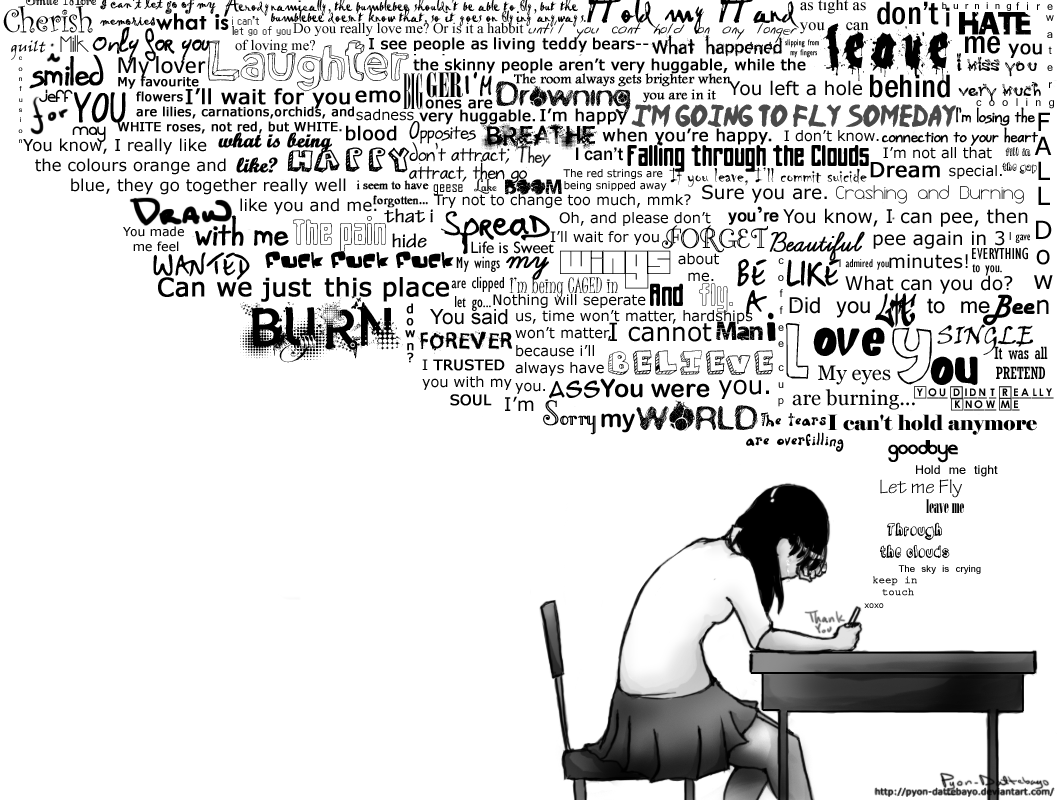
Drawn by Pyon_Pattebayo
Judith Allnatt, author of A Mile Of River and The Poet’s Wife, visited Nottingham Writers’ Club to host a workshop. I'd read and loved her books, so I was looking forward to her visit.
After introductions, Judith started the session with an ideas generator. She suggested writing a list of different characters, locations and objects. By choosing one of these at random from each list, a basis for an idea will appear. Another suggestion was to pick an arbitrary word from the dictionary. Just open the dictionary and point!
As a warm up for the grey matter, Judith suggested describing someone you know in terms of a piece of music, a colour or an animal.
The group moved on to flow writing. We wrote for ten minutes without stopping to think. We scribbled down anything that came into our head without crossing out or editing. Quite a feat, even for ten minutes! After the allotted time, we read over our paragraphs and underlined ideas, phrases and words which we found interesting and could use in the future.
Next we concentrated on mind-mapping and clustering. We chose a word which we wrote in the middle of the page. Using lines (like a child’s drawing of the sun) we wrote words which were connected in some way. For example we chose the word, tower. From that word we mapped over thirty more, including vantage point, Pisa, inferno, suicide, vertigo, sniper, injury, hair. Mind mapping helps the writer to dig deeper and find a new view point.
Judith explained that a writer needs to have a two-sided approach to their work. They need to be spontaneous and creative, but also be a ruthless analyst and editor. The pitfalls are that the writer can become too flippant or censor too harshly. There is a fine balancing act we writers must find.
For our next writing challenge, we all chose a post card from a selection which Judith had brought with her. We had to study it and make notes on what struck us about the picture. The mood, the atmosphere, the colour and textures. We imagined what sounds were present and what was unfolding beyond the boundaries of our picture. Moving on, we conjured up ideas of what had happened before and after the event we were looking at. This exercise was extremely helpful in developing a story with depth and vision.
I find workshops invaluable for picking up new ideas from established writers. I also find it heart-warming that published authors are happy to selflessly share their knowledge with new writers.
I'd love to hear from any writers, publishers or agents who'd like to visit us at Nottingham Writers' Club to talk about their expertise and work lives. We're always delighted to welcome new speakers and learn from their experiences.
Judith Allnatt, author of A Mile Of River and The Poet’s Wife, visited Nottingham Writers’ Club to host a workshop. I'd read and loved her books, so I was looking forward to her visit.
After introductions, Judith started the session with an ideas generator. She suggested writing a list of different characters, locations and objects. By choosing one of these at random from each list, a basis for an idea will appear. Another suggestion was to pick an arbitrary word from the dictionary. Just open the dictionary and point!
As a warm up for the grey matter, Judith suggested describing someone you know in terms of a piece of music, a colour or an animal.
The group moved on to flow writing. We wrote for ten minutes without stopping to think. We scribbled down anything that came into our head without crossing out or editing. Quite a feat, even for ten minutes! After the allotted time, we read over our paragraphs and underlined ideas, phrases and words which we found interesting and could use in the future.
Next we concentrated on mind-mapping and clustering. We chose a word which we wrote in the middle of the page. Using lines (like a child’s drawing of the sun) we wrote words which were connected in some way. For example we chose the word, tower. From that word we mapped over thirty more, including vantage point, Pisa, inferno, suicide, vertigo, sniper, injury, hair. Mind mapping helps the writer to dig deeper and find a new view point.
Judith explained that a writer needs to have a two-sided approach to their work. They need to be spontaneous and creative, but also be a ruthless analyst and editor. The pitfalls are that the writer can become too flippant or censor too harshly. There is a fine balancing act we writers must find.
For our next writing challenge, we all chose a post card from a selection which Judith had brought with her. We had to study it and make notes on what struck us about the picture. The mood, the atmosphere, the colour and textures. We imagined what sounds were present and what was unfolding beyond the boundaries of our picture. Moving on, we conjured up ideas of what had happened before and after the event we were looking at. This exercise was extremely helpful in developing a story with depth and vision.
I find workshops invaluable for picking up new ideas from established writers. I also find it heart-warming that published authors are happy to selflessly share their knowledge with new writers.
I'd love to hear from any writers, publishers or agents who'd like to visit us at Nottingham Writers' Club to talk about their expertise and work lives. We're always delighted to welcome new speakers and learn from their experiences.
Thursday, 25 August 2011
I'm Scrambled!
I'm trying to stay calm and focused. *deep breath* It's not that my mind isn't full of my characters' conversations, or that I have a block in my plotting. But sometimes too many ideas can bring you to a standstill as suddenly as writers' block can. My thoughts are like the wires tied in knots behind my desk. Computer wires are tied around the curly telephone wire, the kettle wire is getting steamy with the bt connection and the printer wire looks like it's doing a bit of heavy petting with the answer phone cable! So many points of communication, but all in one big fat stationary mess. That's the metaphor for my brain at the moment. (not the heavy petting bit....)
I write lists, I make notes, I jot down words and phrases I like, I scribble conversations and I annoy my husband by switching on the bedside lamp to record ideas which have sprung to mind during the night. I think the only thing that can help me unravel my thoughts and get this plot into some sort of order, is an Enigma machine!
Oh and don't get me started on procrastination. *goes and makes a cuppa*
Because my ideas are one big tangle at the moment, instead of trying my hand at deciphering my bouillabaisse of ideas, I write a poem or short story for my writing group. Which is great, because I'm keeping my hand in and even winning some competitions. But a book doesn't write itself and I know I'm going to have to stop saying, "I'll start Chapter 8 tomorrow/at the weekend/next Monday. (sounds a bit like my diet!)
And life! Boy, can't life get in the way of writing? The children, the house, the dogs, the shopping, the chores, work (earning some money is actually quite a good idea) the garden, nights out with friends.... Wonderful diversions, but diversions nonetheless!
Do you have any ideas to make me knuckle down? (no smart comments about tying me to a chair) How do you fit writing into your day and how do you untangle your metaphorical wires of thought? I'd seriously love to know.
Must dash, time to write.....think I'll just take the dogs for a walk.......
Saturday, 30 July 2011
In Hindsight (Chapter 1)

“Liar!”
Ellie Morgan’s coffee mug slipped from her fingers, dropped onto the floor and smashed. Her other hand squeezed her apartment’s door handle so tightly, that her knuckles stood out on her fist like four pale pebbles.
Kate stood defiantly in the doorway, as the gentle strains of Bing Crosby’s White Christmas played in the background. She blinked calmly, unmoved by what she’d just revealed.
“He wouldn’t. I don’t believe you,” continued Ellie, the shake of her head barely perceptible.
Kate tilted her head a fraction to one side and raised her eyebrows. “Don’t you?”
Ellie had been on her way to the kitchen to take some baking out of the oven when a knock on her front door had disturbed her. Now the sweet spicy aroma of cooked mince pies was wafting from the kitchen. She didn’t know whether to rescue her pies or continue to listen to these ridiculous accusations. She decided to stay and listen.
“Why are you doing this?” Ellie frowned. “You said you understood why I’d asked you to leave. I’m sorry if I upset you…”
“Upset me?” Kate laughed, her mouth stretched wide but her eyes remained cold. “You threw me and my daughter out into the street just before Christmas. What would Tom have said about that?”
“Stop bringing Tom into this. You know why I asked you to leave and you know that I gave you time to find somewhere else. Besides, it doesn’t give you the excuse to come here and make up stories about my husband.”
The insincere smile slipped from Kate’s lips. “Tom’s dead.”
Ellie reeled at the venom in her voice. “Do you really think that I need reminding?”
“Yes, I do.” shouted Kate.
“How dare you, after all the chaos you’ve caused.” Ellie let go of the door handle and pointed at her. “I’ll tell you why you’re making up this rubbish. Because you had a crush on Tom and couldn’t stand the fact that he wasn’t attracted to you.” She gripped the handle again for support. “He was professional at his job and you couldn’t handle the reality that he was married and not interested. You might have men falling at your feet every day, but I don’t believe for a minute that Tom was weak enough to fall for your fluttering eyelashes. You models were all just part of the job; props to be dressed and photographed. You’re lying because I asked you to leave – because you’re jealous of what we had. It’s so easy to accuse him of sleeping with you when he’s not here to defend himself, isn’t it?”
Bizarrely, as Ellie was ranting, she’d noticed that her lanky Poinsettia was wilting over the side of its pot, just outside the doorway on the landing. Inanely, she made a mental note to water it.
Kate stared impassively back at her. “I have proof.”
Ellie didn’t believe for a minute that she had proof. She was just looking for a reaction and she wasn’t going to get one. How had it come to this? They’d been friends for the past year and now they couldn’t bear the sight of each other “I’m not interested in hearing any more lies. I’d like you to leave.”
The telephone rang inside the apartment, causing Ellie to momentarily turn. In that instant, Kate pushed past her and walked into the lounge.
“What the hell are you doing? Get out.”
The telephone continued to ring as Kate walked towards a framed photograph of Tom which was sitting on the coffee table. She picked it up and studied it. Tracing her fore-finger around Tom’s profile, she kissed her fingertip and touched his lips with it.
Ellie felt the bile rise in her throat, but took a calming breath, held out her arm and pointed towards the staircase. “Get out!” She rotated her hand so that her palm was facing upwards. “Give me the front door key first. I don’t want you ever coming back.” Her hand shook visibly as it lay upturned, hovering in the empty space between them.
“Look at him,” ordered Kate, turning the photograph.
Ellie continued to glare at Kate.
“Look at him!”
Ellie glanced at the picture of her husband. His kind almond-shaped eyes held her gaze, making it impossible for her to look away immediately. The photograph had been taken in Aubeterre, a small hamlet in France they’d often visited. It’d been awarded a sign which stated that it was a village of outstanding natural beauty. Tom had joked that she should be awarded a badge which read those very same words. He’d asked her to marry him in Aubeterre Square, kneeling on one knee beneath one of the Linden trees which grew around the Place Trarieux. The dappled light had patterned his earnest, smiling face. She could almost evoke the sweet aroma of the trees, just by envisioning them.
The phone stopped and for a few seconds the room was quiet, as the Christmas tree lights flashed on and off to the rhythm of Ellie’s pounding heartbeat. She blinked as a bird screeched an alarm call outside the window, its dark shadow flitting past the glass.
“How can you just move on?” asked Kate. "What’s the point of having photographs sitting around the place if you intend to exchange him like faulty goods?” She replaced the photograph and walked towards the window, her breath clouding the glass. “I could have made him happy you know?” she said quietly, almost to herself.
The sky had a metallic quality to it. Heavy grey clouds hung low in the sky, laden with snow which was promised for later that afternoon. Kate peered into the street below and watched the opposite neighbour dragging a wheelie bin towards the pavement. Another was strapping a child into their car seat before setting off. Perhaps the little girl would visit Santa in the shopping centre before being dragged around the supermarket. Mundane tasks maybe, but a life which Kate had daydreamed about since meeting Tom.
Ellie stood with her arms folded, wondering if she was capable of physically removing Kate from her apartment. She doubted it. It was taking all her self-control not to run to the bathroom and retch.
“For your information, Tom was happy, not that it’s any of your business. You seem to have invented a set of circumstances which are all in your head. We were happy, Tom wasn’t a cheat and I am not seeing anyone else.”
Kate turned, tears balancing precariously on her eyelashes. Ellie let out a sigh as she felt her shoulders relax a little, with relief. Surely Kate was now regretting coming round and had come to her senses. Surely she now realised that making up lies about Tom wouldn’t help her feelings of loneliness.
“It’s okay Kate,” soothed Ellie. “It must be lonely being a single mum but…..”
“I hate you,” spat Kate. “It should’ve been me living here with Tom. I wouldn’t be running round after another man only a few months after he’d died if he’d been my husband. I don’t know why you don’t just ask James to move in, instead of all the ridiculous flirting that goes on. It’s sickening to watch.”
Ellie’s jaw dropped in shock before she regained her composure. “I’m not running around after another man!” shouted Ellie. “James is a friend. He understands it’s too early to think about…besides, how dare you tell me how to live my life. Tom died a year ago, and he would understand that friendships are important for support.”
“Friendship?” Kate mocked. “Come off it! We used to talk, remember?” She pointed at the sofa. “Sitting there. I’d listen to you giggling over what James had done or said. You told me how you felt about him. It made me sick to listen to how quickly you’d forgotten about Tom. How easily you’d moved on.”
“I’ll never stop loving Tom and you know it. James and I are just good friends.”
“That’s pathetic! Don’t insult me by using that old cliché. The only reason you’re not an item is because he doesn’t feel the same way about you.”
Ellie was shocked at how deeply those words had hurt. The notion that James didn’t think that they had something special growing between them, made her feel incredibly sad and isolated; as if she’d lost something very special. She tried to remember if James had ever shown her any affection; given her any hint that he might be interested in getting to known her more intimately. Yes, they’d shared some recent lingering looks, he’d held her hand when she’d been tearful and he’d always been so attentive. But what if Kate was right? What if friendship was all that was on his mind?
Kate continued, with Ellie only half listening. “Yours couldn’t have been a great marriage could it? You say Tom was happy. Why would he stray if he was happy at home?” She swept her hand in a semi-circle in front of her. “It should be us living here. I can’t sleep at night. I miss him. And you! Call yourself a wife? Have you no respect?”
Ellie was determined not to cry in front of Kate, even though she was screaming soundlessly inside. “For the last time, get out.” Her drained face was the only outward sign that Ellie’s memories of her beloved Tom had been shaken as violently as a child’s snow globe.
The sound of someone running upstairs from the apartment below stopped their conversation. James appeared in the open doorway.
“I just phoned you. I heard something smash.”
He looked down as he crunched on the shattered mug underfoot. He paused before raising his eyes to the two women facing each other across the coffee table. Ellie’s face looked ashen. It was instantly obvious that they’d been arguing.
“What’s going on?” He looked from one to the other.
“Well talk of the devil,” said Kate. “Were your ears burning?”
“Ellie?” he asked, looking at her.
“Kate was just leaving,” she replied. She tucked a strand of hair behind her ear, unsure of what to do with her hands as The Little Drummer Boy, rum-pum-pum-pummed from the speakers.
“Oh but we’re having such a lovely time,” cooed Kate, sarcastically. “Come and join us James. We’re just getting to know each other a little better.” She beckoned him into the room.
James didn’t move. “I don’t know what’s going on, but if Ellie wants you to leave, I think you’d better.”
Kate sauntered towards him and stopped an arm’s length away. “What Ellie wants, Ellie gets, is that it? Who are you, the perfect hero on a white charger? Have you come to rescue poor Ellie from the evil mistress? Her husband’s lover.” She laughed in his face. “Thought that would shock you.”
The bitter-sweet smell of burnt pastry drifted into the room as James looked at Ellie. She was chewing her bottom lip nervously and didn’t look up.
“It doesn’t matter why you’re here Kate, but I think it’s best if you leave now.” He stood to one side of the doorway.
Kate sneered. “Oh you do, do you?” She laughed whilst shaking her head. “It’s pathetic. You’ve no idea have you? Well if you think that piece of news shocked you, wait ‘til you hear this.”
Tuesday, 26 July 2011
Chocolate Cake and Tarmac

I love to invent characters, imagine settings and create plots. But one of my most favourite aspects of writing, is adding detail and description. I believe that including sensory details, pulls the reader into the scene and helps to bring characters and situations to life.
It's a bit like an artist adds colour and texture. Our words are our paint.
I have a little note book (well I have about 50 to be honest) into which I write my own similies, metaphors and analogies. I know that one of my writing weaknesses is that I can include too many similies into my writing. A few can be great; too many and you're over egging the pudding as they say! I usually re-read my work at the first edit and find that my flow is disrupted with too many comparisons. This is where I hit the delete button most often when editing!!
Description can be great fun to work on and can be a welcome break from working out the plot and dialogue. Rather than have my character eat a cake, I'd rather she inhaled the sweet smell of baking as she bit into the rich moist chocolate cake, licking her fingers clean of the butter cream which had dribbled down them? I don't know about you, but I can almost smell that chocolate gateaux!
I've added a extract of my second novel, In Hindsight. I think it shows more clearly than explaining, how I colour my story. It's still a work in progress, so please let me know if you think I've gone over-the-top! I know I have to sometimes rein myself in!
June’s heat-haze danced and twitched as it levitated above the broiled pavements. Shiny black slugs of melted tarmac dribbled lazily into the gutter, smelling as sickly-sweet as a bag of pineapple chunks. Aircraft droned above them, leaving white streaks slashed across the bare blue sky, criss-crossing existing contrails. This month was a melting pot of sticky days.
Ellie and Tom Forrester stood in front of the neglected weather-worn house in Clapham, looking up in disbelief. A flaking central front door didn’t bode well for the rest of the building. The sash windows looked rotten where paint had peeled and rain had drenched the exposed wood. The low parapet which was built around the edge of the roof was crumbling in parts and missing in others. Its only redeeming feature was a mature Magnolia tree standing in the diminutive front garden.
Ellie opened the paper she’d been carrying and re-read the advertisement which had caught Tom’s attention over breakfast the previous morning.
“It says here, 'Elegant three-storey semi-detached Georgian town house. In need of some modernisation to bring it back to its former glory. Full of original features. Pretty courtyard to the rear of the property. Dated decor requiring attention throughout.'”
“Dated! I think they mean delapi-dated.” Tom frowned as he rubbed the stubble on his chin. It was a nervous habit he’d developed since establishing his own photographic business, The Bigger Picture.
Nearby church bells chimed half past the hour as the estate agent fidgeted impatiently next to the front steps. She’d felt a trickle of sweat run down between her shoulder blades and was worried that the damp patch would show through her new summer shift dress. The news channels were proclaiming that it was going to be the hottest June on record for the past twelve years and the damp skin on her back, lay testimony to that fact. She silently urged the dithering couple to make up their minds.
“Do you still want to take a look?” Ellie asked.
Tom pulled a face and shrugged. “We’re here I suppose.”
She folded her arm through his as they joined the red-faced agent.
“Tom and Ellie Forrester?”
“That’s us,” Tom smiled.
“Great. Let’s get in out of this heat.”
The woman turned a key in the lock and the door squeaked open. Ellie noticed that a line of perspiration had seeped through the back of the agent’s olive dress, staining it dark green. Once inside the cool hallway, they gave a collective sigh of relief. The smell in the dank entrance hall propelled Ellie back to the many hours she used to dig in the damp earth under the shade of a huge silver birch as a child. Almost like a perfume, it smelt musty and sweet
Monday, 11 July 2011
A Hero By Any Other Name

We imagine a hero to show great courage or ability, to have performed heroic acts, to be admired for his qualities and regarded as an ideal. Not forgetting of course that he must be devilishly good-looking to boot!
Can you imagine just how boring the books we read and write would be, if our pages were filled with white-toothed, grinning, muscular, handsome men? The phrase ‘nice but dim’ springs to mind, along with images of asexual cartoon characters.
As writers, our choice of hero is a very personal thing and speaks volumes about ourselves. We reveal our individual values and preferences. We comment on those we perceive to be lacking or deficient in some way. For me, a hero has to have flaws. The truth is that bad things happen to good people. The best heroes in my mind are male protagonists who have a failing, an imperfection or a weak spot.
Achilles was a handsome Greek hero of the Trojan War. He was the central character and the greatest warrior in Homer’s Illiad, but had one weakness – his heel, an injury to which ultimately led to his death. Although this mythological story refers to a physical vulnerability, we can use this weakness metaphorically in our writing. It will make our hero seem more three dimensional and ‘human,’ as opposed to robotic and boring. Having said that, I believe a handsome or rugged face and an attractive body are important for a fictional hero. We want the reader to ‘fall in love’ with the male protagonist in order to keep reading! After all, if sexual attraction was solely based on inner goodness alone, we’d all fancy the Pope instead of Johnny Depp!
I thought I’d share with you my own personal top five heroes! I’m not going to list the likes of Tarzan, Atticus Finch, Romeo, Batman, Hamlet or Mr Spock – all heroes in their own right, but I’m talking jaw-dropping sexy heroes below. (Although I do have a bit of a thing for Mr Spock’s brooding sexy demeanour. He needs a lady to melt away his….anyway, I digress!)
5th place goes to Mr D’Arcy
Sorry. I know. I can hear some of you groaning, but let me explain. It’s not just the wet clothes clinging like they’ve been vacuum packed on to his taught stomach and thighs. It’s not the droplets of water decorating his face like tribal markings, waiting to be kissed away. It’s not the facts that his damp lips are parted as he catches his breath from swimming. *pauses whilst I catch my breath* It’s that personal preference thing again. I like my heroes to have a brooding, deep, sexy, almost distant character. It’s so much better if the heroine has to win her way into his heart and bed, rather than him turning up, winking at her whilst he flashes his perfect Simon Cowell teeth before beckoning her into the back of his car/carriage/horse. (No, scrap the horse – that doesn’t work!) I prefer the softly, softly catchee monkey approach!
4th place goes to Angel Clare
Thomas Hardy’s hero in Tess of the D’Urbevilles scored a high mark from me. He was good-natured, strong, handsome, jovial character who possessed a sense of humour. He was musical, and I’m a sucker for anyone creative! I also have a penchant for my heroes having long dark shoulder-length hair. Angel also knew what he wanted from life and set out determinedly to get it. I like a man who knows his own mind.
But Hardy was a realistic writer and Angel needed a flaw. Hardy didn’t give him a huge imperfection to overcome, but gave him the poor ability to make the right choices. He fell in love with Tess and married her. When she told him she’d been raped before the marriage, he fled to work abroad without consummating the marriage or even spending the night in the same house as Tess. That callous act eventually led to Tess’ tragic downfall. There was no happy ending for Tess.
3rd place goes to Rupert Campbell-Black
Rupert Edward Algernon Campbell-Black is a rich, famous, Olympic medal-winning show jumper. He’s incredibly handsome, fit and charming. Whereas Angel Clare’s only flaw was that he made a wrong decision (albeit a humongous one), Jilly Cooper doled out a few more imperfections on Rupert! He was a brutish womanizer and an adulterous arrogant cad. The thing about fictional heroes, is that you can have a crush on them safely, secure in the knowledge that you don’t really have a husband/lover who is really that much of a b*stard.
2nd place goes to Edward Rochester
Charlotte Bronte’s Mr Rochester makes a wonderful hero for me. Craggy-faced, abrupt, stern (not to mention he keeps his wife locked up in the attic) you’d be forgiven for thinking he wasn’t your archetypical hero. But he is to my personal ideals for a male protagonist. He’s real – okay, he’s not real, but you know what I mean. He’s doesn’t have perfect handsome features who says all the right things. He has long hair (did I mention I like long hair?) and he’s a little bit dangerous and brooding –not to be mistaken with sulking! He’s intellectual and has an air of mystery. He’s not bad by nature, just finds himself in a bad situation. He needs time, affection and taming. I’m willing to over-look his more glaring flaws in order to indulge the passion he and Jane Eyre share. He’s locked himself away inside Thornfield Hall, and someone needs to slowly and gently unlock his demons…and his heart.
1st place goes to Daniel Cavanagh
“Who?” I hear you say.
I’d like to introduce you to my very own hero. Daniel is the love interest in my first novel, Lies and Linguine. He’s handsome, tall, artistic, sexy, and has a body which makes women silently mouth the word, ‘Wow!’ Okay, so far, not so real – except, he has a flaw which brings him to life.
Daniel is a troubled artist. He inherited Larkston Hall following the death of his parents in a motorway accident. He also blames himself for an accident involving his best friend Sean. His guilt over his absence at the time of his parents’ death and his wrong choice which led to Sean’s accident, have left Daniel with a mild obsessive compulsive disorder. He feels that if he focuses on the number three, a third traumatic incident will be prevented. As well as emotional scars, Daniel has a physical scar on his left temple, received in the same accident in which Sean was injured. My heroine Tess, must slowly, gently and thoughtfully win Daniel’s trust, in order to help him start the slow process of recovering. This, of course, whilst she’s trying to get to grips with her own dramas.
I’ve listed Daniel Cavanagh as my number one hero because I invented him. I have a personal attachment to him and literally know what he’s thinking. I’ve embodied all my most personal physical preferences of a man into Daniel’s appearance and given him the personality of all the character traits of my ideal man. Kind and humorous being high on the agenda.
I have to admit, I missed him terribly when I finished my novel and had edited for the final time. I think I’m a little bit in love….
I'd love to know who your favourite hero/heroes are.
Saturday, 18 December 2010
Mixed Blessings
Oh my goodness! What have I done?
I received an email this week from a relatively small publishing company. They wanted to meet and talk in January about publishing Lies and Linguine. I was over the moon and informed my agent immediately. As I'm new to all this, I needed advice from a professional. She wisely advised me to let them know that I now had an agent who was intending to put my novel out to larger publishing companies mid-January, but that I'd be happy to meet them anyway. This I did.
Unfortunately, this changed everything for the publishers. They said that they'd want me to sign the contract in January in order for my book to be published early 2012. This would be before my agent had tried to find a larger publisher who might be interested in my work. She obviously couldn't promise to find me a better 'deal' and could I take the chance at losing a publishing contract?
The bottom line is that my agent had faith in my work and I have faith in her. I've made the decision to see what 2011 brings with her help. I've said no thank you to the offer and they have now offered the contract to their next choice of author.
Very nerve-racking, but very exciting too.
I received an email this week from a relatively small publishing company. They wanted to meet and talk in January about publishing Lies and Linguine. I was over the moon and informed my agent immediately. As I'm new to all this, I needed advice from a professional. She wisely advised me to let them know that I now had an agent who was intending to put my novel out to larger publishing companies mid-January, but that I'd be happy to meet them anyway. This I did.
Unfortunately, this changed everything for the publishers. They said that they'd want me to sign the contract in January in order for my book to be published early 2012. This would be before my agent had tried to find a larger publisher who might be interested in my work. She obviously couldn't promise to find me a better 'deal' and could I take the chance at losing a publishing contract?
The bottom line is that my agent had faith in my work and I have faith in her. I've made the decision to see what 2011 brings with her help. I've said no thank you to the offer and they have now offered the contract to their next choice of author.
Very nerve-racking, but very exciting too.
Wednesday, 1 December 2010
First Public Reading! Ahhhh!
I've worked hard for my dream and thanks to a wonderful agent called Juliet, it has come true. Thank you Juliet for having faith in my work.
I know that finding an agent isn't a ticket to publication. Having read Natalie Whipple's blog, I know how difficult it is in the publishing world right now. Plus, you only need to read the papers/writing mags etc. But I can't tell you how wonderful it feels to find a professional in the business who sees something in my work, and that they're willing to put their name next to it.
I'm a member of two writing groups in Nottingham. Tomorrow, Nottingham Writers' Studio are holding a Word Of Mouth event at Antenna. I am reading the first chapter of Lies and Linguine, and although I'm very proud, my stomach flips each time I remember that I'm doing it! Will the public like it? Will the male audience yawn as I read contemporary women's fiction? Will it stand up against the wonderful other writers who are reading?
I suppose all writers have moments of doubt. But reading my work out loud for the first time is a bit like the nightmares I have when I'm naked in public!
I hope my next post is letting you know that I didn't fall over my words or even worse - chicken out!!!
I know that finding an agent isn't a ticket to publication. Having read Natalie Whipple's blog, I know how difficult it is in the publishing world right now. Plus, you only need to read the papers/writing mags etc. But I can't tell you how wonderful it feels to find a professional in the business who sees something in my work, and that they're willing to put their name next to it.
I'm a member of two writing groups in Nottingham. Tomorrow, Nottingham Writers' Studio are holding a Word Of Mouth event at Antenna. I am reading the first chapter of Lies and Linguine, and although I'm very proud, my stomach flips each time I remember that I'm doing it! Will the public like it? Will the male audience yawn as I read contemporary women's fiction? Will it stand up against the wonderful other writers who are reading?
I suppose all writers have moments of doubt. But reading my work out loud for the first time is a bit like the nightmares I have when I'm naked in public!
I hope my next post is letting you know that I didn't fall over my words or even worse - chicken out!!!
Subscribe to:
Posts (Atom)


.jpg)
.jpg)
.jpg)
.jpg)
.jpg)
.jpg)
.jpg)