Showing posts with label #amwriting. Show all posts

Monday, 12 February 2018

My Top Tips For New Writers


Read.
I tend to stick to the genre of my current WIP so I feel absorbed in the atmosphere of that era. I must have read 30 novels that are set during WW2 during the last eighteen months. Having said that, it’s helpful to see how other authors plot and construct their books so read whatever takes your fancy. Don’t just stick to fiction, either. There are some wonderful factual books that will guide you through the writing process.

Join a writing group.
I'm a member of Nottingham Writers' Studio and the friendship, support, encouragement and workshops I’ve attended have been an invaluable help to me as a writer. A small group of us have formed Ellipses and Ampersands, a critique group who meet once a month to give advice, praise and constructive criticism of each other’s work. I have no doubt that they have helped to improve my chapters.


Build an online presence.
It’s important to make connections so open a twitter account, a Facebook page, join Instagram and Goodreads, and most importantly, build a professional website/blog. Readers want to ‘meet’ you online. They want to know about your novel, what inspired you to write it, how you achieved publication, and where they can buy your book.

Edit.
Writing your book is the easy part! New writers think their work is of a publishable quality when it isn’t, at least not yet. Read through your novel and you’ll gasp at the spelling, continuity and grammar mistakes you’ve made. You’ll see glaring gaps in your storyline, character inconsistencies, weak resolutions, repetitions and numerous other errors that will have you saying to yourself, ‘What made me think I could be a writer?’
Take a deep breath.
This is perfectly normal for a new writer. You’re learning, after all. By following the above three suggestions you’ll discover, through friends, reading and workshops, how to correct your early mistakes.


Get a professional critique.
Getting a professional critique of your writing is essential. Typos and continuity issues become invisible to us when we’ve read and edited our work ten times. Not only will it help when it comes to finding an agent/publisher, but you will be amazed at the improvement of your work. Take suggestions seriously and learn from them. I chose the Romantic Novelists’ Association. They have a New Writers’ Scheme that I have used for three of my novels. They are brilliant!

Before you submit.
There are many excellent online examples of how to write a submission letter and the dreaded synopsis. Both of these are extremely important communication documents. If a busy agent reads a rushed introductory letter that contains grammar or spelling mistakes, they will be far too busy to give you the benefit of the doubt that there won’t be similar careless mistakes in your book. If your synopsis hints at what might happen to your characters in order to keep an agent intrigued – he/she won’t be the slightest bit intrigued and your MS will be set aside. A synopsis is a concise, clear summary of your entire book, including the ending.


Now what?
So you’ve sent off your manuscript to an agent or publisher. Great! Now what?
You start writing your next novel/article/short story – whatever your inclination, but keep writing. Don’t sit around waiting to hear back because it could take months and statistically, your first novel won’t be your first published book. Keep writing, continue attending workshops, persevere at learning your craft and maintain contact with writer friends and your writing group.

Develop a thick skin.
Your writing will be rejected.
It’s a fact - but it’s not personal. Different agents and publishers are looking for different things. They may have a full client list. They may be looking for historical women’s fiction and you’ve sent them a fantasy novel. They may not like your writing style. There are endless reasons, but develop a thick skin (moisturize it regularly) and keep writing!

Good luck.

Monday, 9 October 2017

Choc Lit's new imprint - Ruby Fiction


I’ve dreamed of writing this particular post for so many years that it’s difficult to believe I’m actually typing it. Earlier this summer I submitted my latest novel, A Hill In France, to Choc Lit; a multi-award winning British independent publisher. Although A Hill In France isn’t a traditional romance (the storyline includes a horrific, factual event), I’m beyond delighted to reveal that three of my books have been accepted for publication. Ruby Fiction is Choc Lit’s new imprint and where my books will belong.

I’ve admired Choc Lit Publishing for many years after becoming online friends with several of their authors. I’m always impressed by how fabulous their book covers look, the support the authors give to one another and how often Choc Lit’s name crops up in competition shortlists and winning books. I’m overwhelmed to be joining their team of authors and am looking forward to meeting them and working alongside them.

Many congratulations to Caroline James and Carol Thomas who have also joined Choc Lit’s Ruby Fiction.

Sunday, 17 September 2017

Conflict


Nobody likes conflict or confrontation. I tell a lie. Some people thrive on it - but they don't have many friends.

However if you're a writer and you avoid conflict, your story will be a pretty boring read. Nothing spectacular needs to happen. Chapter One doesn't have to start with a terrible car accident or a fight, but we do need to introduce conflict as early as possible in order to grab our reader's attention. It can be external, brought about by other people or a situation that affects our protagonist, or it can be internal due to our character's thoughts. Conflict can simply arise from having different values. For example, Pride & Prejudice's Elizabeth Bennet valued her family, honesty, humility, intelligence and kindness. Her conflict with Mr. Darcy was based on her values. She believed him to be dishonest, prideful, rude, and as she says, he “ruined the happiness of a most beloved sister.”

Just to confuse matters, your antagonist shouldn't be all bad. My first novel, Lies and Linguine, was critiqued by the Romantic Novelists' Association's New Writers' Scheme. My reader highlighted that my 'baddy' had no redeeming qualities to make him appear human. He had almost become a caricature of a rogue. I've now revised my first book and given him some virtues which hopefully counterbalance his villainous tendencies.

I endeavour to introduce conflict to my opening few paragraphs but find myself re-visiting my first page many times while writing my books because although people read the blurb on the back before buying, many also read the first page of Chapter One. Like me, they want to discover the voice of the author and establish whether the story grabs them sufficiently to want to buy the book. Here are a few examples of the opening paragraphs of three of my novels. I really hope they make you want to read on, so please leave a comment. I value constructive criticism so don't be afraid to say if you think something needs improving. (Unfortunately Blogspot doesn't allow me to set out my writing correctly.)

A Hill In France.
‘Wait! Stop!’
Arlette turned towards the voice. She saw her friend, Francine, running up Montverre Hill with her hair swinging from side to side and her clogs scuffing the parched ground. As Arlette was leading a cow from the farmyard to the field, the rhythmical choff-choff sound of hooves meant that she couldn’t hear what Francine was now shouting.
Her friend hurried across the farm entrance, scattering a cluster of chickens before stopping and leaning forwards with hands on her hips, trying to catch her breath.
Qu’est-ce qui se passe?’ asked Arlette.
C’est Pétain.’
‘Pétain? What about him?’
Arlette knew that when their fathers talked about the French leader, usually over a glass of pastis, the conversation usually became heated and resulted in insults being directed towards the man.
‘He’s abandoned Paris to the Germans.’
Arlette gave a high-pitched laugh and continued to lead the beast across the lane, its huge bulk swaying and slewing as it walked. ‘Don’t be silly.’
Francine followed. ‘It’s true.’
‘No one gives away a city as if it were a bag of apples.’
‘Pétain has, and not just Paris. Maman heard it on the wireless.’
Arlette’s smile wavered. ‘When?’
‘Just before she’d finished cleaning the mayor’s office.’
‘No. I mean when was Pétain supposed to have done this?’
‘This morning.’
‘But, why?’
Francine held out her hands, palms upturned. ‘I’ve no idea. Papa says he’s a coward.’
Arlette reached the gate to the field and unhooked the lock before slipping the cord from the cow’s neck. ‘Allez!’ She slapped its rump and watched it amble towards the herd. Holding on to the top bar of the sun-warmed gate in a daze, her eyes scanned the landscape, half expecting to see a line of German soldiers marching across its fields. The war. That vague, far off entity that was spoken of in hushed tones for fear of it becoming a reality for them, had arrived.

Magnolia House.
Rowan Forrester believed that she’d never see Catherine again, so with the gentle strains of Bing Crosby’s White Christmas playing in the background and a batch of mince pies in the oven, she answered the knock on the apartment door still humming to herself. Caught off-guard at seeing her standing there, Rowan quickly composed herself, hoping that Catherine hadn’t noticed that she’d gripped her coffee cup a little tighter.
‘I’ve got nothing to say to you,’ said Rowan, and began to push the door to.
Catherine pressed her palm flat against the glossed paintwork. ‘There’s something you need to know.’
The sweet spicy aroma of baking wafted from the kitchen and Rowan didn’t know whether to check on the mince pies or listen to what Catherine had to say.
‘You have one minute to apologise, then I never want to see you again,’ said Rowan.

Tomorrow's Not Promised.
Paris had fallen. It was unthinkable. It was terrifying.
Matilde Pascal leant out of her second floor apartment window, the stone lintel grazing her elbows as she leant forwards to get a better view. She looked at the sky. The weather was showing its allegiance to the citizens of Paris by offering an equally cold reception to the German troops. She watched squat black tanks roll into view, grumbling along the Rue de Rivoli, followed by a line of armoured trucks and motorbikes with sidecars. Along the avenue she could see people watching in silence as the enemy paraded into their capital city. The reverberation of the slow, deliberate invasion made a knot of anxiety tighten in her stomach.
A pall of black smoke had hung over the rooftops for days. Although people spoke openly about civil servants destroying records so that the Germans didn’t have access to them, she had been told that it wasn’t the burning of paperwork that was causing the dark cloud. It came from oil depots that had been set alight by retreating French troops. If the people of France were unable to make use of the fuel, then they’d make sure the Germans wouldn’t get their hands on it either.
Matilde chewed her bottom lip and decided that the darkened skies seemed like a fitting apocalyptic note for Paris as the city prepared to receive the invaders. She felt her husband’s breath on her neck as he leant over her shoulder. Xavier had said he wouldn’t give the filthy Boches the satisfaction of an audience, but his curiosity must have proven too strong. They heard a pulse of rhythmical footfall as row upon row of soldiers marched beneath their window. Matilde swallowed hard. France was occupied by a foreign power. It was appalling, yet fascinating to watch.
She squashed an ant on the stone mullion ledge with her forefinger.

Saturday, 5 August 2017

Sarah's Key - A Book Review


Sarah’s Key by Tatiana de Rosnay is a dual narrative containing both factual history and fiction. I found it to be a heart-wrenching, absorbing, emotional and informative book about the darkest time in France’s history - the Holocaust.

Paris, July 1942. Sarah Starzynski is ten years old when she and her parents are arrested by the French police. Before leaving, Sarah secretly locks her younger brother, Michel, in their childhood hiding place, a cupboard in the family's apartment. She pockets the key and promises him that he will be safe and she will return in a few hours to let him out. They are then taken to the Vélodrome d'Hiver as part of the Jewish roundup.

Paris, May 2002. Julia Jarmond is a journalist and on 60th anniversary of the Vel’ d’Hiv roundup, she is asked to write an article about this bleak event in France's history. Shockingly she discovers that this cruelty is mainly carried out by the French police. Through her investigations, she stumbles upon a trail of long-hidden family secrets that connect her to Sarah. Julia is compelled to retrace the girl's ordeal, from the atrocity of the Vel’ d'Hiv roundup, to the camps. Julia probes into Sarah's past, travelling from France to America and Italy searching for answers. Her search for answers leads her to question her own place in France and to reassess both her marriage and her life.

Sarah's Key is a disturbing, enlightening and touching, with well-developed characters. Tatiana de Rosnay offers her readers a subtle yet compelling portrait of France under occupation during WW2 and she reveals the taboos and silence that surround this painful episode.

Sunday, 28 May 2017

Hiding the Evidence

Unfortunately Blogger doesn't enable me to set out my chapter in the correct format, but here is what happens immediately after Kommandant Steiner takes a step backwards while attempting to assault Arlette and falls down the stone staircase of her house.


Arlette couldn’t move Kommandant Steiner by herself but she knew that he would eventually be missed at German headquarters. She strode back and forth in despair, waiting until Grandma Blaise returned from Saint Pierre’s. She shouldn't be long now. It was nearly curfew.
A few minutes later, she lit the lamp on hearing the trap and stepped outside into the yard. Her fear of attracting the attention of a passing German patrol had prevented her from doing so until now.
‘Woah, girl,’ said Grandma Blaise.
Their horse, Mimi, shook her thick neck and whinnied as she came to a standstill.
‘Thank you for coming out with the lamp, my dear. It’s getting dark, isn’t it? I’m sure I can smell snow in the air. It’s definitely cold enough for it.’
Arlette held up the lamp so her grandmother could climb down safely.
‘Grandma…’
‘What’s the matter? Have you been crying?’
‘Something terrible has happened.’
‘You’re shaking. Is Estelle alright?’
Arlette began to cry. ‘He came and tried to…he tried to…’
‘Come inside.’ Grandma Blaise held Arlette’s elbow and guided her granddaughter across the yard. They stepped inside the kitchen. Shutting the door, the old lady took the lamp from Arlette’s trembling hands. ‘What’s happened? Who’s been here?’
‘Oh grandma, he’s dead. I don’t know what to do. They’re going to hang me in the square.’
Grandma Blaise set the lamp to one side and grasped Arlette firmly by her upper arms. She urged her to calm down. ‘Now explain slowly what has happened.’
Despite hyperventilating, Arlette managed to tell her what had happened. ‘But he fell, grandma. I swear I didn’t push him.’
‘By the sound of things I shouldn’t think anyone would blame you if you had. Stay here for a moment. I’ll take the lamp and check if he’s just unconscious.’ After a few minutes the old lady returned. ‘He’s dead. We don’t have long. By the morning there’ll be a search party looking for him.’
‘He’s too heavy. What shall we do?’
‘I want you to take the lamp and carefully dig up the winter kale.’
‘What?’
‘Do as I say. Protect the roots and don’t damage the leaves because we’re going to replant them.’
‘I don’t understand.’
‘Just do as I say and do it quickly.’
Outside, the strengthening wind bit her skin. She grasped the winter kale by its stalks and pulled both the leaves and root balls from the vegetable plot. The absurdity of the present moment struck Arlette as she stacked bunches of kale in the darkness. The weak glow of the lamp seemed to transform their curly green leaves into hideous black blossoms.
Arlette continued to dig. Nausea overwhelmed her, making her throat sting with stomach acid. She heaved into the soil, spitting bitter bile into a hole where she’d dug up the vegetables. They would kill her. They wouldn’t believe her story. What would happen to Estelle? She wiped hot tears from her cold cheeks with the back of her hand. The earth smelt sweet and acrid, like a forgotten jar of perfume. Grey flakes floated around the lamp. It had started to snow.
Klara wagged her tail and sniffed around the fresh holes before squatting to leave her scent. Arlette shooed her away and when she’d dug up the kale, stood up and went to find her grandmother. Inside the kitchen, she found her unravelling a large skein of string.
‘I’ve done it. What are you doing?’ asked Arlette.
‘By using this thick twine and Mimi’s strength, we’ll be able to move the body.’
Arlette recognised the ball of string as the one that had brought the breech calf into the world when she’d first met Saul. Now, instead of helping bring life into the world it was helping to drag a dead body. She followed her grandmother through the sitting room and into the hall where Kommandant Steiner lay in a fetid state, dark blood coagulating around a head wound. A shadow of liquid circled his underwear where his bladder had emptied after he’d fallen. His trousers still lay crumpled around his knees revealing his pale twisted thighs.
‘We must be quick. His body hasn’t stiffened yet but it won’t be long. Here, your fingers are younger than mine. Tie this around his ankles.’
Arlette looked horrified and didn’t move.
‘Come along. He can’t hurt you now. Think of Estelle.’
Arlette took the twine and edged closer to the Kommandant’s body. Her fingers shook. She tied it around his ankles and secured it with a knot.
‘Tie it tightly,’ said Grandma Blaise.
Arlette stood up. ‘I’ve done it.’
‘Right, now listen. I’m going to fetch Mimi and bring her round to the front door so she can drag the body to the vegetable garden. I want you to take a shovel from the front of the barn and dig a hole where the kale was growing. A big hole. Do you understand?’
Arlette nodded.
‘Take the lamp with you because I need to move the body in darkness. Be as quick and quiet as you can.’
Arlette hurried back outside. Snowflakes melted on her face. She retrieved a shovel and returned to the vegetable garden. She began to dig, thankful that the well-tended soil wasn’t too hard to cut into with the blade of the spade. Klara began to dig too, nose down and paws scraping soil behind her. The irony of the situation didn’t escape her. She remembered that the Kommandant had sanctioned the return of their horse at her own request. Due to that decision, they now had a way of disposing of his body.
After ten minutes of digging and with sweat sticking her undergarments to her clammy back, Arlette heard a noise. She stopped shovelling and listened. There was a hushing sound. Something was scraping. She strained her ears in the darkness to hear above the gusting wind. Klara growled deep inside her throat. The noise grew louder. Then Mimi’s outline lumbered around the corner of the house. Her hooves were clomping on the gravel as she dragged the Kommadant’s body behind her.
She heard her grandmother order the horse to stop. Grandma Blaise appeared beside her and they both continued to dig. After twenty minutes, they stopped.
‘We’re going to have to drag him ourselves now. You can do this, Arlette. Think of Saul and Estelle. We need to do this to survive. Are you listening to me?’
‘Yes.’
‘Good girl. Come and help me then.’
They walked around Mimi’s huge frame and looked down at the Kommandant’s body lying outstretched on the ground. His legs were raised because the twine tied to his ankles had been attached to a strap across the mare’s flanks. His arms had splayed out behind his body, raised above his head as if in surrender.
‘I’ll cut the string,’ said Grandma Blaise, ‘and you lead Mimi out the way.’
The body was released and the mare was led inside the barn. They began to drag the German’s dead weight towards the vegetable plot. Arlette grasped at his shirt. It ripped under the pressure.
‘His arm. Grab his arm,’ said the old lady. ‘I’ll grab the other one.’
Arlette shuddered and reached for the Kommandant’s wrist. It felt like cold wax but she grasped it and pulled. He didn’t move until her grandmother told her to pull at the same time as she did.
‘One, two, pull. One, two, pull.’
Slowly the body inched closer to the hole but Klara began to yap loudly. She growled and barked, snapping at the body’s clothing. She snarled, pulling at the material with her teeth.
‘She’ll disturb everyone in the manor. Put her in the kitchen,’ said Grandma Blaise.
With Klara inside the farmhouse and her barking muffled by the thick walls, they continued to drag the corpse until they reached the vegetable garden. They leant the Kommandant against the low wall. The wind abated for a few seconds and a low groan emanated from his body.
Arlette let out a shriek and took several steps back. ‘He’s alive. My God. He’s alive.’
Grandma Blaise put her finger to her lips. ‘Shhhh! He’s not. Calm down. He’s not. We’ve just dislodged some air in his body. It’s normal for dead bodies to make sounds when they’re disturbed.’
‘Are you sure? Are you sure? I don’t like it.’
‘Arlette! Calm down.’ Grandma Blaise was beside her now. ‘Stop making a noise. Do you want an entire manor of Germans to come and find out what all the noise is about? He’s dead. He can’t hurt you any more, but those men over there certainly can, so come along.’
Breathing through her open mouth, Arlette helped her grandmother drag the body over the low wall of the vegetable garden and lay it beside the hole.
‘We haven’t made it long enough,’ said Arlette.
‘It’ll do. It’s deep,’ answered her grandmother. ‘We’ll have to fold the body into it.’
Together they pushed his upper body into the void head first, leaving his legs lying flat on the soil. By pulling and pushing in turn, they folded his legs into the hole and stood up gasping for breath. Snowflakes danced and swirled on top of his crumpled uniform.
‘We can’t stop yet,’ said Grandma Blaise. ‘We’ve got to fill it in now.’
‘The gun!’
‘What gun?’
‘He took off his gun and belt off upstairs.’
‘Fetch them. Be quick.’
Arlette ran inside and through the kitchen. She skirted the congealed pool of blood and hurried upstairs. Once she’d picked up his belongings she sidled downstairs, carefully cradling the cold heavy gun in her palms. She feared that a sudden movement might make it fire. Back outside, she threw them in to the hole and the women began to dig the soil back over the body. When half the soil had been evenly spread over his body they replanted the kale on top of the makeshift grave.
‘What shall we do with the soil that’s left over?’ asked Arlette. ‘We need to move it.’
‘It needs distributing. Spread it everywhere. Like this.’
Grandma Blaise dug a spade into the remaining earth and walked to the back of the vegetable plot. She scattered it evenly. Arlette joined her until the pile eventually disappeared. Standing back, she held the lamp at shoulder height to view where they’d been. Small drifts of snow were already banking against one side of the kale stems, slowly hiding any evidence of disturbed earth.
‘We have some cleaning to do now and we need to get our story straight,' said Grandma Blaise. 'Neither of us have seen the Kommandant in several days, do you understand?’

Wednesday, 3 May 2017

My Own Little Writing Retreat in Cornwall


Day 1. Easter Sunday

What a beautiful sunny day. Sunglasses a must and no need for a coat on Harlyn Bay. Brook and Harlyn love this beach – we named Harlyn after it thirteen years ago. She’s an old lady now but you wouldn't know it watching her running on the sand. Look at her smiling in this photograph!


Back to the rental cottage for a day of writing. Only 1,500 words written because I was reading through my research and plotting my next chapter. I’m writing a dual narrative called Tomorrow's Not Promised. My first protagonist is Matilde Pascal, a French woman who works at the Jeu de Paume museum in the Tuileries, in Paris during WW2. My other main character is Corporal Hans Engel, a German soldier who has been assigned to work alongside Matilde.


Day 2.

Sunshine and bare blue skies. I’ve made friends with two donkeys in the adjacent field and enjoyed a cream tea in the garden.


I read through yesterday’s writing and edited a little. I like to know my chapters are acceptable before continuing with the next chapter. (I’ll be doing two or three edits of the whole book at a later date.) 2,500 words completed today with Matilde making an unexpected decision and Reichsmarshall Hermann Göring arriving at the museum.

Day 3.

Is it really the middle of April? Where are the April’s showers and cool winds? This weather is amazing, just look at the blue sky! My hairy daughters and I are loving being here.


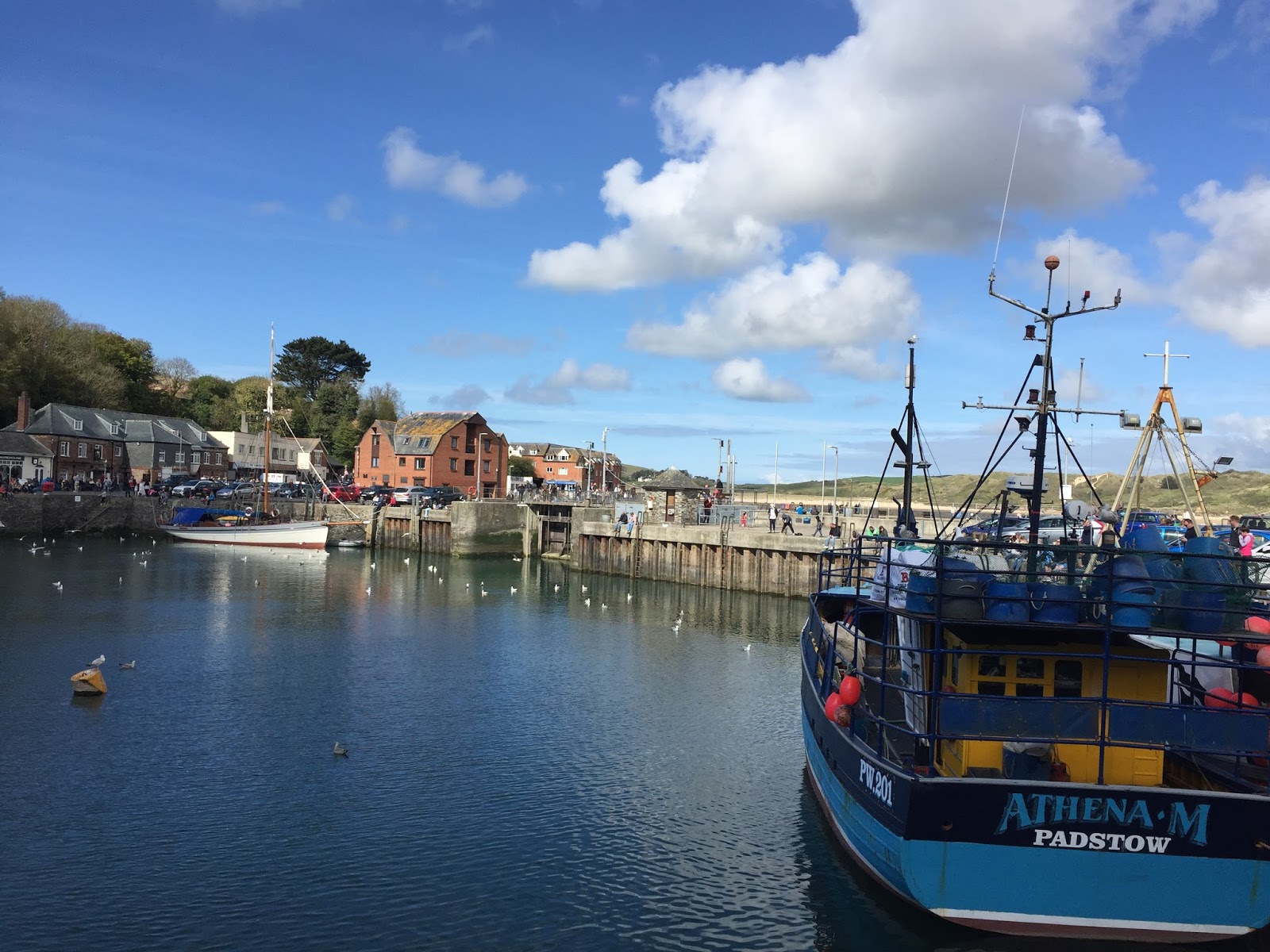
I had lunch in Padstow at the amazing Burgers and Fish and noticed that a bookshop had opened in town. Everyone knows I'd rather spend an hour in a bookshop than a clothes shop so I bought a book - A Country Road, A Tree. I’ve been reading as well as writing this afternoon. 2,300 words written.


Day 4.

I explored a new beach called Hawkers’ Cove. How have I been visiting this part of Cornwall for twenty years and never discovered it? It’s a beautiful small bay between Harlyn and Padstow. I collected some stones for painting when I get back home. Here are two I’ve done, but as you can see, I need practice to make the lavender feel less rigid. (See my blog about our lavender field at www.ourlavenderfield@blogspot.co.uk) I visited a wonderful farm shop on the way back from Hawkers' Cove and bought too much! If you're ever down in the south-west, it's well worth a visit. Even the hens wander in from the yard - look!


The hens are shopping - wonder if they're looking for eggs?

Almost 3,000 words written today and lots of research about Jewish art galleries being raided by the Nazis. I also made notes about the catacombs beneath Paris. (There are hundreds of miles of them with thousands of bodies buried down there.)

Day 5.

My daughter, her fiancé and my 3 year old twin granddaughters are visiting Harlyn next week, so I bought 5 x 2 gifts and buried them on Harlyn Bay, took photographs and made a map of where to find them. The treasure hunt is ready – I only hope they’re not discovered by other little fingers first!

2,800 words written this afternoon. Matilde has been evicted which came as a surprise to me! She’s now working for the Resistance as well as the Jeu de Paume museum, which is full of the enemy. I know what’s going to happen a few chapters on, but I can’t warn her!

Day 6.

The sun is still shining and my coat is still being left behind at the cottage! I took a long walk on the beach with Harlyn and Brook followed by a wander round Padstow. The buried treasure looks untouched, but it is very well hidden!

Padstow harbour

3,000 words written this afternoon helped along by Turkish delight bought this morning. It's my last day as I'm travelling home tomorrow after another morning dog walk.


Here's an excerpt from the opening chapter of Tomorrow's Not Promised. It sets the scene at the beginning of my book, but a huge amount has happened since then and where I am now, writing Chapter 17. (I know it's not set out correctly, but blogger won't enable me to indent etc.)

1.
June 1940

Paris had fallen. It was unthinkable. It was terrifying.
Matilde Pascal leant out of her second floor apartment window, the stone lintel grazing her elbows as she edged forwards to get a better view. She looked at the sky. The weather was showing its allegiance to the citizens of Paris by offering an equally cold reception to the German troops. She watched squat black tanks roll into view, grumbling along the Rue de Rivoli, followed by a line of armoured trucks and motorbikes with sidecars. Along the avenue she could see people watching in silence as the enemy paraded into their capital city. The reverberation of the slow, deliberate invasion made a knot of anxiety tighten in her stomach.
A pall of black smoke had hung over the rooftops for days. Although people spoke openly about civil servants destroying records so that the Germans didn’t have access to them, she had been told that it wasn’t the burning of paperwork that was causing the dark cloud. It came from oil depots that had been set alight by retreating French troops. If the people of France were unable to make use of the fuel, then they’d make sure the Germans wouldn’t get their hands on it either.
Matilde chewed her bottom lip and decided that the darkened skies seemed like a fitting apocalyptic note for Paris as the city prepared to receive the invaders. She felt her husband’s breath on her neck as he leant over her shoulder. Xavier had said he wouldn’t give the filthy Boches the satisfaction of an audience, but his curiosity must have proven too strong. They heard a pulse of rhythmical footfall as row upon row of soldiers marched beneath their window. Matilde swallowed hard. France was occupied by a foreign power. It was appalling, yet fascinating to watch.
She squashed an ant on the stone mullion ledge with her forefinger.

Friday, 24 February 2017

The Art Of A One Sentence Pitch


Yes, there's an art to the one sentence pitch and it's something I don't find easy. Writing a synopsis is difficult but I prefer it to the one-liner. With a synopsis, I can pick the most important developments from each chapter and condense them into one or two pages. (See how easy I made that sound?) But why do writers need a single sentence pitch and how do we encapsulate a whole book into a single sentence?

If a friend, stranger, agent, publisher or nosey neighbour asks you what your book is about, you need to explain clearly while engaging your enquirer and keeping them interested (and awake). We must endeavour to pick out the highlights of our novel so that whoever we're speaking to wants to buy or represent our hard work.


I've discovered that there are three basic elements to a good one sentence pitch.

- The opening conflict
- The obstacle
- The quest

The opening conflict is the hook, the first step that leads to a quest. The obstacle is a situation/s that prevents your protagonist from overcoming their difficulty. It could be a person, an illness, a lack of courage, a lack of money etc. The quest can be a physical or spiritual journey, but it describes how your story and most importantly, your protagonist, develops between the plot's beginning and ending.

The resulting basic pitch is: When OPENING CONFLICT happens to CHARACTER(s), they OVERCOME CONFLICT to COMPLETE QUEST. There are lots different ways of structuring these basic elements, but each should be included. The important thing to remember is that a good one sentence pitch is a description of the plot, not the theme.

The danger of describing the theme in your one sentence pitch, instead of the actual plot, is that it will sound generic. The pitch for Eat Pray Love, is not A recently divorced woman seeks love and happiness. That sounds like many romantic books on our shelves. A more accurate pitch would be, A recently divorced woman flies to Italy for pleasure, India for spirituality, and Bali for balance, but discovers love instead. Because that's what actually happens.

If your final sentence isn't already half a page long by now, try to add some details that will give a sense of the character of your novel; is it humorous, tense, sad, etc. This will help to give your sentence individuality.

There! Easy! *swallows hard and scratches head*

Good luck...and please wish me luck too!

Sunday, 29 January 2017

The Story Arc.


Every story must have an arc. It rises to a high point and then slopes back down again. This is a must. A story arc has several headings, all of which must be included.


1. Exposition (Setting the scene.)
This is the every day life in which the story is set. Introduce your main character/s. Where are they? What do they want to achieve? What is stopping them from getting what they want?

2. Conflict (The hook that grabs your readers’ attention.)
Something beyond the control of the protagonist (hero/heroine) is the hook that grabs your readers’ attention. Something must make your story arc rise.

The beginning of your novel matters; every page matters, but you only have so long to interest an agent or reader in the first few pages. It doesn’t matter if, later on, the book is filled with gorgeous prose and heart-stopping suspense. Someone browsing in a bookstore or using the ‘look inside’ feature online, is looking for something to make them take your book to the till. If the beginning isn’t strong enough, if it doesn’t grab your reader’s attention, down the book goes, back on the shelf. (Not that it would have made the shelf, because your agent wouldn’t have allowed it to go out to publishing without a gripping beginning.) It pays to think carefully about the beginning, and spend an outsized amount working on it. The beginning doesn’t have to contain fireworks in order to captivate. But it does have to captivate. It might not be clear what the beginning ought to be until the book is nearly finished, so don’t worry about it right away. Get it written, then go back to figure out where it should begin. An agent will read a few paragraphs, and if they’re not ‘hooked,’ they’ll set your manuscript aside and move on to the next submission.

3. Rising Action (The story grows more exciting, frightening or dangerous for your main character.)
The conflict results in a quest – a long, hard search for something. It can be a person, love, an object or peace of mind. It can be anything you choose. Your protagonist must be given a challenge or conflict that they must overcome, and in doing so, they will become a stronger person. They must resolve whatever problem is put in front of them. If Harry Potter asked one of his teachers to wave a magic wand and sort out all his problems, J. K. Rowling would still be living in a bedsit wondering how to pay her next bill! It was a great success because Harry had to fight every inch of the way through exciting adventures. Give your protagonist an adventure.

4. Surprise or Climax
Your main character needs to make a crucial decision - a critical choice. The choice(s) made by your protagonist need to result in the climax. This is the highest peak of drama in your story and when your book should be ‘unputdownable.’ This is often when we find out exactly who a character is, as real personalities are revealed at moments of high stress. This must be a decision made by your protagonist. Whatever path your hero/heroine chooses it cannot be something that happens by chance. This should bring us to the top of the arc because it makes up most of the middle part of the story. Surprise, or the climax of the story doesn’t mean pleasant events. It means placing the biggest obstacle, complication, conflict or trouble in front of your character, and only they can get themselves out of trouble.
To complicate matters, surprises shouldn’t be too random or too predictable. They need to be unexpected, but believable. Readers like to be surprised and think, ‘I should have seen that coming!’

5. Falling Action.
The reversal should be the outcome of the choice that your protagonist made and it should change the status of your characters – especially your protagonist. Your story’s reversal should be probable. Nothing should happen without a reason.
Changes can’t happen without your main character making them happen.
Your story should unfold leaving your readers feeling satisfied and not short-changed.
Remember that your readers must be on your protagonist’s side, so your main character must be likable.


6. Resolution.
The resolution is a return to calm and satisfaction. Your protagonist should be changed in some way through her own actions; wiser, braver, happier or more confident having achieved something. Your reader puts down your book feeling pleased and a little sad that the story has ended.

Friday, 27 May 2016

Me Before You by Jojo Moyes


Everyone is talking about the book and the film is about to be released with huge media attention. If you haven't read the book yet, here is my review of Jojo Moyes' latest bestseller. This post doesn't contain any spoilers.

Me Before You is a story about Louisa Clark, a bright young woman who is growing bored of her fitness-obsessed boyfriend and is fed up when the café in which she's worked for years, closes down. Reluctantly she accepts a temporary six month post as a carer to a young man who has been left in a quadriplegic state following a road accident two years earlier. It was either that, or work at a local chicken factory!

Will Traynor used to have an exciting well paid job, buying and selling businesses. He’s travelled the world, skiing, parachuting, diving and climbing. In the blink of an eye, his life was turned up-side down one morning as he crossed the road to hail a taxi. Will is bitter and angry, especially when his glamorous girlfriend moves on and dates a mutual friend of theirs. His family are at the end of their tether and shortly after Louisa is taken on as his carer, she hatches a desperate plan to try to convince Will that his life is worth living.

This storyline may sound a bit grim and depressing - I thought the same when I read the blurb, but I’m so pleased I overlooked my initial misgivings. Jojo Moyes writes with sensitivity and humour. She tackles the subject of quadriplegia and the rights of disabled people with great perception and compassion. The descriptions of Will's day to day existence which involves relying on others for almost every aspect of his personal care, was written with warmth and understanding.

Jojo Moyes has written a novel which has left me emotionally exhausted, inspired and incredibly impressed. Me Before You gripped me like a spiny teasel clings to clothing. I resented being drawn away from the story by household chores and the necessity of sleep and work. I frowned at the dogs as I sensed the hues outside the window become darker because a dog walk would tear me from Will and Lou. It took three days to finish Me Before You due to daily commitments, but even at work or trudging around the village green, with my spaniels, the story never left my thoughts. I found myself grinning inanely at a page one minute and wiping tears from my cheeks the next. It was an emotional, uplifting, life-affirming read. I became emotionally involved with the characters and in the storyline.

Jojo Moyes has written a book which will stay with me for a long time.

Thursday, 18 February 2016

It's All About The Story at Choc Lit


I've been known to hang around Choc Lit's hot-pink stand at the London Book Fair in the past, trying hard not to look like a crazed fan. What I love about their submission process, is that submitted manuscripts are read by genuine readers and they only publish books their readers want to see in print. What better recommendation is there than that?

Choc Lit was established in 2009 and I've seen them grown into a highly respected independent publisher of quality women’s romantic fiction. They've won eleven awards, including the 2012 and 2013 Publisher of the Year and the 2012 Romantic Novel of the Year. Their books are available as ebooks and paperbacks and are distributed world-wide.

Last Monday I was sitting in bed at the end of a busy day, scrolling through my twitter notifications. I was confused to see lots of tweets congratulating me along with several other writers. After a little investigating, I discovered that I'd been shortlisted for Choc Lit's Search for a Star competition. Who'd have thought it? I shrieked for my husband to come out of the bathroom. My brave hero came out clutching a fist of scrunched up tissue thinking I'd seen a spider, because I tend to shriek when I see one. Who doesn't? Okay, lots of people, but I do.
I've been thrilled to bits all week and if I was more agile, I'd jump from the kitchen table and click my heels together.

My writing story began eight years ago when my three children became more independent and I discovered that I had more time to devote to my passion of storytelling. I soon realised that an imagination wasn't quite enough. I needed to learn the craft of novel writing.
I joined Nottingham Writers' Studio and an off-shoot fiction group attached to the studio. Here a small group of writers critique each other's work every month. I know my writing and my editing has benefitted hugely from these meetings. Slowly my first novel began to develop. I would urge new writers to join a group in their area. As well as a great social scene with like-minded people, there's also so much to learn from speakers and workshops. I also took the opportunity of attending writing masterclasses in Nottingham, London and at local libraries. I read constantly, entered competitions, visited both local and London book fairs and began this blog. However, nothing beats shutting myself in my writing room in the garden (a present for a special anniversary from my husband) and having imaginary conversations with my characters. It's a sanctuary of peace and quiet.

My writing room.

My writing gradually improved over the years and to my delight and surprise, I began to win local competitions. I joined the Romantic Novelists' Association's New Writers' Scheme and had my manuscript professionally critiqued. With revisions made, I entered another competition, this time a national one where writers were asked to submit the first chapter of an unpublished novel. To coin a phrase, you could have knocked me down with a feather when I discovered I'd won with the first chapter of Lies and Linguine, my first novel. Since then I've written another contemporary novel set in London and also one telling the story of a farmer's daughter living in a small village in France, during World War 2. (Of course there is a love interest threaded throughout the story despite the subject matter.) At the moment I'm writing my fourth book, also during in World War 2 but this time in occupied Paris.

In November 2015 my third book, All Is Fair, was shortlisted for the Love Stories 2015 New Talent Award held in London, by the Festival Of Romance. I didn't win, but wow, what a wonderful day out I had at Jewell, Piccadilly, with prosecco flowing and cup cakes laid out on the tables. I met several authors I'd spoken to on twitter and what a lovely bunch of ladies they were.

There's no doubt that rejections are hard to take and like many writers, I sometimes wonder if I'm good enough. Doubt has a habit of creeping up unexpectedly before I remind myself that I love the actual process of writing books. Whether or not I'm ever published, I know I'll continue telling stories because it's my favourite thing in the world to do.

A speaker once said at Earl's Court, that every writer must take a turn in the cold shower of rejection. I'd like to thank all the team at Choc Lit and their readers for turning the thermostat up a notch for me.

Sunday, 10 January 2016

My Latest Chapter

It's may be against her will, but a sudden realisation that she's a collaborator, shocks Matilde. Things are going to change...


Matilde was late for work. She hurried along garden pathways of the Tuileries’ having lingered in Xavier’s arms a little too long before rising. As she approached the museum, she noticed yet more red and black flags adorning the building. They snapped and flicked in the wind, their cords rattling against their flagstaffs. It seemed to her that the number of banners in the city had doubled as the population diminished. It was as if the Germans were replacing each fleeing French citizen with a swastika. The Parisians that remained were forbidden to use public spaces; the same parks and squares where they had grown up. Matilde felt that the Germans had multiplied the oppressive effect of being occupied. Buildings had grown tyrannical, days longer and the Seine, blacker.
It was Monday and the beginning of her fifth week. Matilde’s shoes click-clacked along the museum’s corridors, yellowed with subdued lighting, before setting about her morning routine in her windowless office. At least she didn’t have to sit with Gertrude. Small blessings. She turned on an electric heater and heard it begin to click as the elements heated up. She knew from experience that it would be half an hour before the room was warm enough to remove her coat.
Matilde laid out a suede mat for examining each piece of jewelry, removed the cover of her typewriter and polished her magnifying glass. She breathed on the glass and rubbed it against the hem of her skirt. Just as she was about to leave and collect another box to be sifted through, Kommandant Beitel and another man walked into her office. She hadn’t seen the Kommandant since their first meeting and she silently berated herself for blushing in surprise.
He looked at her, his features showing no emotion. His back was straight and his chin was raised. ‘Good morning, Madame Guillon. I trust you are well?’
Matilde laid the magnifying glass on her desk. ‘Very well, thank you, Herr Beitel.’
The Kommandant gave a quick nod. ‘The amount of valuables we’ve received has risen significantly. This is Officer Meyer. He’s been assigned to assist you.’
She looked at the taller man at the Kommandant’s side and smiled in simple reflex. Immediately she felt ashamed. In that instant of introduction, she had been transported back to her life before war, where manners and smiles were commonplace. She had dropped her guard; lost her concentration. Officer Meyer didn’t return her smile. His hair was fair and pushed to one side at the front, like the wing of a gull. He was young, but an ageing v-shaped frown sat between his blue-grey eyes. He wore a look of resignation about him, as if working alongside her wasn’t his idea of a substantial enough contribution for the German war effort. She blinked when he suddenly bowed his head and brought his heels together. Something jangled in the worn leather bag he was holding.
‘I have a busy morning, so I will leave Officer Meyer to show you where you will both be working for the time being. Good morning, Madame Guillon.’
Matilde watched the Kommandant leave her office. His footsteps receded down the corridor, leaving an uncomfortable silence hanging in the air.
‘Well…’ began Matilde, trying to make an effort at polite conversation. Ingrained good manners were a difficult habit to break.
Officer Meyer interrupted her. ‘This way.’ He turned and left the room.
She hurried to catch up with him as he marched down the corridor in the opposite direction to the Kommandant. On reaching a staircase, he shoved the leather bag beneath his arm and took a crumpled packet of cigarettes out of his pocket, removed one and lit it. Matilde followed him downstairs. Her body was turned slightly to one side because her restrictive brown pencil skirt was making movement difficult on the steps. She held on to the handrail, sliding her fingers down the smooth wood and praying he wouldn’t look back at her because the hem of her tight skirt was riding above her knees as she descended. She inhaled the bitter smoke left in the officer’s wake. Three floors below, he paused and waited for her to catch up. She saw him pinch a speck of tobacco from his tongue with his thumb and forefinger before sucking once more on his cigarette’s diminishing length.
Despite working at the museum for over a month, Matilde still felt out of her depth. It wasn’t that she couldn’t organize an inventory, but surely she was expected to understand what she was recording. Apart from the obvious red rubies and blue sapphires, she couldn’t recognize one cut stone from another. Her mornings were spent sifting through jewelry: rings, bracelets, necklaces, earrings and watches. She made use of a measuring gauge, a Zeiss Ikon camera and a book filled with photographs of gems and precious stones for ease of identification. Inevitably she would come across a stone she couldn’t find pictured on any page. These pieces were placed inside a velveteen bag that was collected daily; she had no idea where they were destined. Presumably to be examined by a more qualified eye. It didn’t stop her puzzling over where they’d come from, especially when she prized open lockets with a fingernail to reveal sepia photographs of family members. Perhaps their owners had sold them in order to feed their families.
Every afternoon she would type up the inventory that she had scribbled on sheets of paper and at the end of each day, Gertrude Loup would collect these typed lists. Occasionally Matilde would make her wait in front of her desk, as she herself had been made to wait on her first day. It amused her to see Gertrude’s jaw tighten with annoyance, her lips pursing and stretching as if she was sucking sherbet.
At the bottom of the staircase, two guards opened double doors and stood to attention, arms extended and palms straight. ‘Heil Hitler.’ They spoke in unison. Officer Meyer responded. She prayed that she wouldn’t be spending too much time with this ill-disposed German. He marched ahead, lithe and square-shouldered. His uniform fit him well and was pressed sharply, with just a frown of wrinkles puckered behind the knees of his trousers, disclosing the fact that he’d been sitting earlier.
They walked along a corridor lined with empty display cases and shelves covered in layers of dust. The walls were studded with oblong smudges of accumulated grime; ghosts of missing paintings. Eventually the passage widened into a foyer where more armed soldiers stood at intervals around the tiled space. Officer Meyer walked towards a solid mahogany desk, behind which sat a double-chinned soldier lost in his own cloud of tobacco smoke. The walrus of a soldier coughed and the two men exchanged a few sentences in German.
Officer Meyer turned and beckoned to her. She followed him to a wide, metal door. Two armed men moved aside as he removed the bag from beneath his arm and retrieved a ring of keys from inside. He inserted one in the keyhole and turned it. There was a loud click. He pushed open the door and walked inside, turning to look at her by way of asking her to follow. She stepped through the doorway. An aroma of beeswax, old books and damp material hung in the air as her eyes slowly adjusted to the dim light. Officer Meyer’s footsteps echoed with each stride, leading her to believe that this was a large room, but when he pressed several switches and light flooded the space, Matilde caught her breath. The room was vast. It was even bigger than Monsieur Lombard’s main saleroom at the auction house. It was two stories high and as wide the Vue du Jardin where she lived. Makeshift shelving and storage racks had been erected in long rows, each one laden with objects.
‘What is this place?’ she asked.
The German spread his arms wide. ‘This is one of many storage facilities ordered by the Führer.’
‘One of many?’ She took a few steps further, stopping at an ornate table with barley twist legs. A huge swastika flag had been draped over its surface, but much of its colour was hidden beneath a pile of glistening valuables: gold fountain pens, silver cutlery, goblets, watches, picture frames, candlesticks and oddly, spectacles. She turned to the German. ‘Where has all this come from?’
He gave her a look that she couldn’t decipher.
‘Your job is to log everything, not ask questions.’
‘Everything? All of it?’
‘Are we keeping you from something more important, Madame Guillon?’
Matilde picked at a cuticle with a fingernail and shook her head. ‘Of course not. I just didn’t imagine the scale of the job.’
He began walking towards one side of the room. ‘This way.’
Matilde hugged her arms against the chill and followed him. She could hear grit scrape beneath his soles. He stopped in front of different sized boxes, each draped with thick sacking. He pulled a length of hessian away with a flourish, as if wielding a bullfighter’s cloak. They weren’t boxes. They were paintings stacked against each other. Some had ornate frames of polished wood or feathered with gold leaf. Others were frameless, paint exposed on naked canvas.
Wherever would she begin?

Later that day, Matilde had been ordered to leave work early due to a last minute visit by a high-ranking member of the Gestapo. She supposed they didn’t want the possibility of a Parisian eavesdropping on their secret plans; and that was fine by her. She’d much rather escape the claustrophobic atmosphere of the museum’s basement and the hostile eyes of Herr Meyer.
Outside the sky was the colour of watered-down milk and a breeze carried scents of woodsmoke and rotting leaves. Before the war Matilde had loved autumn with its glow of streetlights reflecting on rain-drenched boulevards and the promise of Christmas; but now Paris appeared insipid and dirty. Windows wore a coat of neglect and paintwork was dulled with grime. Even the railings of the Tuileries reminded her of ribs instead of ornate metalwork. Perhaps this time next year the war would be over. Maybe festive lights would illuminate the avenues with colour once again.
Matilde wrapped her coat tightly around her body and hurried home with thoughts of Xavier and hot onion soup cheering her mood. But as she approached the entrance to the Vue du Jardin, she slowed her pace. Across the road, saw a French gendarme salute a German officer with submissive servility. Stiff and mechanical - already infused with German traits. It hadn’t taken that Frenchman long to surrender. With her next breath, a creeping realization made her stop and clutch a railing. Who was she to condemn this French policeman? Didn’t she work for the Germans? She was as bad as him. Yes, it was against her will, but she was still collaborating. France must fight back. She would fight back. If everyone relied on each other to retaliate, nothing would change. France would willingly succumb to the enemy, one person at a time. She vowed to support Xavier more actively from now on.
A shout. Her head shot up. Sharp, guttural commands were being barked nearby. The sound of an engine grew louder. She pressed her back against the railings. A truck sped past and braked sharply outside the entrance door to the building where she lived. Raised voices echoed inside the doorway. Matilde’s breath came in gasps and she could feel her heart thumping as she pressed her knuckles to her lips. The French policeman and the German officer ran across the road towards the noise. So, their meeting hadn’t been a coincidence; they were working alongside each other. She stayed where she was, partly hidden behind a large evergreen shrub and skeletal branches of an arched tree that hung over the metal fencing. What was happening inside the Vue du Jardin? Had someone run inside the building to hide and had been discovered?
She watched wide-eyed as several Germans scuffled with a man. They’d found who they were looking for. The man was hunched forwards. He stumbled despite being grasped by uniformed men. They dragged him to his feet. Blood covered his shirt. The French policeman opened the back door to the truck. Traitor! The prisoner gave one final attempt to retaliate and as he did so, he raised his head.
Xavier!

Friday, 20 November 2015

Love Stories Awards' Ceremony


I doubt if there’s a writer anywhere who hasn’t at one time or another been confronted with the question, Do I continue to write or do I call it a day? Many give up on their dreams, knocked either by seemingly endless polite rejections or because their submissions have been met by silence. For others, it's not just a matter of becoming published. For others, like myself, writing is a passion that we can't live without.

I keep writing because I simply must. There's always an unwritten story in my head, some fragment of a sentence urging me to set it down on paper or a character nagging me until I type his/her point of view on my computer screen. I love creating fiction and I'm drawn to my computer almost as if I'm under a spell. Like all writers, I've had darker moments of self-doubt and wonder if I'm good enough. But despite the fear persisting, I'm occasionally reminded by others, that I am a good writer. I've won writing competitions, had stories published in magazines and last month was shortlisted for Love Stories 15, New Talent award.

On Wednesday 18th November, I travelled to London to attend the ceremony. It was held at Jewell Piccadilly, a chandelier-strewn cocktail bar in the centre of the city. It was lovely to meet fellow Romantic Novelist Association's New Writers' Scheme members and hear about their works in progress. Prosecco flowed and cupcakes decorated the tables. I met authors I'd read about online and was proud to be part of such an encouraging and positive event. I didn't win my category, but still feel extremely proud to have been chosen nationally as one of a handful of nominees.

The first chapter of my shortlisted novel, All Is Fair. (Unfortunately Blogger.com doesn't allow for correct layout).

All Is Fair


1.
The air was thick and still, with nothing moving in the valley except the flow of the river. A chalk-smudge moon sat in the early morning sky and somewhere in the valley a dog barked, its sound travelling far in the stillness. Arlette Blaise was leading a caramel-coloured beast through the farmyard, scattering a cluster of chickens as she guided the cow by a rope at arm’s length in order to avoid its horns. Its bulk swayed and slewed with each step and its hooves made a rhythmical choff-choff sound as they disturbed the parched ground.
Arlette lifted her head and listened. Someone was calling her name.
She shouted back. ‘Par ici!’
Her best friend, Francine, was running up the hill, her clogs scuffing the dust and her long hair swinging from side to side.
‘Qu’est-ce qui se passe?’ asked Arlette.
Francine reached the summit and hung onto Arlette’s shoulders. She leant forwards trying to catch her breath, her face maroon as the beet that grew in their vegetable garden. ‘C’est Pétain!’
Arlette felt a chill run down her back. The French leader had been a topic of conversation as recently as yesterday’s birthday gathering. Neither of their fathers had hidden their disparagement of the premier of their country.
‘What about him?’
‘He’s abandoned Paris to the Germans.’
Arlette gave a high-pitched laugh. ‘Don’t be silly.’
‘It’s true. Maman heard it on the wireless.’
‘But why?’
‘I’ve no idea.’
‘Surely he wouldn’t give in? No one gives away part of their country as if it were a basket of surplus apples.’ Arlette looked across the valley. Her eyes scanned the landscape, half expecting to see a line of German soldiers marching across its fields. The war. That vague far off entity that was spoken of in hushed tones. That destructive predator roaring in the north was stealthily creeping closer.
‘Surely they won’t come to Montverre?’
‘I hope not. Can you imagine?’
‘I need to speak with father,’ she said, gripping Francine’s hand and pulling her towards the farmyard.
The girls hurried towards the huge stone barn. They ran through the yard, dispersing the reassembled chickens. Arlette heard her father curse. Inside the vast structure, the interior was striped with sunlight that streamed in through gaps in the wooden boards in the eaves. It smelt of pungent manure that stung the back of her nose. Her father, Henri, raked his hands through his thick greying hair and noticed the girls standing in the entrance.
‘Ma pêche!’ he said quietly, beckoning to Arlette.
He’d called her his peach since she was a baby, on account of the velvety cheeks she had been born with. She leant into his chest and nestled just below his shoulder, his shirt infused with laundry soap, tobacco and fresh sweat. She looked up at him.
‘What does it mean, father?’
‘I’m not sure, but we’ll carry on as normal and work hard to bring in the harvest. We’re a long way from Paris and hopefully we won’t be too affected by the armistice. I’m sure we’ll be left alone to get on with our work.’
He tried to sound matter-of-fact but Arlette sensed a change in his voice. She heard a faltering that hadn’t been present before.
‘Where’s Gilbert?’ asked Francine, trying to sound nonchalant.
It was unspoken knowledge that Francine had become sweet on Arlette’s younger brother this past year.
‘He went inside for bread and goats’ cheese,’ said Henri, loosening his embrace on his daughter. ‘Go and tell him to hurry up. We won’t let the Germans disrupt our lives.’
She nodded. If her father wanted to pretend that everything was fine, then she would reciprocate. She walked out of the barn in step with Francine and heard the hushed baritone voices of their fathers’ conversation resume.
Gilbert didn’t move when Arlette walked into the kitchen. He was leaning back in their father’s armchair with his feet resting on a stool, chewing the remnants of his sandwich. He was tall and broad, with muscles developed through hard graft after years working on the farm. As soon as Francine entered, he sat up and straightened his hair.
So, thought Arlette. Francine’s infatuation wasn’t one-sided.
‘Hi Francine,’ muttered Gilbert. He wiped crumbs from his lips.
She smiled and lifted a hand in greeting, then stared at her feet in embarrassment.
Arlette found this unaccustomed shyness between her brother and her best friend very confusing. How was it possible that despite spending sultry summers and bitter winters together since they were children, they suddenly found it more difficult to communicate despite growing fonder of each other?
‘Father says to hurry up,’ said Arlette.
She looked at her brother’s dishevelled hair, scattered whiskers and large questioning fern-green eyes, a colour that they’d both inherited from their late mother. No, she couldn’t tell him of Pétain’s cowardice. Her own bravery had escaped her for the moment. She’d leave it to her father.

The first Sunday in September arrived, with the countryside adorned with pearls of dew and a low mist. The late summer heat and ripened fruit mingled together to fill the air with a honeyed fragrance. Arlette and her brother cycled into the yard having returned from Grande Masse at Saint Pierre’s church. Their father hadn’t been to a service since the death of their mother but had never tried to dissuade his children from attending.
Having leant their bikes against the barn, Arlette waved to her father who was walking towards them through the wheat field behind the farmhouse. His eyes were shadowed beneath his hat but he smiled and strode out of the golden field, cupping his right hand in front of him.
‘We’re all set for tomorrow,’ said Henri, rubbing the wheat heads between his palms and blowing the chaff away. He offered his children a kernel each.
‘It’s ready,’ said Gilbert, tasting it. ‘Very dry.’
Arlette bit into hers, cracking it between her teeth. She knew that if it wasn’t bone dry the harvest was likely to rot.
‘We start harvesting first thing tomorrow and this year is more important than ever due to the shortages,’ said Henri. ‘I’ve spoken to Thierry and Bruno and they’re both willing to help. Monique and Francine are coming too. I want you to sharpen the scythes today, Gilbert, because we have no choice but to harvest the old way.’
Due to fuel shortages, the tractor was out of use along with their mechanised conveyor belt that had been used in previous years for transferring the wheat stoops onto their largest cart. Their neighbour, Thierry, owned a small pig farm at the bottom of the hill. Twice a year they would swap a carcass of beef for a carcass of pork and were always willing to lend a hand if one was needed.
‘Choose two chickens for the pot today, ma pêche. We’ll eat a large dinner to prepare for the cutting and we’ll make extra to feed everyone tomorrow. Let’s pray for good weather.’

Monday morning dawned above the drooping golden heads of wheat. The swaying field sounded as if it was whispering in anticipation of the harvest. The air held humid warmth and butterflies and bees flitted indecisively from flower to flower in the garden.
Inside the farmhouse, the small group of neighbours huddled around the oven that Arlette had lit before dawn to take the early morning chill out of the kitchen. The logs crackled and the friends hugged their cups of coffee, discussing plans for the day.
Henri removed his cap and scratched his head. ‘Gilbert and I will be cutting the wheat starting at the top end of the field closest to the brook. I want everyone to stay well back from the scythes. Bruno and Thierry, you’ll be gathering the wheat into bundles. Ladies, your job is to tie them and stand them into stoops to dry. It looks as if it’s going to be another hot day, so Arlette and Francine, can you bring jugs of water and apples with you?’
Everyone nodded.
Henri shuffled and rubbed his stubbled chin. ‘I just want to say thank you. We couldn’t have managed this without your help now that the tractor and binder can’t be used this year. We have a tough couple of days ahead of us, but just think of Marshal Pétain and Hitler when you’re chopping and binding, and we’ll soon get it finished!’
Everyone laughed as they left the kitchen and crossed the farmyard. They pushed their way through the metre-high wheat field, their thighs shushing against the stalks with each step they took. The sun was now above the horizon, already warming their skin and dampening their backs. The growing heat had also stirred insects that flew and jumped, causing the friends to blow, bat and spit as they made their way to the far corner of the field. Once there, the men peeled off layers of clothing. The refreshments were placed in the shade of a tree and covered with rectangles of muslin cloth weighted at each corner by glass beads. Arlette noticed Francine watching Gilbert as he hoisted his jacket above his head, momentarily revealing his taut stomach. Her brother glanced back at Francine, making her blush. He threw his jacket beneath the tree.
Then the harvesting began. Henri and Gilbert started the process, walking steadily six feet apart while swinging their scythes rhythmically from left to right. The stalks collapsed, falling to the ground to be walked over by father and son as they continued forwards. Bruno and Thierry followed a short distance behind. They crouched to collect the fallen wheat and assemble them into untidy piles. The girls and Francine’s mother fell into step at the rear, scooping the bundles into huggable diameters and tying them with loose stray stalks. These were then stood up in bunches of ten, leant against each other resembling tepees and left to dry in the sun.
This continued for over an hour until the group had walked down the length of the field and back up again, returning close to their starting point. They stopped to stretch, groan and reach for a drink of water. Arlette sat beside Francine and Gilbert, their three noses hidden inside their cups. They emptied every drop before Gilbert laid back, his chest rising and falling with each breath. He studied his hands.
‘I’ve got blisters already,’ he said.
‘You have girl’s hands,’ laughed Thierry, examining his own hard calloused palms. ‘These are what you call working hands, lad.’ He lifted them to show the group, causing Henri and Bruno to mock and compare areas of hardened skin.
‘Can I see?’ Francine asked Gilbert.
Arlette watched her friend take Gilbert’s hand, running her forefinger gently over his blisters. She saw her brother swallow, his throat constricting. His gaze fell on Francine’s hands holding his own. Arlette felt like she was intruding on an intimate moment, so reached for an apple and knife. A spiral of apple skin looped and fell like a pink ribbon onto her knees. She turned to speak to Francine’s mother.
‘I put a chicken casserole in the oven. The heat of this morning’s embers should keep it warm.’
‘Ooh, we’ll be ready for that my dear,’ said Monique. ‘I’m sure your mother is looking down from heaven and feeling very proud of you.’
After five minutes Henri stood up and batted the dust from his trousers. He spat on one palm before rubbing his hands together and reaching for his scythe. Everyone took this as an unspoken sign their break was over. Arlette noted that Gilbert stood up first and offered his hand to help Francine. How wonderful it would be if her best friend were to become her sister-in-law.

Two days later, the wheat field was cut and an exhausted and dishevelled group left the field. They trudged back to the kitchen where Arlette had spent the last hour preparing a meal of rabbit, potatoes and the last of the runner beans. Dinner was to be followed by plump blackberries that she had hand picked and which had left her fingertips stained indigo. She could hear their voices getting louder and crossed the yard to greet them, hugging her father and walking beside him towards the well.
‘Food’s nearly ready.’
‘You’re a good girl,’ said Henri, kissing her forehead. ‘First we need to wash the dust off our hands.’
Arlette heard her brother curse under his breath. She turned to see what he was looking at. Soldiers. The melice had returned.
An open-topped truck had turned into the farmyard and stopped in front of the assembled group. Two uniformed men wearing blue berets climbed out, their buttons catching the sunlight. They moved to the front of their vehicle.
‘Whose farm is this?’ the older of the two demanded.
Henri lifted an arm.
‘What’s your name?’
‘Henri Blaise.’
‘Papers.’ The melice officer clicked his fingers impatiently.
‘They were checked recently.’
‘I’m checking them again.’
‘They’re inside,’ answered Henri.
‘Fetch them,’ he barked. ‘Your papers should be on you at all times.’ He scanned the gathered group of neighbours, his lips curled in distaste.
Arlette watched the younger soldier write something down on his clipboard. Her father returned from the kitchen carrying his paperwork. It was snatched from his hands when he offered them. The French policeman barely looked at them.
‘We’re taking your wheat. German soldiers in the north are short of food and we’re starting a process of redistribution.’
Arlette noticed her father’s distraught face. This harvest would have sustained the family throughout the coming winter and also earned them a little money. Now it was to be taken from them to feed the enemy. The future suddenly seemed like a darker place.

Friday, 17 July 2015

All The Light We Cannot See


This 523-page novel is a winner of the Pulitzer prize for fiction. The story is set in Paris during World War 2 and its primary focus is about what warfare does to ordinary people, not their leaders. At the age of six, Marie-Laure becomes blind. Her father, who works at the Museum of Natural History, builds her a model of Paris so she is able to navigate her way around the city. The Jardin des Plantes is their favourite place, and here Marie-Laure familiarises herself by counting drain covers and trees and streets, memorising routes and recognising the scents of trees and flowers. But when the Nazis occupy Paris, they're driven from their home.

In a parallel story, Werner, a young orphaned boy in Germany, comes to the notice of the Nazis for his astonishing skill at fixing radios. This leads to his relocation to an elite school aimed at providing skills for the Reich. Young Werner proves his worth and survives, even though the school is brutal and unrelenting. I liked the idea that we see into the minds and feel the emotions of both Germans and French. Some of the Germans are evil but you also come to understand how living in those times shaped you. To stand up against the Nazi regime was almost impossible. There are some who tried in this book, but they didn't succeed.

When the Nazis arrive in Paris they demand the keys from Marie's father and begin to investigate the museum. He makes plans for himself and his daughter to move to his uncle’s house in Saint-Malo. Despite her blindness, Marie is able to visualise the layout of this new town when her father makes another small and detailed model of it.

Months pass and Werner is stationed closer to the front as the Germans want experts who can pick up radio transmissions from the allies. For Marie, life in Saint-Malo becomes increasingly difficult as the Germans take full control. Her father is investigated and taken away, ending up in a German camp. Marie joins the Resistance and carries messages in baguettes. Of course, as I read the dual narrative, I wondered how soon it would be before Marie-Laure and Werner were going to meet.

Through using flash forwards and flash backs, Anthony Doerr's novel follows the course of Marie and Werner's lives as they struggle to find out wether it is possible to truly own your life when it's smothered by the the events of history. Werner is driven by a deep love of science while Marie struggles with life in darkness. Occasionally the sudden changes in the story's timeline were confusing. At times I found myself checking back to see what year I was reading about, but not frequently enough to detract from the story.

This novel is a war story and a coming-of-age story. In the midst of the rise of German fascism and the founding of the French Resistance, how do these two individuals survive? The novel constantly turns between the moral uncertainties of life and the beautiful precision of the natural world; between the political complications of war and the wonders of nature and the human brain.

I found this novel deeply moving but it is Doerr's prose that gave it five stars from me. The descriptions of objects, nature, places, a particular grip of a hand, the movement of a body and the characters' dialogue, are wonderful. I think the overall message for me, having read this book, is that mankind continues to see beauty and good in the world, despite experiencing harrowing, devastating and cruel situations.

'December sucks light from the castle. The sun hardly clears the horizon before sinking away. Snow falls once, twice, then stays locked over the lawns. Has Werner ever seen snow this white, snow that was not fouled immediately with ash and coal dust? The only emissaries from the outside world are the occasional songbird who lands in the lindens beyond the quadrangle, blown away by distant storm,or battle, or both...'

Friday, 5 June 2015

Writing Historical Fiction


I'm writing the second book of a trilogy set in France during World War 2. As LP Hatley says in The Go Between, 'The past is a foreign country; they do things differently there.'

Not only did I need to become a virtual back-packer and learn the cultural differences of another country, but I also had to become a time traveller, re-setting and familiarising my world to the early 1940's. A writer of historical fiction must be accurate because the reader will not be fooled by guesswork. It only takes one inaccurate fact for the reader to close the book with a tut (or worse) and never buy another novel by that writer again. The first book of my trilogy, The Midday Moon, is set in rural France and tells the story of a farmer's daughter during the five years of WW2. My protagonist, Arlette Blaise, takes her grandmother back home to Oradour-sur-Glane on the day of the massacre. So apart from imagination, how do I strive to write exact historical fiction?

1. I couldn’t have placed Arlette in such a traumatic situation without visiting the martyred village first hand. I have walked the roads of this once quaint village and absorbed the atmosphere. I’ve seen the aftermath of brutality. As a writer, I feel a weight of responsibility in telling a story about a fictional character living through what was an actual genocide. I’ve endeavoured to honour the villagers' last hours with respect and accuracy, to choose the right words and not to glamourize this horrendous crime. Charles de Gaulle declared that the ruins must stay as a permanent national monument to the townspeople’s suffering, so I found Oradour-sur-Glane just as it had been left on the day of the massacre; frozen in time. What better way to write about factual surroundings and infrastructure.

2. I've read numerous novels set in the era. This is a great starting point for cultural immersion. I attuned myself to the writers' rhythm, nuances and the tone of the language used back then. Picking up a few extra details is always a bonus - which of course must be placed in my novel in my own way. For example, I learned through reading one book that the French folded their Metro tickets into V shapes, for Victory during the war. It was a small way to show contempt towards the invading Germans.

3. Non-fiction books are also invaluable. Pages and pages of facts and photographs build up a past world to write about.

4. Speaking to people who lived during the war highlights some rare treasures of information. Obviously this is only possible if your story is set during the past seventy-eighty years, but the older generation are full of stories they love to share.

5. The Internet! What did we do before the Internet? There are archives, interviews, photographs, paintings, stories and newspaper articles out there, all waiting to be discovered.

6. Magazines are also a hive of information. One which has been an enormous help to me is World War 2 Magazine. The description of tanks and writing about accurate weaponry is vital to make a scene sound authentic.

7. Television films and documentaries pull you into the screen making it easy to absorb the atmosphere, the fear, the horror and the bravery of many ordinary people. Here are just a few I've watched with notepad and pen in hand!
'Colditz,' 'Thunderbolt,' 'World War Two - The Lost Colour Archives,' 'The War' by Ken Burns, 'World of War: The Complete set,' narrated by Sir Lawrence Olivier, 'Band of Brothers,' 'Holocaust,' mini series and 'The Architects of Doom,' documentary.

Here is my blog post about my visit to the devastated remains of Oradour-sur-Glane and a excerpt from that particular chapter of The Midday Moon. Arlette and her grandmother have been ordered to the village green by the Nazis. Blogspot doesn't allow me to indent speech or change the layout but I hope it sounds authentic to you and thank you for reading this post.

Although there wasn’t any panic among the gathering, Arlette could feel a mounting anxiety. The air was heavy with anticipation and a low murmuring of conversation spread between the villagers. How long would they be delayed? She didn’t need this hold up if she was going to make it back home today. Perhaps she would be staying overnight after all.
Lines of people continued to scurry along the main road towards them. Mademoiselle Petit, a schoolteacher, ushered a group of children in front of her and joined the congregation of villagers. The click-clacking of their small wooden clogs was silenced by the grass.
‘It’s Saturday. Why are the children at school today?’ asked Arlette.
The schoolteacher sounded impatient. ‘They’re attending an immunisation programme and this nonsense is very disruptive.’ She shook her head with irritation and turned to count her pupils.
Arlette looked into the sky hoping to see white clouds that might give them respite from the relentless intensity of the sun’s rays. The sky was cloudless but a single buzzard soared in a wide circular pattern, its wings outstretched and static.
Grandma Blaise held her lower back and spoke to Berthe, an acquaintance who had worked in the hairdresser’s for more than twenty years. ‘Goodness, I do ache.’
‘Hopefully they won’t be too much longer,’ said Berthe. ‘I’m dying of thirst.’
‘I hope they’re being careful with my ornaments.’
‘Look, grandma.’ Arlette pointed to a lorry convoy that had parked in the lower part of Oradour. Soldiers wearing flecked waterproof clothing in yellow and green, swarmed out of the back of the trucks and through the streets.
‘Why are there so many Germans?’ asked Grandma Blaise. She slipped her arm through her granddaughter’s. ‘The village is already swarming with them.’
Arlette shook her head. She didn’t have an answer.
Everyone was watching and waiting in a dignified silence. Soldiers continued to empty surrounding houses and shops of their occupants. They were being herded in groups towards the green. The crowd was now so large that it was spreading out towards a covered well. A woman stumbled towards them with her hair in curlers. A half-dressed child was held in his mother’s arms. Still with his jaw covered in shaving foam, a man had been ordered out of the barber’s. Worried mothers clutched the tiny fingers of their children or pushed prams towards the assembly point, its numbers growing by the minute. Next the grocer and another teacher arrived, accompanied by a larger group of children. The priest arrived, followed by a man carrying an elderly woman on his back.
The throng began to move. Arlette looked around in confusion. ‘What’s happening?’
A voice in the crowd answered. ‘They’re separating the women and children from the menfolk.’
‘Why?’
The question went unanswered. Arlette took hold of her grandmother’s hand and moved closer to the front of the crowd.
From where they were now standing, Arlette could see and hear the SS officer more clearly. He was a solid man whose uniform was decorated with emblems and badges. The letters SS were zig-zagged like two lightning strikes on his collar. He demanded that the elders of the village reveal the hiding place of the ammunition. Arlette heard the mayor respond by denying any knowledge of the presence of arms. The officer turned to another German soldier and spoke out of earshot, no doubt translating.
‘The mayor’s just offered to be held hostage with his sons so the elderly and children can get out of the sun,’ said Arlette.
‘How brave,’ said Grandma Blaise.
Arlette felt a trickle of sweat run down her spine. The sun was sweltering. Her mouth was dry and she was worried for her grandmother. Why had they decided to come here today? If only they had made the journey the following day.
She immediately became more alert. Commands were being shouted to the gathered men. They were ordered to walk away from the fairground en masse. At gunpoint.
‘Where are they taking them?’ asked Berthe. ‘My son is with them.’
‘We don’t know,’ Arlette shrugged. ‘Try not to worry. They won’t hurt them because they haven’t done anything wrong.’ She realised how naïve she sounded. Hadn’t little Maurice only been trying to keep warm? Hadn’t the Jewish people only been trying to work hard and settle into a community?
Arlette watched several men turn to look back at the women. She recognised them: the ticket-seller at the tram station from when she used to travel to sell her silk cocoons, the owner of her favourite café, her grandmother’s elderly neighbour, Jean-Philippe. The men’s eyes searched for glimpses of their wives and children. They were led away. Their faces drawn with fear. They looked confused, many trying to dodge the pushing and shoving of Germans fists. Next the SS officer turned his attention to the remaining women and children.
‘What’s he saying?’ asked Grandma Blaise. ‘I do wish he would speak up.’
‘We’ve got to go to the church,’ said Arlette. ‘Maybe they realise that we need to sit down in some shade.’ She patted her grandmother’s hand for reassurance and helped her along the main street towards the village’s place of worship at the southern end of town. In front of the church grew a tall tree in full leaf. They walked beneath its dappled shade. Several women close by sighed audibly at the momentary respite from the sun’s rays as they were shepherded towards Oradour’s church entrance.
German voices grew more frenzied. Women and children were hurried along and pushed inside. An old lady fell at the doorway. Arlette recognised her as her grandmother’s friend, Jeanne. She didn’t mention it to her grandmother who was anxious enough. There was momentary turmoil when the women behind helped her to stand. People behind were bumping into each other. Arlette stumbled but she steadied herself and her eyes began to adjust to the dim light inside the church. Looking down, she saw flowers being trampled underfoot. They looked like the same flowers that Jeanne had been carrying. She reached for a pew for balance, smelling the familiar aroma of incense and candle smoke. It comforted her a little. She grasped Grandma Blaise’s hand and pushed to the back of the church. In seconds they were next to the altar.
Arlette didn’t let go of her grandmother’s hand despite the bumping and jostling from others. They were ordered deeper inside. The cool interior was a welcome relief from the fierce heat outside and many women and children settled themselves on the wooden benches. She helped her grandmother to sit on a stool beside the altar but as more women were herded inside, the crowd pushed Arlette a short way from the old lady. Helpless to stop the momentum, she was thrust to the opposite side of the altar.
A cough. A baby’s whimper. A child’s voice calling for maman. But still the women remained calm, their ears straining for any communication or sign of what was going to happen next.
Then it came.
Distant machine gun fire could be heard through the open church door. It continued for a long minute until it slowed. Then just occasional short bursts.
‘What are they firing at?’ someone whispered.
‘Perhaps they’re destroying something.’
‘The men…you don’t think…’
The woman didn’t finish her sentence and no one answered. Arlette sought out her grandmother’s face. They exchanged worried glances. A commotion at the entrance of the church made everyone turn and look. Two German soldiers were carrying a large chest into the building. They struggled under its weight.
‘Perhaps they’ve brought us water,’ someone suggested.
A soldier attached a thin rope to the chest and laid it on the ground. He walked backwards out of the door. An orange glow could be seen in his hand. He bent to the ground. The doors were slammed shut.