Showing posts with label Lies and Linguine. Show all posts

Sunday, 17 September 2017

Conflict


Nobody likes conflict or confrontation. I tell a lie. Some people thrive on it - but they don't have many friends.

However if you're a writer and you avoid conflict, your story will be a pretty boring read. Nothing spectacular needs to happen. Chapter One doesn't have to start with a terrible car accident or a fight, but we do need to introduce conflict as early as possible in order to grab our reader's attention. It can be external, brought about by other people or a situation that affects our protagonist, or it can be internal due to our character's thoughts. Conflict can simply arise from having different values. For example, Pride & Prejudice's Elizabeth Bennet valued her family, honesty, humility, intelligence and kindness. Her conflict with Mr. Darcy was based on her values. She believed him to be dishonest, prideful, rude, and as she says, he “ruined the happiness of a most beloved sister.”

Just to confuse matters, your antagonist shouldn't be all bad. My first novel, Lies and Linguine, was critiqued by the Romantic Novelists' Association's New Writers' Scheme. My reader highlighted that my 'baddy' had no redeeming qualities to make him appear human. He had almost become a caricature of a rogue. I've now revised my first book and given him some virtues which hopefully counterbalance his villainous tendencies.

I endeavour to introduce conflict to my opening few paragraphs but find myself re-visiting my first page many times while writing my books because although people read the blurb on the back before buying, many also read the first page of Chapter One. Like me, they want to discover the voice of the author and establish whether the story grabs them sufficiently to want to buy the book. Here are a few examples of the opening paragraphs of three of my novels. I really hope they make you want to read on, so please leave a comment. I value constructive criticism so don't be afraid to say if you think something needs improving. (Unfortunately Blogspot doesn't allow me to set out my writing correctly.)

A Hill In France.
‘Wait! Stop!’
Arlette turned towards the voice. She saw her friend, Francine, running up Montverre Hill with her hair swinging from side to side and her clogs scuffing the parched ground. As Arlette was leading a cow from the farmyard to the field, the rhythmical choff-choff sound of hooves meant that she couldn’t hear what Francine was now shouting.
Her friend hurried across the farm entrance, scattering a cluster of chickens before stopping and leaning forwards with hands on her hips, trying to catch her breath.
Qu’est-ce qui se passe?’ asked Arlette.
C’est Pétain.’
‘Pétain? What about him?’
Arlette knew that when their fathers talked about the French leader, usually over a glass of pastis, the conversation usually became heated and resulted in insults being directed towards the man.
‘He’s abandoned Paris to the Germans.’
Arlette gave a high-pitched laugh and continued to lead the beast across the lane, its huge bulk swaying and slewing as it walked. ‘Don’t be silly.’
Francine followed. ‘It’s true.’
‘No one gives away a city as if it were a bag of apples.’
‘Pétain has, and not just Paris. Maman heard it on the wireless.’
Arlette’s smile wavered. ‘When?’
‘Just before she’d finished cleaning the mayor’s office.’
‘No. I mean when was Pétain supposed to have done this?’
‘This morning.’
‘But, why?’
Francine held out her hands, palms upturned. ‘I’ve no idea. Papa says he’s a coward.’
Arlette reached the gate to the field and unhooked the lock before slipping the cord from the cow’s neck. ‘Allez!’ She slapped its rump and watched it amble towards the herd. Holding on to the top bar of the sun-warmed gate in a daze, her eyes scanned the landscape, half expecting to see a line of German soldiers marching across its fields. The war. That vague, far off entity that was spoken of in hushed tones for fear of it becoming a reality for them, had arrived.

Magnolia House.
Rowan Forrester believed that she’d never see Catherine again, so with the gentle strains of Bing Crosby’s White Christmas playing in the background and a batch of mince pies in the oven, she answered the knock on the apartment door still humming to herself. Caught off-guard at seeing her standing there, Rowan quickly composed herself, hoping that Catherine hadn’t noticed that she’d gripped her coffee cup a little tighter.
‘I’ve got nothing to say to you,’ said Rowan, and began to push the door to.
Catherine pressed her palm flat against the glossed paintwork. ‘There’s something you need to know.’
The sweet spicy aroma of baking wafted from the kitchen and Rowan didn’t know whether to check on the mince pies or listen to what Catherine had to say.
‘You have one minute to apologise, then I never want to see you again,’ said Rowan.

Tomorrow's Not Promised.
Paris had fallen. It was unthinkable. It was terrifying.
Matilde Pascal leant out of her second floor apartment window, the stone lintel grazing her elbows as she leant forwards to get a better view. She looked at the sky. The weather was showing its allegiance to the citizens of Paris by offering an equally cold reception to the German troops. She watched squat black tanks roll into view, grumbling along the Rue de Rivoli, followed by a line of armoured trucks and motorbikes with sidecars. Along the avenue she could see people watching in silence as the enemy paraded into their capital city. The reverberation of the slow, deliberate invasion made a knot of anxiety tighten in her stomach.
A pall of black smoke had hung over the rooftops for days. Although people spoke openly about civil servants destroying records so that the Germans didn’t have access to them, she had been told that it wasn’t the burning of paperwork that was causing the dark cloud. It came from oil depots that had been set alight by retreating French troops. If the people of France were unable to make use of the fuel, then they’d make sure the Germans wouldn’t get their hands on it either.
Matilde chewed her bottom lip and decided that the darkened skies seemed like a fitting apocalyptic note for Paris as the city prepared to receive the invaders. She felt her husband’s breath on her neck as he leant over her shoulder. Xavier had said he wouldn’t give the filthy Boches the satisfaction of an audience, but his curiosity must have proven too strong. They heard a pulse of rhythmical footfall as row upon row of soldiers marched beneath their window. Matilde swallowed hard. France was occupied by a foreign power. It was appalling, yet fascinating to watch.
She squashed an ant on the stone mullion ledge with her forefinger.


Thursday, 18 February 2016

It's All About The Story at Choc Lit


I've been known to hang around Choc Lit's hot-pink stand at the London Book Fair in the past, trying hard not to look like a crazed fan. What I love about their submission process, is that submitted manuscripts are read by genuine readers and they only publish books their readers want to see in print. What better recommendation is there than that?

Choc Lit was established in 2009 and I've seen them grown into a highly respected independent publisher of quality women’s romantic fiction. They've won eleven awards, including the 2012 and 2013 Publisher of the Year and the 2012 Romantic Novel of the Year. Their books are available as ebooks and paperbacks and are distributed world-wide.

Last Monday I was sitting in bed at the end of a busy day, scrolling through my twitter notifications. I was confused to see lots of tweets congratulating me along with several other writers. After a little investigating, I discovered that I'd been shortlisted for Choc Lit's Search for a Star competition. Who'd have thought it? I shrieked for my husband to come out of the bathroom. My brave hero came out clutching a fist of scrunched up tissue thinking I'd seen a spider, because I tend to shriek when I see one. Who doesn't? Okay, lots of people, but I do.
I've been thrilled to bits all week and if I was more agile, I'd jump from the kitchen table and click my heels together.

My writing story began eight years ago when my three children became more independent and I discovered that I had more time to devote to my passion of storytelling. I soon realised that an imagination wasn't quite enough. I needed to learn the craft of novel writing.
I joined Nottingham Writers' Studio and an off-shoot fiction group attached to the studio. Here a small group of writers critique each other's work every month. I know my writing and my editing has benefitted hugely from these meetings. Slowly my first novel began to develop. I would urge new writers to join a group in their area. As well as a great social scene with like-minded people, there's also so much to learn from speakers and workshops. I also took the opportunity of attending writing masterclasses in Nottingham, London and at local libraries. I read constantly, entered competitions, visited both local and London book fairs and began this blog. However, nothing beats shutting myself in my writing room in the garden (a present for a special anniversary from my husband) and having imaginary conversations with my characters. It's a sanctuary of peace and quiet.

My writing room.

My writing gradually improved over the years and to my delight and surprise, I began to win local competitions. I joined the Romantic Novelists' Association's New Writers' Scheme and had my manuscript professionally critiqued. With revisions made, I entered another competition, this time a national one where writers were asked to submit the first chapter of an unpublished novel. To coin a phrase, you could have knocked me down with a feather when I discovered I'd won with the first chapter of Lies and Linguine, my first novel. Since then I've written another contemporary novel set in London and also one telling the story of a farmer's daughter living in a small village in France, during World War 2. (Of course there is a love interest threaded throughout the story despite the subject matter.) At the moment I'm writing my fourth book, also during in World War 2 but this time in occupied Paris.

In November 2015 my third book, All Is Fair, was shortlisted for the Love Stories 2015 New Talent Award held in London, by the Festival Of Romance. I didn't win, but wow, what a wonderful day out I had at Jewell, Piccadilly, with prosecco flowing and cup cakes laid out on the tables. I met several authors I'd spoken to on twitter and what a lovely bunch of ladies they were.

There's no doubt that rejections are hard to take and like many writers, I sometimes wonder if I'm good enough. Doubt has a habit of creeping up unexpectedly before I remind myself that I love the actual process of writing books. Whether or not I'm ever published, I know I'll continue telling stories because it's my favourite thing in the world to do.

A speaker once said at Earl's Court, that every writer must take a turn in the cold shower of rejection. I'd like to thank all the team at Choc Lit and their readers for turning the thermostat up a notch for me.

Sunday, 5 August 2012

Sparrows and Parrots


My husband saw a parrot today.

So what, I hear you say. Perhaps you're thinking he visited an old aunt with a caged bird or wandered around a pet shop or a zoo. No. He was working in London and spotted it in a tree.

So what, I hear you mutter. The odd parrot escapes now and then. No big deal.

Well I have a little tale to tell, which may help you to understand why my husband was so anxious to see it and I was perturbed to hear that he had.

This experience left such an impression on me that I wrote a sub-plot for my first novel, Lies and Linguine, around the theme. My husband Paul, hadn't been feeling well for weeks and so decided to make an appointment with his doctor. Without any specific symptoms to speak of, the doctor told Paul that there were more sparrows in the sky than parrots. This flippant remark obviously meant that Paul probably wasn't suffering with anything exotic, and to get on with his life. Which he did!

About a fortnight after hearing his doctor make this remark, Paul shouted for me to hurry into the kitchen. He was pointing at something sitting on our garden fence.

An exotic parrot!

We live in Nottingham, not exactly a tropical rain forest! It'd obviously escaped from its cage, but nonetheless, it made the goose bumps tingle. For the next few weeks, Paul hadn't felt any better. It came to a head one cold, dark November morning, before anyone was awake. A strange, terrifying noise woke me from a deep sleep. It sounded like an animal in pain. NEXT TO ME!

I switched on the bed-side lamp to see my husband, unconscious on the bed. He was having a grand mal seizure. His face was grey, his lips were blue and a trickle of blood dribbled from his mouth from where he'd bitten his tongue. The children came running in to the bedroom because of the loud noise their daddy was making. After calming three terrified crying children and calling for an ambulance, things happened quickly. Paul was assessed and allowed home, with an appointment to go to radiology for a brain scan.

Arriving in radiology at hospital, we were once again shocked into silence, on seeing a brightly coloured poster behind the receptionist's desk. A heading proudly boasted, 'Parrots of the World.' Suddenly there seemed to be a lot more parrots than sparrows in our lives.

Paul was diagnosed with a brain tumour, which was miraculously operated on successfully. Paul's recovery and absence from his company, led to the folding of his own design agency. It also instigated a house move, as Paul wasn't allowed to drive. But, ten years on, Paul is well and we look back on that episode in our lives, as a lesson learnt.

Life is short. Make the most of it. Don't get hung up on trivial arguments or irritations.
You don't know what's round the corner.

Except he's just seen another damned parrot!

Saturday, 14 January 2012

Drizzle and Sizzle

Not even the drizzle of an English winter could dampen the excitement I felt at returning to Harlyn Bay in Cornwall just after Christmas. It's my favourite place in the UK and has featured in my first novel, Lies and Linguine. Nothing beats a long walk along the waters' edge and then heading back home to start sizzling some bacon! The photograph below reveals the huge expanse of golden sand surrounded by storm-grey cliffs. It's the kind of place where you can turn your back on the land, look out to sea and feel like all your worries are literally behind you!


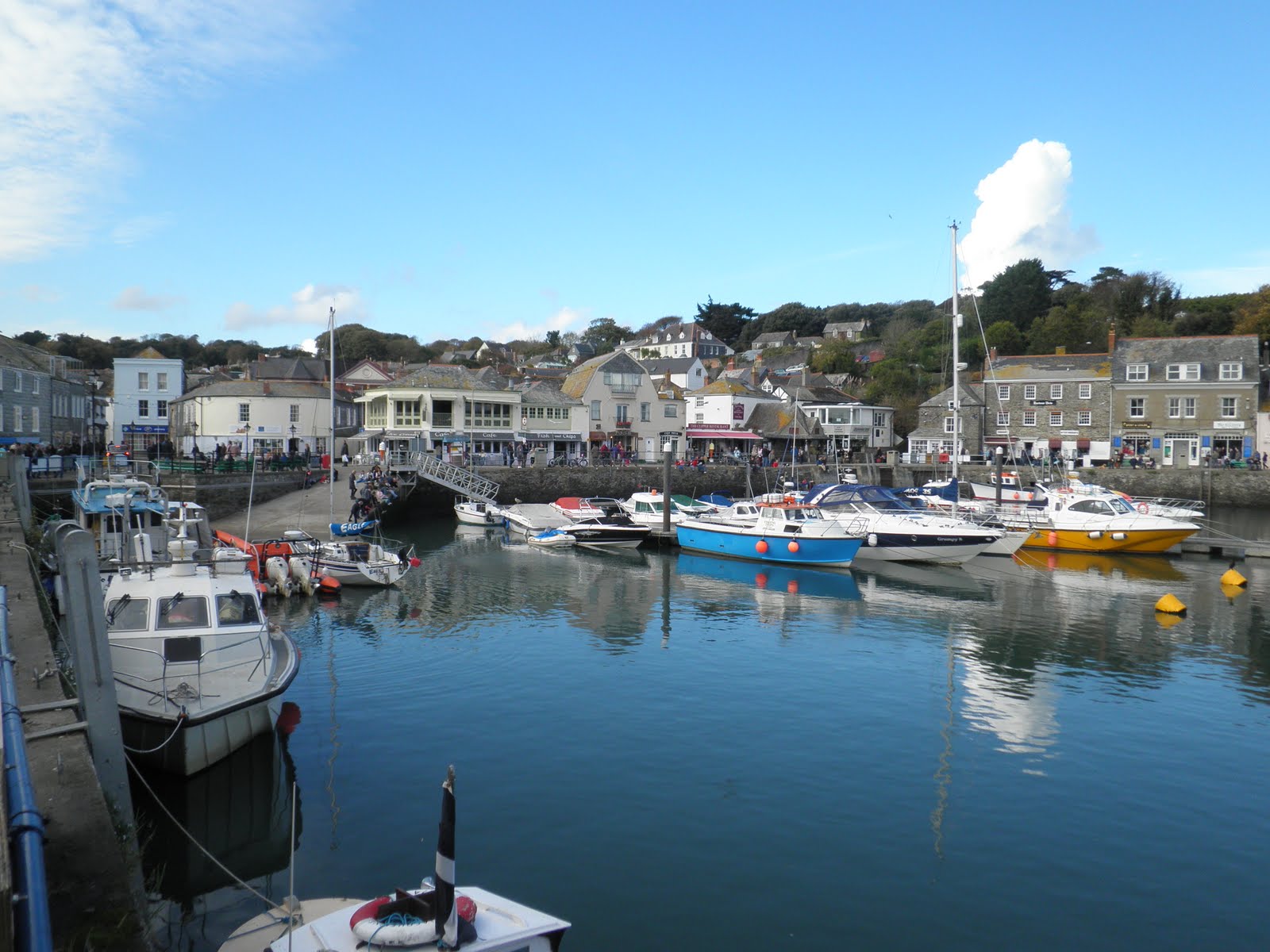
I thought I'd add a little from my novel Lies and Linguine, to describe Padstow.

The smell of fish and chips wafted around Padstow’s harbour as Tess and her parents made their way to view the tea shop. Brightly coloured boats bobbed up and down on the water like plastic ducks at the fair waiting to be hooked for a prize. Four children ran past, their ice-cream-smeared mouths looking like clowns’ make-up. In the distance Tess could see the ferry which travelled backwards and forwards to Rock, transporting visitors across the estuary. She watched the hustle and bustle of the holiday makers coming and going in and out of the small gift shops. The reds, blues and yellows of the painted hulls reflected in the water as bunting flickered in the breeze. Tess’ mind buzzed at the opportunity this shop could give her, in a place she loved.

They stopped outside the tea shop and looked up at the white-washed building. It was a small two-storey cafe directly facing the beautiful harbour. There was no doubt that its position was perfect. It had black paint work and a sign hanging over the door which read, Crimptons Tea Shop. Below the name was a picture of a tea-pot, cup and saucer.

Celia linked arms with Tess. “Isn’t it perfect darling?”

“It’s very pretty mum.”

“A manageable size, not too big to start off with.”

Tess grinned, unable to hide her excitement. “Let’s have a look inside then.”

They followed each other up two steps and pushed open the glazed door. The room buzzed with conversation and smelt of marzipan and coffee. They wound their way past several tables and push chairs and stood in the queue patiently. Tess looked into the cabinet which displayed insipid and unappetizing cakes. The colourless coffee cake looked dry, the shortbread was broken and some blueberry muffins looked stodgy. She could definitely improve on that meagre display, she thought.


My lovely dogs, Harlyn and Brook have walk-on parts in Lies and Linguine!! Below are photographs of them digging for treasure and recovering with me after a long walk on the beach.


I'm not sure how this doorway in the cliffs was made. Perhaps it was a point of access for smugglers when the tide was coming in. It certainly doesn't look like a natural doorway as the sides are too straight. I imagine it was used by the smugglers after they'd hidden in caves waiting for tea, brandy and tobacco to arrive in the dead of night. Remember that in those days there weren't roads or tourists, so many communities were difficult to reach. Many families participated in the secrecy in order to benefit in some way. The involvement of the gentry would range from turning a blind eye, to full scale involvement. Harlyn Bay was perfect for smuggling in that it had a long expanse of sandy beach to pull the boats ashore and a rocky uninhabited coastline meant that few revenue men patrolled it.


Below is a picture taken on a walk we took on New Year's Day along part of the River Camel's estuary. It stretches from Wadebridge downstream to the open sea at Padstow Bay. It's an idyllic place of meandering pathways, bays and breath-taking scenery. John Betjamen obviously appreciated the views because he wrote,

"The next five and a half miles beside the broadening Camel to Padstow is the most beautiful train journey I know."

Saturday, 30 July 2011

In Hindsight (Chapter 1)


“Liar!”

Ellie Morgan’s coffee mug slipped from her fingers, dropped onto the floor and smashed. Her other hand squeezed her apartment’s door handle so tightly, that her knuckles stood out on her fist like four pale pebbles.

Kate stood defiantly in the doorway, as the gentle strains of Bing Crosby’s White Christmas played in the background. She blinked calmly, unmoved by what she’d just revealed.

“He wouldn’t. I don’t believe you,” continued Ellie, the shake of her head barely perceptible.

Kate tilted her head a fraction to one side and raised her eyebrows. “Don’t you?”

Ellie had been on her way to the kitchen to take some baking out of the oven when a knock on her front door had disturbed her. Now the sweet spicy aroma of cooked mince pies was wafting from the kitchen. She didn’t know whether to rescue her pies or continue to listen to these ridiculous accusations. She decided to stay and listen.

“Why are you doing this?” Ellie frowned. “You said you understood why I’d asked you to leave. I’m sorry if I upset you…”

“Upset me?” Kate laughed, her mouth stretched wide but her eyes remained cold. “You threw me and my daughter out into the street just before Christmas. What would Tom have said about that?”

“Stop bringing Tom into this. You know why I asked you to leave and you know that I gave you time to find somewhere else. Besides, it doesn’t give you the excuse to come here and make up stories about my husband.”

The insincere smile slipped from Kate’s lips. “Tom’s dead.”

Ellie reeled at the venom in her voice. “Do you really think that I need reminding?”

“Yes, I do.” shouted Kate.

“How dare you, after all the chaos you’ve caused.” Ellie let go of the door handle and pointed at her. “I’ll tell you why you’re making up this rubbish. Because you had a crush on Tom and couldn’t stand the fact that he wasn’t attracted to you.” She gripped the handle again for support. “He was professional at his job and you couldn’t handle the reality that he was married and not interested. You might have men falling at your feet every day, but I don’t believe for a minute that Tom was weak enough to fall for your fluttering eyelashes. You models were all just part of the job; props to be dressed and photographed. You’re lying because I asked you to leave – because you’re jealous of what we had. It’s so easy to accuse him of sleeping with you when he’s not here to defend himself, isn’t it?”

Bizarrely, as Ellie was ranting, she’d noticed that her lanky Poinsettia was wilting over the side of its pot, just outside the doorway on the landing. Inanely, she made a mental note to water it.

Kate stared impassively back at her. “I have proof.”

Ellie didn’t believe for a minute that she had proof. She was just looking for a reaction and she wasn’t going to get one. How had it come to this? They’d been friends for the past year and now they couldn’t bear the sight of each other “I’m not interested in hearing any more lies. I’d like you to leave.”

The telephone rang inside the apartment, causing Ellie to momentarily turn. In that instant, Kate pushed past her and walked into the lounge.

“What the hell are you doing? Get out.”

The telephone continued to ring as Kate walked towards a framed photograph of Tom which was sitting on the coffee table. She picked it up and studied it. Tracing her fore-finger around Tom’s profile, she kissed her fingertip and touched his lips with it.

Ellie felt the bile rise in her throat, but took a calming breath, held out her arm and pointed towards the staircase. “Get out!” She rotated her hand so that her palm was facing upwards. “Give me the front door key first. I don’t want you ever coming back.” Her hand shook visibly as it lay upturned, hovering in the empty space between them.

“Look at him,” ordered Kate, turning the photograph.

Ellie continued to glare at Kate.

“Look at him!”

Ellie glanced at the picture of her husband. His kind almond-shaped eyes held her gaze, making it impossible for her to look away immediately. The photograph had been taken in Aubeterre, a small hamlet in France they’d often visited. It’d been awarded a sign which stated that it was a village of outstanding natural beauty. Tom had joked that she should be awarded a badge which read those very same words. He’d asked her to marry him in Aubeterre Square, kneeling on one knee beneath one of the Linden trees which grew around the Place Trarieux. The dappled light had patterned his earnest, smiling face. She could almost evoke the sweet aroma of the trees, just by envisioning them.

The phone stopped and for a few seconds the room was quiet, as the Christmas tree lights flashed on and off to the rhythm of Ellie’s pounding heartbeat. She blinked as a bird screeched an alarm call outside the window, its dark shadow flitting past the glass.

“How can you just move on?” asked Kate. "What’s the point of having photographs sitting around the place if you intend to exchange him like faulty goods?” She replaced the photograph and walked towards the window, her breath clouding the glass. “I could have made him happy you know?” she said quietly, almost to herself.

The sky had a metallic quality to it. Heavy grey clouds hung low in the sky, laden with snow which was promised for later that afternoon. Kate peered into the street below and watched the opposite neighbour dragging a wheelie bin towards the pavement. Another was strapping a child into their car seat before setting off. Perhaps the little girl would visit Santa in the shopping centre before being dragged around the supermarket. Mundane tasks maybe, but a life which Kate had daydreamed about since meeting Tom.

Ellie stood with her arms folded, wondering if she was capable of physically removing Kate from her apartment. She doubted it. It was taking all her self-control not to run to the bathroom and retch.

“For your information, Tom was happy, not that it’s any of your business. You seem to have invented a set of circumstances which are all in your head. We were happy, Tom wasn’t a cheat and I am not seeing anyone else.”

Kate turned, tears balancing precariously on her eyelashes. Ellie let out a sigh as she felt her shoulders relax a little, with relief. Surely Kate was now regretting coming round and had come to her senses. Surely she now realised that making up lies about Tom wouldn’t help her feelings of loneliness.

“It’s okay Kate,” soothed Ellie. “It must be lonely being a single mum but…..”

“I hate you,” spat Kate. “It should’ve been me living here with Tom. I wouldn’t be running round after another man only a few months after he’d died if he’d been my husband. I don’t know why you don’t just ask James to move in, instead of all the ridiculous flirting that goes on. It’s sickening to watch.”

Ellie’s jaw dropped in shock before she regained her composure. “I’m not running around after another man!” shouted Ellie. “James is a friend. He understands it’s too early to think about…besides, how dare you tell me how to live my life. Tom died a year ago, and he would understand that friendships are important for support.”

“Friendship?” Kate mocked. “Come off it! We used to talk, remember?” She pointed at the sofa. “Sitting there. I’d listen to you giggling over what James had done or said. You told me how you felt about him. It made me sick to listen to how quickly you’d forgotten about Tom. How easily you’d moved on.”

“I’ll never stop loving Tom and you know it. James and I are just good friends.”

“That’s pathetic! Don’t insult me by using that old cliché. The only reason you’re not an item is because he doesn’t feel the same way about you.”

Ellie was shocked at how deeply those words had hurt. The notion that James didn’t think that they had something special growing between them, made her feel incredibly sad and isolated; as if she’d lost something very special. She tried to remember if James had ever shown her any affection; given her any hint that he might be interested in getting to known her more intimately. Yes, they’d shared some recent lingering looks, he’d held her hand when she’d been tearful and he’d always been so attentive. But what if Kate was right? What if friendship was all that was on his mind?

Kate continued, with Ellie only half listening. “Yours couldn’t have been a great marriage could it? You say Tom was happy. Why would he stray if he was happy at home?” She swept her hand in a semi-circle in front of her. “It should be us living here. I can’t sleep at night. I miss him. And you! Call yourself a wife? Have you no respect?”

Ellie was determined not to cry in front of Kate, even though she was screaming soundlessly inside. “For the last time, get out.” Her drained face was the only outward sign that Ellie’s memories of her beloved Tom had been shaken as violently as a child’s snow globe.

The sound of someone running upstairs from the apartment below stopped their conversation. James appeared in the open doorway.

“I just phoned you. I heard something smash.”

He looked down as he crunched on the shattered mug underfoot. He paused before raising his eyes to the two women facing each other across the coffee table. Ellie’s face looked ashen. It was instantly obvious that they’d been arguing.

“What’s going on?” He looked from one to the other.

“Well talk of the devil,” said Kate. “Were your ears burning?”

“Ellie?” he asked, looking at her.

“Kate was just leaving,” she replied. She tucked a strand of hair behind her ear, unsure of what to do with her hands as The Little Drummer Boy, rum-pum-pum-pummed from the speakers.

“Oh but we’re having such a lovely time,” cooed Kate, sarcastically. “Come and join us James. We’re just getting to know each other a little better.” She beckoned him into the room.

James didn’t move. “I don’t know what’s going on, but if Ellie wants you to leave, I think you’d better.”

Kate sauntered towards him and stopped an arm’s length away. “What Ellie wants, Ellie gets, is that it? Who are you, the perfect hero on a white charger? Have you come to rescue poor Ellie from the evil mistress? Her husband’s lover.” She laughed in his face. “Thought that would shock you.”

The bitter-sweet smell of burnt pastry drifted into the room as James looked at Ellie. She was chewing her bottom lip nervously and didn’t look up.

“It doesn’t matter why you’re here Kate, but I think it’s best if you leave now.” He stood to one side of the doorway.

Kate sneered. “Oh you do, do you?” She laughed whilst shaking her head. “It’s pathetic. You’ve no idea have you? Well if you think that piece of news shocked you, wait ‘til you hear this.”

Monday, 11 July 2011

A Hero By Any Other Name


We imagine a hero to show great courage or ability, to have performed heroic acts, to be admired for his qualities and regarded as an ideal. Not forgetting of course that he must be devilishly good-looking to boot!

Can you imagine just how boring the books we read and write would be, if our pages were filled with white-toothed, grinning, muscular, handsome men? The phrase ‘nice but dim’ springs to mind, along with images of asexual cartoon characters.
As writers, our choice of hero is a very personal thing and speaks volumes about ourselves. We reveal our individual values and preferences. We comment on those we perceive to be lacking or deficient in some way. For me, a hero has to have flaws. The truth is that bad things happen to good people. The best heroes in my mind are male protagonists who have a failing, an imperfection or a weak spot.

Achilles was a handsome Greek hero of the Trojan War. He was the central character and the greatest warrior in Homer’s Illiad, but had one weakness – his heel, an injury to which ultimately led to his death. Although this mythological story refers to a physical vulnerability, we can use this weakness metaphorically in our writing. It will make our hero seem more three dimensional and ‘human,’ as opposed to robotic and boring. Having said that, I believe a handsome or rugged face and an attractive body are important for a fictional hero. We want the reader to ‘fall in love’ with the male protagonist in order to keep reading! After all, if sexual attraction was solely based on inner goodness alone, we’d all fancy the Pope instead of Johnny Depp!

I thought I’d share with you my own personal top five heroes! I’m not going to list the likes of Tarzan, Atticus Finch, Romeo, Batman, Hamlet or Mr Spock – all heroes in their own right, but I’m talking jaw-dropping sexy heroes below. (Although I do have a bit of a thing for Mr Spock’s brooding sexy demeanour. He needs a lady to melt away his….anyway, I digress!)

5th place goes to Mr D’Arcy

Sorry. I know. I can hear some of you groaning, but let me explain. It’s not just the wet clothes clinging like they’ve been vacuum packed on to his taught stomach and thighs. It’s not the droplets of water decorating his face like tribal markings, waiting to be kissed away. It’s not the facts that his damp lips are parted as he catches his breath from swimming. *pauses whilst I catch my breath* It’s that personal preference thing again. I like my heroes to have a brooding, deep, sexy, almost distant character. It’s so much better if the heroine has to win her way into his heart and bed, rather than him turning up, winking at her whilst he flashes his perfect Simon Cowell teeth before beckoning her into the back of his car/carriage/horse. (No, scrap the horse – that doesn’t work!) I prefer the softly, softly catchee monkey approach!

4th place goes to Angel Clare

Thomas Hardy’s hero in Tess of the D’Urbevilles scored a high mark from me. He was good-natured, strong, handsome, jovial character who possessed a sense of humour. He was musical, and I’m a sucker for anyone creative! I also have a penchant for my heroes having long dark shoulder-length hair. Angel also knew what he wanted from life and set out determinedly to get it. I like a man who knows his own mind.
But Hardy was a realistic writer and Angel needed a flaw. Hardy didn’t give him a huge imperfection to overcome, but gave him the poor ability to make the right choices. He fell in love with Tess and married her. When she told him she’d been raped before the marriage, he fled to work abroad without consummating the marriage or even spending the night in the same house as Tess. That callous act eventually led to Tess’ tragic downfall. There was no happy ending for Tess.

3rd place goes to Rupert Campbell-Black

Rupert Edward Algernon Campbell-Black is a rich, famous, Olympic medal-winning show jumper. He’s incredibly handsome, fit and charming. Whereas Angel Clare’s only flaw was that he made a wrong decision (albeit a humongous one), Jilly Cooper doled out a few more imperfections on Rupert! He was a brutish womanizer and an adulterous arrogant cad. The thing about fictional heroes, is that you can have a crush on them safely, secure in the knowledge that you don’t really have a husband/lover who is really that much of a b*stard.

2nd place goes to Edward Rochester

Charlotte Bronte’s Mr Rochester makes a wonderful hero for me. Craggy-faced, abrupt, stern (not to mention he keeps his wife locked up in the attic) you’d be forgiven for thinking he wasn’t your archetypical hero. But he is to my personal ideals for a male protagonist. He’s real – okay, he’s not real, but you know what I mean. He’s doesn’t have perfect handsome features who says all the right things. He has long hair (did I mention I like long hair?) and he’s a little bit dangerous and brooding –not to be mistaken with sulking! He’s intellectual and has an air of mystery. He’s not bad by nature, just finds himself in a bad situation. He needs time, affection and taming. I’m willing to over-look his more glaring flaws in order to indulge the passion he and Jane Eyre share. He’s locked himself away inside Thornfield Hall, and someone needs to slowly and gently unlock his demons…and his heart.

1st place goes to Daniel Cavanagh

“Who?” I hear you say.

I’d like to introduce you to my very own hero. Daniel is the love interest in my first novel, Lies and Linguine. He’s handsome, tall, artistic, sexy, and has a body which makes women silently mouth the word, ‘Wow!’ Okay, so far, not so real – except, he has a flaw which brings him to life.

Daniel is a troubled artist. He inherited Larkston Hall following the death of his parents in a motorway accident. He also blames himself for an accident involving his best friend Sean. His guilt over his absence at the time of his parents’ death and his wrong choice which led to Sean’s accident, have left Daniel with a mild obsessive compulsive disorder. He feels that if he focuses on the number three, a third traumatic incident will be prevented. As well as emotional scars, Daniel has a physical scar on his left temple, received in the same accident in which Sean was injured. My heroine Tess, must slowly, gently and thoughtfully win Daniel’s trust, in order to help him start the slow process of recovering. This, of course, whilst she’s trying to get to grips with her own dramas.

I’ve listed Daniel Cavanagh as my number one hero because I invented him. I have a personal attachment to him and literally know what he’s thinking. I’ve embodied all my most personal physical preferences of a man into Daniel’s appearance and given him the personality of all the character traits of my ideal man. Kind and humorous being high on the agenda.

I have to admit, I missed him terribly when I finished my novel and had edited for the final time. I think I’m a little bit in love….

I'd love to know who your favourite hero/heroes are.

Monday, 6 June 2011

Lies and Linguine

When Mark Twain uttered the phrase, 'Write What You Know', did he realise that those four words could impose huge limitations on writers imaginations? Panic ensues for the majority of us who lead, if not boring, then routine family lives. Do I really want to write about supermarket shopping, trying to find out which of my offspring uses a towel once and drops it on the floor, or when to give worming tablets to the dogs? Do our heroes have to be replicas of our partners, with the same annoying habits? Not the makings of a best seller!

But what does it really mean? After all, Shakespeare didn't know what it was like to be a young girl. But he had been in love before, so he knew how Juliet felt about Romeo. Writing what you know doesn't have to be taken so literally. We've all experienced sadness, grief, love, joy and fear. We've all taken a holiday, sat an exam, had painful unrequited crushes (or is that just me?) and encounted extreme weather conditions. It's our emotions and memories which we can draw on and write about.

Research is essential for accurately getting the facts right. My antagonist, Tess' boyfriend Blake, appears in court towards the end of my novel. I needed to research the workings of a Magistrate's Court. I spoke to lawyers and researched the correct procedure on the internet. In Lies and Linguine, Blake also visits a brothel in Amsterdam's Red Light District. Although I did visit Amsterdam and walked through the area, I drew the line at knocking on a door highlighted by a neon red light! Thankfully the internet came to my rescue for the seedier side of things!


I do think it helps to write a scene if I've visited a certain place. Accurate description can help paint a picture in the mind's eye. Write What You Know makes more sense and can be applied literally when it comes to settings. The photograph above is Car Colston, the village where I live. I've named it Larkston in Lies and Linguine. This is where my protagonist, Tess, lives. This is how I described Larkston in my novel.

After a twenty-five minute commute, Tess’ car rattled to a standstill outside Rose Cottage in the beautiful village of Larkston. The little house’s rent was comfortably affordable because most people didn’t want a morning commute in rush hour into the city of Nottingham. But Tess didn’t mind. For her, living in Larkston was like living in a painting. A narrow winding road curled around the village green, where grasses and wild flowers were given free rein to do as they pleased. By day, cows lolled and grazed on the common land, hemmed in by a small electric fence which crackled its warning at passers-by. A weathered matt pink phone box stood guard over the expanse of grass, the colour of unripe tomatoes, tinged taupe by the sun. The grass of the cricket pitch had been manicured into a smooth velvet covering, where birds dotted its surface looking like bored fielders. Informal gatherings of cottages bordered the edges of the open land, which were fringed by blackberry bushes and mature trees. The embattled clock tower of St Mary’s church rose above Larkston’s homes, protecting the eternally sleeping villagers beneath their storm-tossed head stones. At the heart of the green stood The Royal Oak, which swelled with the laughter of friends and family as they shared news and embellished stories.


Before I wrote my novel, I was fascinated by this magical house in the village. It over-looks the cricket pitch and whilst taking the dogs for their evening walk, I'd notice a light flickering in one of the windows. I wondered who lived there and what their story was. I decided that my hero, Daniel, would be the owner of this gorgeous property. Being young and with the property market being in such a poor state, I had to engineer the story to make it possible. Sadly I had to kill off his parents so that he inherited Larkston Hall from them. Writers can control anything in their novel - if only it was that easy in real life!

Daniel is a troubled artist who's haunted by two tragedies in his past. The death of his parents in a car accident and a further trauma involving his close friend Sean; a tragedy he blames himself for. His guilt and grief leave him with a mild compulsive disorder. An obsession with the number three. He believes that a third catastrophe will be averted if he completes particular tasks, three times.

The evenings had been long and seemingly endless in the early days. He’d spent them numbly staring at the television or in front of a crackling fire in the library. There he’d lose himself in long novels which whisked him away into other worlds. It was usually during these long evenings, after he’d finished reading but before attempting sleep, when Daniel thought about his parents and Sean most vividly. He’d tormented himself as he watched the twinkling orange embers collapse into grey ashes, blaming his own absence for his parents’ death and his wrong decision for Sean’s injury.
Two accidents. Didn’t bad things happen in threes?
This was the day that the number three took on a greater significance in Daniel’s life. He became fixated with the number. He stood up to go to bed, stopping at the library door. His eyes had lingered on the light switch. Perhaps if he switched it three times it’d keep the third disaster from happening.
OFF. ON. OFF.


This photograph is taken at the top of Parliament Hill on Hampstead Heath. I visited London just to spend the day on the Heath so I could colour my descriptions with more depth. My hero Daniel, has a twin sister called Denise who lives in London with her family. She's never had to fight for anything in her life, but after finding a breast lump, she must fight for life itself. This extract is from a family visit to Hampstead Heath. It's written before her life is turned upside-down.

“Come on slow coach, we’re nearly there,” she panted.
Four year old Sam was lagging behind, head bowed and pushing his chubby hands onto his bare scuffed knees with each laborious step he took up Parliament Hill. Simon had been a little way ahead with their eldest son Peter. It was a Sunday afternoon on a warm sunny blue-skied day. The melody of an ice-cream van tinkled up the hill, as lazy bees zig-zagged from daisy to daisy.
Today they were exploring Hampstead Heath in all its wondrous beauty. Living close by meant that over the years, they’d already discovered most of its wonderful secrets. Hidden glens, ponds obscured by leafy willows, crooked trees for small boys to climb and best of all, the stunning expansive views from the top of Parliament Hill. The boys loved visiting the adventure playground and watching the entertainers - clowns, puppets and magicians. Fairs visited on summer bank holidays and Simon took them fishing on the calm lakes. When each summer was almost over and the hint of autumn floated on the breeze, they’d pick a basket of blackberries to freeze and cook throughout the winter months. It was their special place to people-watch, fly kites, share picnics or just to wander and gaze.
It was to drink in the breath-taking view from the top of Parliament Hill, that they were climbing the grassy mount to the highest point in the city of London. An excited yell from the top of the hill drew her attention upwards. She shielded her eyes and laughed as Simon and Peter waved their arms above their heads having reached the top. She stopped and waited until Sam had caught up.
“Mummy, can we have an ice-cream when we go back down?”
“Of course, but let’s play king of the castle and sit on the top of the hill first.”
“Can we sit on our favourite bench?”
“If it’s free we can.”
Denise had held out her hand to her youngest son, which he grasped tightly.
“Mummy?”
“Yes darling?”
“Can I have a piggy back?”
Denise chuckled between breaths. “Phew, mummy is very old Sam and doesn’t have your young legs to carry her, let alone carry a little boy as well.”
“I’m not little, I’m four.”
“Compared to mummy and daddy you’re little.”
“And Peter?”
“Yes.”
“Mummy?”
“Yes…phew,” she panted.
“How old are you?”
“Mmm, well you shouldn’t really ask a lady how old they are, but because I know you can keep a secret, I’m thirty-two.”
“Mummy?”
“Yes Sam.”
“If you’re thirty-two and Uncle Daniel is your twin, then he is thirty-two too!” Sam had giggled and repeated, “thirty-two too, two too.”
“That’s right, there are no flies on you are there!”
Sam looked at his arms and bent double to survey his legs. “No.”
“No it means….never mind, look we’ve made it.”
Simon stood next to Peter on the summit, his arm draped around his eldest son’s shoulders. They were standing with their backs to her, looking at the view of the city.
“Hello, you two.”
They turned, smiling.
“Beat you,” Peter teased.
“Mum is very old and she has thirty-two legs. No, I mean her legs are thirty-two and old, so I had to stay with her,” Sam explained.
Simon laughed and kissed Denise’s cheek. “Sexiest old legs I’ve ever seen,” he whispered in her ear and tapped her bottom.


St. Mary's Church stands in the centre of our village. I lie in bed at night and listen to the mellow tones of the bells striking the hour. It doesn't play a significant part in my book, but is mentioned several times.

Larkston slept quietly the night before the exhibition. A rusting lamp spilled its pale glow onto the village green, flickering as if blinking tiredly. The silence was only broken by several persistent moths which fluttered repeatedly against the bulb’s plastic covering. A dusting of mist coated the grass like a froth of fungi, spreading a ghostly white blanket across the cricket pitch and countryside. St Mary’s church bell tolled three times, unheard by the sleeping villagers.


I loved writing this chapter. Above is a photograph of our village's Little Green. (The Big Green is in front of The Royal Oak) This is where Daniel took his dogs for a walk and the heavens opened drenching them all. Tess had seen Daniel walk past her cottage, so when the storm broke, she realised that Daniel had no protection from the elements. She raced to rescue him, her heart racing at the thought of seeing him again.

Tess rinsed her hands again and glanced up as she heard tapping on the window. Raindrops were spotting all over the glass. After drying her hands, she started stacking the dishwasher just as the tapping turned into a loud hammering. The rain beat down on the windows with ferocious strength. Tess was just thinking that a second deluge of water in twenty four hours would be good for her sun-baked lawn, when she remembered Daniel. He’d passed by with the dogs and the only place for dogs to run in that direction would be the little green, which had no shelter.
Without hesitating she shoved the pizza in the oven, grabbed her car keys and an umbrella from under the stairs and ran down the garden path. She jumped in her car and accelerated along the road with her wipers waving frantically in front of her. The rain pounded against the roof of her little car, deafening the music from the radio. She turned the corner and saw the expanse of grass and wild flowers being battered by the downpour. Standing in the middle of the green she saw Daniel and his dogs, hunched together under a mature tree. She beeped her horn and saw him turn to look towards her car.
Realisation dawned. She’d driven to Daniel’s rescue without giving it a second thought. Now here she was - the unimaginable about to happen. He would be sitting in her car, enclosed in this tiny metal box inches away from her within seconds. She hyperventilated as she saw Daniel running towards her. It was thrilling and terrifying. She took a lungful of air and exhaled slowly. He was a few feet away now, so she rolled down her window a few inches and yelled.
“Get in. It’s a strange ark but you’re all welcome aboard!”
Daniel opened the back door and jumped in gratefully. Harlyn and Brook leapt in after him and shook themselves on the back seat, showering them both.
“Best ark I’ve ever seen. Thanks.” He smiled at her through the rear view mirror.
Tess looked at his handsome wet face in the mirror. She felt awkward and shy now that he was sitting in her car with her. She hoped he couldn’t tell her heart was hammering against her chest, so decided to make up an excuse for passing by.
“I was on my way to Jackson’s mini store for some….mushrooms.”
Daniel leaned forwards so that his head was between the two front seats.
“Thanks for stopping. I was beginning to think I’d need a snorkel!”
His voice was inches from her ear, tantalizingly close. She could feel his breath on her skin as he spoke and could smell a faint lemon fragrance from his soapy shower.


This is the tree seat looking towards the village green and The Royal Oak. Tess tries to help Daniel overcome his phobia of fireworks, brought on by witnessing his best friend being maimed by a wayward rocket. She has done some research and believes that confronting a fear is the first step to overcoming it. She suggests that Daniel sits with her on the tree seat and watches a firework display on November 5th.

Tess shone the torch on the rough grass as they trudged across the green towards the bench. Behind them they could hear the crowds cheer as a rocket screeched skywards.
Daniel flinched and hoped that Tess didn’t feel it.
“They’ve started, you okay?”
“I’m fine,” Daniel lied, as they turned and sat beneath the skeletal canopy of the huge tree.
Sitting with their arms still linked, they both looked ahead towards the distant glow of the bonfire. The navy blue sky was bare and clear. Daniel thought how romantic this would be if they were on their own instead of sharing the village green with hundreds of people and waiting for disfiguring bombs to explode. Laughter occasionally broke free from the huddled crowd as voices cheered into the night, serenaded by crackling sparks from the fire.
Suddenly, the sky lit up with brilliant arms of cascading gold and silver stars. Bright glowing pearls rose silently into the darkness, dissolving into the heavens. Blue tracer stars crackled as they wriggled in a sparkling mesmeric dance. Gold clusters of star-bursts flashed and glittered above the green, lighting upturned faces. The whizzing and whirring echoed across the cricket pitch and far past the village.
Daniel pulled his scarf up to hide his mouth and nose. He didn’t think that a soft cashmere mix, a gift from his sister, would be much protection from a wayward explosive, but it made him feel warmer and safer. He turned to look at Tess to see if she was looking at him with a pitying gaze. Fortunately, she was looking skyward with a hint of a smile on her glistening lips. Her profile was silhouetted against The Royal Oak’s lights, a pale glow outlining her features. His eyes were drawn to her smooth neck which stretched upwards as she watched another rocket explode into a chrysanthemum of stars. Her lips parted slightly as a series of whistling clusters shot into the black night. He watched her eyelashes blink with each explosion and burst of colour. From the position they were sitting in, Daniel slightly behind Tess, he could watch her in secret against a backdrop of Swarkovski crystals raining down from the sky.
So, for the next ten minutes whilst a crescendo of squeals, oohs and aahs emanated from the distant crowd, and a climax of whistles, bangs and crackles sprang from the sky, Daniel focused on Tess. He drank in the curves of her profile and the warmth of her body leaning against him. A cheer and a noisy round of applause heralded the end of the display. Tess turned towards Daniel.
“You okay?”
“I’m fine,” he answered, truthfully. Watching the fireworks as a background to Tess’ lovely face, had been the perfect way to be re-introduced to the volatile explosives. They were the colour wash to the central eye-catching subject of the painting - Tess.


As Daniel walks Tess home, she gives him a piece of paper. The note contains information which changes Daniel's future. I can't give away what has been downloaded from Tess' computer, but it shocks him to his core.

Daniel laughed, having read it for the fourth time. It was the laugh of a hostage’s first view of open meadows after years of captivity - heady with manic relief. He shook his head and ran his hands through his hair. How thoughtful of Tess to let him read it privately. His eyes glistened with tears as he laughed again with loud rasps, his head thrown back and his hands clutching handfuls of hair. He paused, open-mouthed in disbelief.
Standing up, he paced around the table still clutching his hair. Like a demented Dickensian character, his frenzied laughter was interspersed with undecipherable words which he chanted to himself. His hand slipped to cover his face as he bent forwards, his laughter slowly morphing into deep uncontrollable anguished cries. His body shuddered with violent racking sobs as he leant on his folded arms against the kitchen wall.
He cried with relief. He cried for his parents. He cried for forbidden love.


Our family visits Cornwall during the summer and at Christmas. We know every alley way and short cut of Padstow, so it made writing a scene set in the little harbour town, so much easier. In Lies and Linguine Tess' parents still live at her childhood home near Padstow. Tess is offered a chance to fulfil her dream. She's always wanted to own and run a tea shop, and when one comes available over-looking the harbour, she makes an appointment to view it. I won't give the story away and tell you whether she buys 'Crimpton's Tea Shop', but here's a paragraph or two from the chapter.

The smell of fish and chips wafted around Padstow’s harbour, as Tess and her parents made their way to view the tea shop. Brightly coloured boats bobbed up and down on the water, like plastic ducks at the fair waiting to be hooked for a prize. As usual, the seagulls were out in force pestering the weekend visitors. The tourists were oblivious to the cunning skills the greedy gulls possessed in order to steal a chip or two. Four children ran past, their ice-cream-smeared mouths looking like clowns’ make-up.
The sun shone weakly through a thin veil of clouds, as Tess and her parents stopped outside the tea shop and looked up at the white-washed building. It was a small two-storey cafe directly facing the beautiful harbour. There was no doubt that its position was perfect. It had black paint work and a sign hanging over the door which read, Crimptons Tea Shop. Below the name was a picture of a pretty tea-pot with a cup and saucer.
Celia linked arms with Tess. “Isn’t it perfect darling?”
“It’s very pretty mum.”
“A manageable size, not too big to start off with.”
“Let’s have a look inside then.”


This is where our family stays when we visit Cornwall. The house over-looks majestic Harlyn Bay and the garden peters out onto the beach. We have spent many happy holidays in this house, so this is where Tess' parents live in my novel. Tess visits Harlyn Bay three times. Once is set a Christmas time where there's much laughter and frivolity. Another visit is beset with disappointment and despair. This excerpt is from her first visit home where it dawns on her that she's fallen in love with Daniel.

At the water’s edge, strands of seaweed tickled her toes as a smooth pebble cart-wheeled on a shallow wave and stopped at her feet. She picked it up and stared at it in disbelief. Lying in her palm was a pebble – the perfect shape of the capital letter D. Was it a sign? Tess shook her head with a smile. Now she was just being sentimental. Common sense told her that somewhere on its ocean-tossed journey, this pebble would have smashed against rocks and split in two. She wrapped her fingers tightly around her precious rescued treasure. Glancing along the deserted beach to check that she was alone and that the kite flyers had left, she breathed in deeply, closed her eyes and lifted her face to the sun.
“I love you Daniel Cavanagh,” she shouted out to sea, his name lost amongst the call of the gulls.


The beach is where my story ends. My four main characters have obstacles to overcome before they reach the finale. Will Daniel overcome his demons and allow himself to love again? Will Tess find out that it's a devious lie which is stopping her from leaving her boyfriend? Can Denise beat her life-threatening illness? And does Blake escape a prison sentence and win Tess' heart back?

Friday, 27 May 2011

My Visit To The Chelsea Flower Show 2011

Perfumes are the feelings of flowers. Heinrich Heine

The RHS Chelsea Flower Show is a garden show held every year for five days in May. It's held in the grounds of the Royal Hospital Chelsea. The RHC is a retirement home and nursing home for British soldiers who are unfit for further duty, due to old age or injury. The residents are referred to as Chelsea Pensioners and wear iconic red coats on which to display their medals.


'Tis my faith that every flower
Enjoys the air it breathes. William Wordsworth

The Chelsea Flower Show is the most famous show in the UK and perhaps the most famous gardening event in the world. It has become part of London's summer social season. It's a ticket only show, covering eleven acres in the Royal Hospital's gardens. Medals are highly coveted and awarded to the best show gardens, best flowers, exhibits of trees/shrubs and vegetables.

The photograph below shows delicious plump ruby strawberries, but sadly the picture doesn't convey the amazing sweet smell which surrounded the display!


Earth laughs in flowers. Ralph Emerson

I loved this statue of Alice in Wonderland. It reminded me of Edgar Degas' ballerina in bronze which I saw last autumn at the D'Orsay Museum, in Paris. If I owned this Alice, I would dig a deep round hole nearby so she could follow a top-hat-wearing white rabbit when it appeared!


I will be the gladdest thing
Under the sun!
I will touch a hundred flowers
And not pick one. Edna St. Vincent Millay


Flowering Redcurrant

Underneath the silver birch
They’d hang pink with pleasure,
Blushing blossoms
Full and frothing.
Beneath the birch’s lolling leaves
I’d read, or sing or dream.
And look through dappled light
To pale bare skies
Where contrails paint across the blue.
Small fingers fashioning necklaces
From a constellation
Of crimson-tinged daisies,
Dotted on the lawn.
The smell of earth, damp and raw,
Grass stained knees and the tantalising
Whispers of summer on the breeze.
I’d lie beneath those verdant boughs,
Embraced in their beauty.
And even today,
When years have passed,
I smell the flowering redcurrant
And remember,
And smile.

By Angela Barton


This flower display (below) in the Grand Pavillion, reminded me of fireworks. Here are a few paragraphs from my novel Lies and Linguine. Daniel has been scarred physically and mentally by a firework accident in his past. Tess has suggested that he faces his fear with her, in order to help heal his nightmares.

The sky lit up with brilliant arms of cascading gold and silver stars. Bright glowing pearls rose silently into the darkness, dissolving into the heavens. Blue tracer stars crackled as they wriggled in a sparkling mesmeric dance, lighting upturned faces. The whizzing and whirring echoed across the cricket pitch and far past the village.
Daniel pulled his scarf up to hide his mouth and nose. He didn’t think that a soft cashmere mix, a gift from his sister, would be much protection from a wayward explosive, but it made him feel warmer and safer. He turned to look at Tess to see if she was looking at him with a pitying gaze. Fortunately, she was looking skyward with a hint of a smile on her glistening lips. Her profile was silhouetted against The Royal Oak’s lights, a pale glow outlining her features. His eyes were drawn to her smooth neck which stretched upwards as she watched another rocket explode into a chrysanthemum of stars. Her lips parted slightly as a series of whistling clusters shot into the black night. He watched her eyelashes blink with each explosion and burst of colour. From the position they were sitting in, Daniel slightly behind Tess, he could watch her in secret against a backdrop of Swarkovski crystals raining down from the sky.
So, for the next ten minutes whilst a crescendo of squeals, oohs and aahs emanated from the distant crowd, and a climax of whistles, bangs and crackles sprang from the sky, Daniel focused on Tess. He drank in the curves of her profile and the warmth of her body leaning against him.
A cheer and a noisy round of applause heralded the end of the display. Tess turned towards Daniel.
“You okay?”
“I’m fine,” he answered, truthfully.
Watching the fireworks as a background to Tess’ lovely face, had been the perfect way to be re-introduced to the volatile explosives. They were the colour wash to the central eye-catching subject of the painting - Tess.


I can't look at blossoms now without thinking of Dennis Potter. What an incredible interview he gave to Melvyn Bragg. Dennis Potter was dying of cancer and this interview was to be his last. As he sat there obviously in great pain and occasionally swigging liquid morphine, I'll never forget some of his descriptions. He said that he knew his days left on earth were numbered, which made him take notice of simple things and appreciate the beauty of nature. It's so easy to walk past a blossom tree, but he said that as he knew this would be his last spring, the blooms looked like the 'blossomiest blossom' he'd ever seen. He said he was appreciating the 'nowness of now' and not just sailing through his last days. It was a great lesson in appreciating the present and not always planning for the future. Our lives are now - we're living it!


Flower-filled garden partitioning.


I'm always transfixed when I see a bonsai tree. Barely a foot high, they are perfect minatures of the giants in our gardens and parks. This beautiful artistic medium originated in Japan. Their purpose is purely ornamental. They're not grown for fruit or medicines. The earliest mention of dwarfed potted trees was depicted on a scroll dated back to 1195. Luckily, due to the early warm spell this year, this bosai tree blossomed during the perfect week - The Chelsea Flower Show week!


What's in a name?
That which we call a rose
By any other name would smell as sweet.

Shakespeare (Romeo and Juliet)


With plaited alleys of trailing rose
Long alleys falling down to twilight grots,
Or opening upon level plots
Of crowned lilies, standing near
Purple-spiked lavender;
Whither in after life retired
From brawling storms,
From weary wind,
With youthful fancy, re-inspired.

Tennyson (Ode to Memory)


The flower that smells the sweetest
Is shy and lowly. William Wordsworth

Thursday, 21 April 2011

A Bitter-Sweet Affair


For the most part, I have a good relationship with my work in progress. My manuscript and I co-exist happily enough, both needing the other in order to get closer to a finished novel. But like any relationship, we have our ups and downs. But doesn't every writer hate their manuscript at some stage? Surely even the most successful author must doubt their next piece of work occasionally. Forget the old cliche of a roller coaster. My emotions are more like scaling and free-falling the Pennines!

One minute I love my work in progress. I think to myself, 'This is brilliant! It's so much better than that last reading book I bought but was too boring to finish.' I'm thrilled with the plot and my fingers are tapping on the keyboard like a demented woodpecker. Fast forward an hour, and I'm doubting my worthiness as a writer and wondering if I'll ever be published. Despite the free-fall, I know I love writing and have a great affinity with my characters. They're like real friends to me. I know what they're thinking, what they worry about and what they dream about. In fact, I miss the characters in Lies and Linguine and wonder how their lives have panned out since I left them. But no matter how much I love to write, some days it's difficult to stay motivated.

Manuscripts have to be almost perfect these days. Agents and publishers have such hectic and cost-sensitive work days, that they're looking for manuscripts which have been polished and sparkle, requiring very little additional tweaking. Nowadays a writer can't be satisfied with sending out three chapters and a synopsis having only edited them a couple of times. A book must be professionally prepared before submission. I suppose that's where some of the doubt creeps in. No matter how many times I return to a chapter, I can always swap a word, or tweak a sentence. It's knowing when you've done your best and it's time to step away.

Just like the lottery, you have to be in it to win it! If you don't finish your novel and edit it to within an inch of its life, you won't stand a chance at finding a publisher. But the crazy thing is, even if I won the lottery, all I really want to do is write. So surely I should be satisfied with the knowledge that I'm already doing what I love?

I think it's time to kiss and make up. My new characters in Sugar and Spite are waiting for me. We need to work together to get my second book finished. If you'll excuse me....I have a date with my keyboard!


Wednesday, 5 January 2011

Angst to Agent

I don't suppose three years is too long a time for a new writer to find an agent. It can take a much longer - if ever. So it was with delight, relief and gratitude when an agent contacted me in November 2010 to say she wanted to represent me. Thank you Juliet.

I have to say it was a hard, lonely slog. I didn't just send submissions out for three years and sit back and wait to get lucky. Initially, being a new writer with a lot to learn, I posted some submissions, crossed my fingers and waited. Of course I was rejected. Knowing what I do now, I was nowhere near ready to submit. But writing is a learning curve. I re-read my novel and was surprised by several silly mistakes I'd made. Missing speech marks, spelling mistakes etc. I'd also read that I should be indenting new paragraphs and dialogue, which I hadn't known beforehand. Can you believe that in the early days I didn't know how to number a page on my computer so on my first submission, I wrote down the page number with a pen! (I know, I know - shameful.)

And so I started learning the craft of writing. I visited The London Book Fair and attended a masterclass on How To Get Published. I also attended a workshop at Harper Collins and had a one to one chat with Jonathon Lloyd, CEO of Curtis Brown. Armed with more literary knowledge, I revised my novel over the next couple of months. I sent out a flurry of submissions once more. (Literary agent Simon Trewin from United Agency, advised me that it wasn't practical to send out only one submission at a time.) I received more rejections, but with one important difference. They were personal, hand written rejections. Agents said they'd enjoyed reading my work and it was well written, but the hook didn't grab them early enough, or my antagonist was too antagonistic! To me however, it was a giant step forwards and it didn't get me down. After all, as author Richard Ford said as I sipped my latte listening to his interview at the Literary Cafe at The London Book Fair,

"Every writer experiences rejection. We all have to take a turn in the cold shower. Ultimately, be yourself. You've got to write what you've got to write."

I gave my antagonist a conscience and made him friendlier. (Oh, to wave that particular magic wand on some drivers!) I re-wrote the first three chapters, moving the hook to the first few pages. I joined two writing groups and entered competitions.

I wrote, I read, I learned.

Monthly writing magazines dropped through my letter box and I invested in literary text books. I transferred this knowledge into improving my other chapters. I printed a hard copy and read it out loud. This really heped to ensure that the sentences ran smoothly and the dialogue flowed. I created a blog and started tweeting to other authors, agents, publishers, would-be writers. I read my work at writing group meetings, and later at a public literary event in Nottingham. I proudly won some competitions, most notably First Chapter Of An Unpublished Novel Competition, by firstwriter.com. I had my chapter published online on their website for a couple of months which was thrilling for a new writer.

In early summer 2010, I decided to spend some time researching three agents who were interested in contemporary women's fiction. One of which was Juliet Burton. I sent off my submissions and Juliet was the first to get in touch. She requested my full manuscript and having read it, Juliet out-lined areas which she was unsure about but praised my novel, which was wonderful to hear. I asked if I could send her my manuscript back once I'd made the suggested changes, and she agreed.

Having listened to and respected Juliet's professional advice, I deleted a whole chapter, merged two chapters into one and changed the work place of my heroine. Lies and Linguine was getting there! I emailed it back and Juliet agreed to represent me and my book. I had signed and returned the contract within a week and now, as they say, the hard work begins! And I'm looking forward to it.

Last Wednesday was Nottingham Writers' Club's Awards Night. Having spent a laughter-filled evening with fellow writers, I was awarded a silver rose bowl and two trophies for Lies and Linguine, a children's story and poetry. Wow! I walked back to my car with a dazed smile on my face. I'm sure the people I passed must have thought I was quite simple! (In the photo above, I'm proudly displaying my treasured awards in my writing room.)

I know nothing in life is guaranteed. Lies and Linguine still needs to find a publisher, but knowing that a professional literary agent has faith in my work is the most positive way I could have imagined starting 2011.

Saturday, 1 January 2011

Happy New Year


Happy New Year.

I haven't got out of bed yet! I'm sitting propped up with a cuppa on my right, laptop on my knee and husband on my left. Sunny Cornwall seems so far away now, but it re-charged my flagging batteries. We stayed in the house in the photo, so you can see just what a delight it was. (my protagonist's parents live in this house)
Now it's time to metaphorically roll my sleeves up and get busy. I don't believe in making resolutions on new year's eve. I think you're setting yourself up for a fall if you voice huge changes to be made in your life. Instead, I just like to set myself goals which are achievable. I want to complete my second novel, eat a healthier diet, re-visit The Chelsea Flower Show, Cirque de Soleil and The London Book Fair. Last year at the LBF, so many stands were deserted because travellers couldn't fly due to the volcanic dust cloud. All that planning - then with one puff of smoke from mother nature, everything's cancelled.
One of my writing groups holds its Christmas buffet and awards night next Wednesday. Our previous attempt to hold it was blighted by the snow. (mother nature putting her oar in again) I've entered Lies and Linguine into a competition along with some other poems and prose, so I'm crossing everything that something may have won a placing. I would urge any new writer to join a writing club. I've entered competitions, attended workshops, made friends, read my work out loud for the first time, listened to constructive criticism and picked up many valuable literary tips. I wish I'd done it earlier!
Well, my tea's cold now and my husband has got up and walked the dogs on the village green whilst I've been typing. I can hear him stacking the dishwasher now, so guilt is kicking in and I'd better get up!
Oh, one more thing I'd like to achieve - find more followers for my blog.....