It's may be against her will, but a sudden realisation that she's a collaborator, shocks Matilde. Things are going to change...
Matilde was late for work. She hurried along garden pathways of the Tuileries’ having lingered in Xavier’s arms a little too long before rising. As she approached the museum, she noticed yet more red and black flags adorning the building. They snapped and flicked in the wind, their cords rattling against their flagstaffs. It seemed to her that the number of banners in the city had doubled as the population diminished. It was as if the Germans were replacing each fleeing French citizen with a swastika. The Parisians that remained were forbidden to use public spaces; the same parks and squares where they had grown up. Matilde felt that the Germans had multiplied the oppressive effect of being occupied. Buildings had grown tyrannical, days longer and the Seine, blacker.
It was Monday and the beginning of her fifth week. Matilde’s shoes click-clacked along the museum’s corridors, yellowed with subdued lighting, before setting about her morning routine in her windowless office. At least she didn’t have to sit with Gertrude. Small blessings. She turned on an electric heater and heard it begin to click as the elements heated up. She knew from experience that it would be half an hour before the room was warm enough to remove her coat.
Matilde laid out a suede mat for examining each piece of jewelry, removed the cover of her typewriter and polished her magnifying glass. She breathed on the glass and rubbed it against the hem of her skirt. Just as she was about to leave and collect another box to be sifted through, Kommandant Beitel and another man walked into her office. She hadn’t seen the Kommandant since their first meeting and she silently berated herself for blushing in surprise.
He looked at her, his features showing no emotion. His back was straight and his chin was raised. ‘Good morning, Madame Guillon. I trust you are well?’
Matilde laid the magnifying glass on her desk. ‘Very well, thank you, Herr Beitel.’
The Kommandant gave a quick nod. ‘The amount of valuables we’ve received has risen significantly. This is Officer Meyer. He’s been assigned to assist you.’
She looked at the taller man at the Kommandant’s side and smiled in simple reflex. Immediately she felt ashamed. In that instant of introduction, she had been transported back to her life before war, where manners and smiles were commonplace. She had dropped her guard; lost her concentration. Officer Meyer didn’t return her smile. His hair was fair and pushed to one side at the front, like the wing of a gull. He was young, but an ageing v-shaped frown sat between his blue-grey eyes. He wore a look of resignation about him, as if working alongside her wasn’t his idea of a substantial enough contribution for the German war effort. She blinked when he suddenly bowed his head and brought his heels together. Something jangled in the worn leather bag he was holding.
‘I have a busy morning, so I will leave Officer Meyer to show you where you will both be working for the time being. Good morning, Madame Guillon.’
Matilde watched the Kommandant leave her office. His footsteps receded down the corridor, leaving an uncomfortable silence hanging in the air.
‘Well…’ began Matilde, trying to make an effort at polite conversation. Ingrained good manners were a difficult habit to break.
Officer Meyer interrupted her. ‘This way.’ He turned and left the room.
She hurried to catch up with him as he marched down the corridor in the opposite direction to the Kommandant. On reaching a staircase, he shoved the leather bag beneath his arm and took a crumpled packet of cigarettes out of his pocket, removed one and lit it. Matilde followed him downstairs. Her body was turned slightly to one side because her restrictive brown pencil skirt was making movement difficult on the steps. She held on to the handrail, sliding her fingers down the smooth wood and praying he wouldn’t look back at her because the hem of her tight skirt was riding above her knees as she descended. She inhaled the bitter smoke left in the officer’s wake. Three floors below, he paused and waited for her to catch up. She saw him pinch a speck of tobacco from his tongue with his thumb and forefinger before sucking once more on his cigarette’s diminishing length.
Despite working at the museum for over a month, Matilde still felt out of her depth. It wasn’t that she couldn’t organize an inventory, but surely she was expected to understand what she was recording. Apart from the obvious red rubies and blue sapphires, she couldn’t recognize one cut stone from another. Her mornings were spent sifting through jewelry: rings, bracelets, necklaces, earrings and watches. She made use of a measuring gauge, a Zeiss Ikon camera and a book filled with photographs of gems and precious stones for ease of identification. Inevitably she would come across a stone she couldn’t find pictured on any page. These pieces were placed inside a velveteen bag that was collected daily; she had no idea where they were destined. Presumably to be examined by a more qualified eye. It didn’t stop her puzzling over where they’d come from, especially when she prized open lockets with a fingernail to reveal sepia photographs of family members. Perhaps their owners had sold them in order to feed their families.
Every afternoon she would type up the inventory that she had scribbled on sheets of paper and at the end of each day, Gertrude Loup would collect these typed lists. Occasionally Matilde would make her wait in front of her desk, as she herself had been made to wait on her first day. It amused her to see Gertrude’s jaw tighten with annoyance, her lips pursing and stretching as if she was sucking sherbet.
At the bottom of the staircase, two guards opened double doors and stood to attention, arms extended and palms straight. ‘Heil Hitler.’ They spoke in unison. Officer Meyer responded. She prayed that she wouldn’t be spending too much time with this ill-disposed German. He marched ahead, lithe and square-shouldered. His uniform fit him well and was pressed sharply, with just a frown of wrinkles puckered behind the knees of his trousers, disclosing the fact that he’d been sitting earlier.
They walked along a corridor lined with empty display cases and shelves covered in layers of dust. The walls were studded with oblong smudges of accumulated grime; ghosts of missing paintings. Eventually the passage widened into a foyer where more armed soldiers stood at intervals around the tiled space. Officer Meyer walked towards a solid mahogany desk, behind which sat a double-chinned soldier lost in his own cloud of tobacco smoke. The walrus of a soldier coughed and the two men exchanged a few sentences in German.
Officer Meyer turned and beckoned to her. She followed him to a wide, metal door. Two armed men moved aside as he removed the bag from beneath his arm and retrieved a ring of keys from inside. He inserted one in the keyhole and turned it. There was a loud click. He pushed open the door and walked inside, turning to look at her by way of asking her to follow. She stepped through the doorway. An aroma of beeswax, old books and damp material hung in the air as her eyes slowly adjusted to the dim light. Officer Meyer’s footsteps echoed with each stride, leading her to believe that this was a large room, but when he pressed several switches and light flooded the space, Matilde caught her breath. The room was vast. It was even bigger than Monsieur Lombard’s main saleroom at the auction house. It was two stories high and as wide the Vue du Jardin where she lived. Makeshift shelving and storage racks had been erected in long rows, each one laden with objects.
‘What is this place?’ she asked.
The German spread his arms wide. ‘This is one of many storage facilities ordered by the Führer.’
‘One of many?’ She took a few steps further, stopping at an ornate table with barley twist legs. A huge swastika flag had been draped over its surface, but much of its colour was hidden beneath a pile of glistening valuables: gold fountain pens, silver cutlery, goblets, watches, picture frames, candlesticks and oddly, spectacles. She turned to the German. ‘Where has all this come from?’
He gave her a look that she couldn’t decipher.
‘Your job is to log everything, not ask questions.’
‘Everything? All of it?’
‘Are we keeping you from something more important, Madame Guillon?’
Matilde picked at a cuticle with a fingernail and shook her head. ‘Of course not. I just didn’t imagine the scale of the job.’
He began walking towards one side of the room. ‘This way.’
Matilde hugged her arms against the chill and followed him. She could hear grit scrape beneath his soles. He stopped in front of different sized boxes, each draped with thick sacking. He pulled a length of hessian away with a flourish, as if wielding a bullfighter’s cloak. They weren’t boxes. They were paintings stacked against each other. Some had ornate frames of polished wood or feathered with gold leaf. Others were frameless, paint exposed on naked canvas.
Wherever would she begin?
Later that day, Matilde had been ordered to leave work early due to a last minute visit by a high-ranking member of the Gestapo. She supposed they didn’t want the possibility of a Parisian eavesdropping on their secret plans; and that was fine by her. She’d much rather escape the claustrophobic atmosphere of the museum’s basement and the hostile eyes of Herr Meyer.
Outside the sky was the colour of watered-down milk and a breeze carried scents of woodsmoke and rotting leaves. Before the war Matilde had loved autumn with its glow of streetlights reflecting on rain-drenched boulevards and the promise of Christmas; but now Paris appeared insipid and dirty. Windows wore a coat of neglect and paintwork was dulled with grime. Even the railings of the Tuileries reminded her of ribs instead of ornate metalwork. Perhaps this time next year the war would be over. Maybe festive lights would illuminate the avenues with colour once again.
Matilde wrapped her coat tightly around her body and hurried home with thoughts of Xavier and hot onion soup cheering her mood. But as she approached the entrance to the Vue du Jardin, she slowed her pace. Across the road, saw a French gendarme salute a German officer with submissive servility. Stiff and mechanical - already infused with German traits. It hadn’t taken that Frenchman long to surrender. With her next breath, a creeping realization made her stop and clutch a railing. Who was she to condemn this French policeman? Didn’t she work for the Germans? She was as bad as him. Yes, it was against her will, but she was still collaborating. France must fight back. She would fight back. If everyone relied on each other to retaliate, nothing would change. France would willingly succumb to the enemy, one person at a time. She vowed to support Xavier more actively from now on.
A shout. Her head shot up. Sharp, guttural commands were being barked nearby. The sound of an engine grew louder. She pressed her back against the railings. A truck sped past and braked sharply outside the entrance door to the building where she lived. Raised voices echoed inside the doorway. Matilde’s breath came in gasps and she could feel her heart thumping as she pressed her knuckles to her lips. The French policeman and the German officer ran across the road towards the noise. So, their meeting hadn’t been a coincidence; they were working alongside each other. She stayed where she was, partly hidden behind a large evergreen shrub and skeletal branches of an arched tree that hung over the metal fencing. What was happening inside the Vue du Jardin? Had someone run inside the building to hide and had been discovered?
She watched wide-eyed as several Germans scuffled with a man. They’d found who they were looking for. The man was hunched forwards. He stumbled despite being grasped by uniformed men. They dragged him to his feet. Blood covered his shirt. The French policeman opened the back door to the truck. Traitor! The prisoner gave one final attempt to retaliate and as he did so, he raised his head.
Xavier!
Sunday, 10 January 2016
Friday, 20 November 2015
Love Stories Awards' Ceremony
I doubt if there’s a writer anywhere who hasn’t at one time or another been confronted with the question, Do I continue to write or do I call it a day? Many give up on their dreams, knocked either by seemingly endless polite rejections or because their submissions have been met by silence. For others, it's not just a matter of becoming published. For others, like myself, writing is a passion that we can't live without.
I keep writing because I simply must. There's always an unwritten story in my head, some fragment of a sentence urging me to set it down on paper or a character nagging me until I type his/her point of view on my computer screen. I love creating fiction and I'm drawn to my computer almost as if I'm under a spell. Like all writers, I've had darker moments of self-doubt and wonder if I'm good enough. But despite the fear persisting, I'm occasionally reminded by others, that I am a good writer. I've won writing competitions, had stories published in magazines and last month was shortlisted for Love Stories 15, New Talent award.
On Wednesday 18th November, I travelled to London to attend the ceremony. It was held at Jewell Piccadilly, a chandelier-strewn cocktail bar in the centre of the city. It was lovely to meet fellow Romantic Novelist Association's New Writers' Scheme members and hear about their works in progress. Prosecco flowed and cupcakes decorated the tables. I met authors I'd read about online and was proud to be part of such an encouraging and positive event. I didn't win my category, but still feel extremely proud to have been chosen nationally as one of a handful of nominees.
The first chapter of my shortlisted novel, All Is Fair. (Unfortunately Blogger.com doesn't allow for correct layout).
All Is Fair
1.
The air was thick and still, with nothing moving in the valley except the flow of the river. A chalk-smudge moon sat in the early morning sky and somewhere in the valley a dog barked, its sound travelling far in the stillness. Arlette Blaise was leading a caramel-coloured beast through the farmyard, scattering a cluster of chickens as she guided the cow by a rope at arm’s length in order to avoid its horns. Its bulk swayed and slewed with each step and its hooves made a rhythmical choff-choff sound as they disturbed the parched ground.
Arlette lifted her head and listened. Someone was calling her name.
She shouted back. ‘Par ici!’
Her best friend, Francine, was running up the hill, her clogs scuffing the dust and her long hair swinging from side to side.
‘Qu’est-ce qui se passe?’ asked Arlette.
Francine reached the summit and hung onto Arlette’s shoulders. She leant forwards trying to catch her breath, her face maroon as the beet that grew in their vegetable garden. ‘C’est Pétain!’
Arlette felt a chill run down her back. The French leader had been a topic of conversation as recently as yesterday’s birthday gathering. Neither of their fathers had hidden their disparagement of the premier of their country.
‘What about him?’
‘He’s abandoned Paris to the Germans.’
Arlette gave a high-pitched laugh. ‘Don’t be silly.’
‘It’s true. Maman heard it on the wireless.’
‘But why?’
‘I’ve no idea.’
‘Surely he wouldn’t give in? No one gives away part of their country as if it were a basket of surplus apples.’ Arlette looked across the valley. Her eyes scanned the landscape, half expecting to see a line of German soldiers marching across its fields. The war. That vague far off entity that was spoken of in hushed tones. That destructive predator roaring in the north was stealthily creeping closer.
‘Surely they won’t come to Montverre?’
‘I hope not. Can you imagine?’
‘I need to speak with father,’ she said, gripping Francine’s hand and pulling her towards the farmyard.
The girls hurried towards the huge stone barn. They ran through the yard, dispersing the reassembled chickens. Arlette heard her father curse. Inside the vast structure, the interior was striped with sunlight that streamed in through gaps in the wooden boards in the eaves. It smelt of pungent manure that stung the back of her nose. Her father, Henri, raked his hands through his thick greying hair and noticed the girls standing in the entrance.
‘Ma pêche!’ he said quietly, beckoning to Arlette.
He’d called her his peach since she was a baby, on account of the velvety cheeks she had been born with. She leant into his chest and nestled just below his shoulder, his shirt infused with laundry soap, tobacco and fresh sweat. She looked up at him.
‘What does it mean, father?’
‘I’m not sure, but we’ll carry on as normal and work hard to bring in the harvest. We’re a long way from Paris and hopefully we won’t be too affected by the armistice. I’m sure we’ll be left alone to get on with our work.’
He tried to sound matter-of-fact but Arlette sensed a change in his voice. She heard a faltering that hadn’t been present before.
‘Where’s Gilbert?’ asked Francine, trying to sound nonchalant.
It was unspoken knowledge that Francine had become sweet on Arlette’s younger brother this past year.
‘He went inside for bread and goats’ cheese,’ said Henri, loosening his embrace on his daughter. ‘Go and tell him to hurry up. We won’t let the Germans disrupt our lives.’
She nodded. If her father wanted to pretend that everything was fine, then she would reciprocate. She walked out of the barn in step with Francine and heard the hushed baritone voices of their fathers’ conversation resume.
Gilbert didn’t move when Arlette walked into the kitchen. He was leaning back in their father’s armchair with his feet resting on a stool, chewing the remnants of his sandwich. He was tall and broad, with muscles developed through hard graft after years working on the farm. As soon as Francine entered, he sat up and straightened his hair.
So, thought Arlette. Francine’s infatuation wasn’t one-sided.
‘Hi Francine,’ muttered Gilbert. He wiped crumbs from his lips.
She smiled and lifted a hand in greeting, then stared at her feet in embarrassment.
Arlette found this unaccustomed shyness between her brother and her best friend very confusing. How was it possible that despite spending sultry summers and bitter winters together since they were children, they suddenly found it more difficult to communicate despite growing fonder of each other?
‘Father says to hurry up,’ said Arlette.
She looked at her brother’s dishevelled hair, scattered whiskers and large questioning fern-green eyes, a colour that they’d both inherited from their late mother. No, she couldn’t tell him of Pétain’s cowardice. Her own bravery had escaped her for the moment. She’d leave it to her father.
The first Sunday in September arrived, with the countryside adorned with pearls of dew and a low mist. The late summer heat and ripened fruit mingled together to fill the air with a honeyed fragrance. Arlette and her brother cycled into the yard having returned from Grande Masse at Saint Pierre’s church. Their father hadn’t been to a service since the death of their mother but had never tried to dissuade his children from attending.
Having leant their bikes against the barn, Arlette waved to her father who was walking towards them through the wheat field behind the farmhouse. His eyes were shadowed beneath his hat but he smiled and strode out of the golden field, cupping his right hand in front of him.
‘We’re all set for tomorrow,’ said Henri, rubbing the wheat heads between his palms and blowing the chaff away. He offered his children a kernel each.
‘It’s ready,’ said Gilbert, tasting it. ‘Very dry.’
Arlette bit into hers, cracking it between her teeth. She knew that if it wasn’t bone dry the harvest was likely to rot.
‘We start harvesting first thing tomorrow and this year is more important than ever due to the shortages,’ said Henri. ‘I’ve spoken to Thierry and Bruno and they’re both willing to help. Monique and Francine are coming too. I want you to sharpen the scythes today, Gilbert, because we have no choice but to harvest the old way.’
Due to fuel shortages, the tractor was out of use along with their mechanised conveyor belt that had been used in previous years for transferring the wheat stoops onto their largest cart. Their neighbour, Thierry, owned a small pig farm at the bottom of the hill. Twice a year they would swap a carcass of beef for a carcass of pork and were always willing to lend a hand if one was needed.
‘Choose two chickens for the pot today, ma pêche. We’ll eat a large dinner to prepare for the cutting and we’ll make extra to feed everyone tomorrow. Let’s pray for good weather.’
Monday morning dawned above the drooping golden heads of wheat. The swaying field sounded as if it was whispering in anticipation of the harvest. The air held humid warmth and butterflies and bees flitted indecisively from flower to flower in the garden.
Inside the farmhouse, the small group of neighbours huddled around the oven that Arlette had lit before dawn to take the early morning chill out of the kitchen. The logs crackled and the friends hugged their cups of coffee, discussing plans for the day.
Henri removed his cap and scratched his head. ‘Gilbert and I will be cutting the wheat starting at the top end of the field closest to the brook. I want everyone to stay well back from the scythes. Bruno and Thierry, you’ll be gathering the wheat into bundles. Ladies, your job is to tie them and stand them into stoops to dry. It looks as if it’s going to be another hot day, so Arlette and Francine, can you bring jugs of water and apples with you?’
Everyone nodded.
Henri shuffled and rubbed his stubbled chin. ‘I just want to say thank you. We couldn’t have managed this without your help now that the tractor and binder can’t be used this year. We have a tough couple of days ahead of us, but just think of Marshal Pétain and Hitler when you’re chopping and binding, and we’ll soon get it finished!’
Everyone laughed as they left the kitchen and crossed the farmyard. They pushed their way through the metre-high wheat field, their thighs shushing against the stalks with each step they took. The sun was now above the horizon, already warming their skin and dampening their backs. The growing heat had also stirred insects that flew and jumped, causing the friends to blow, bat and spit as they made their way to the far corner of the field. Once there, the men peeled off layers of clothing. The refreshments were placed in the shade of a tree and covered with rectangles of muslin cloth weighted at each corner by glass beads. Arlette noticed Francine watching Gilbert as he hoisted his jacket above his head, momentarily revealing his taut stomach. Her brother glanced back at Francine, making her blush. He threw his jacket beneath the tree.
Then the harvesting began. Henri and Gilbert started the process, walking steadily six feet apart while swinging their scythes rhythmically from left to right. The stalks collapsed, falling to the ground to be walked over by father and son as they continued forwards. Bruno and Thierry followed a short distance behind. They crouched to collect the fallen wheat and assemble them into untidy piles. The girls and Francine’s mother fell into step at the rear, scooping the bundles into huggable diameters and tying them with loose stray stalks. These were then stood up in bunches of ten, leant against each other resembling tepees and left to dry in the sun.
This continued for over an hour until the group had walked down the length of the field and back up again, returning close to their starting point. They stopped to stretch, groan and reach for a drink of water. Arlette sat beside Francine and Gilbert, their three noses hidden inside their cups. They emptied every drop before Gilbert laid back, his chest rising and falling with each breath. He studied his hands.
‘I’ve got blisters already,’ he said.
‘You have girl’s hands,’ laughed Thierry, examining his own hard calloused palms. ‘These are what you call working hands, lad.’ He lifted them to show the group, causing Henri and Bruno to mock and compare areas of hardened skin.
‘Can I see?’ Francine asked Gilbert.
Arlette watched her friend take Gilbert’s hand, running her forefinger gently over his blisters. She saw her brother swallow, his throat constricting. His gaze fell on Francine’s hands holding his own. Arlette felt like she was intruding on an intimate moment, so reached for an apple and knife. A spiral of apple skin looped and fell like a pink ribbon onto her knees. She turned to speak to Francine’s mother.
‘I put a chicken casserole in the oven. The heat of this morning’s embers should keep it warm.’
‘Ooh, we’ll be ready for that my dear,’ said Monique. ‘I’m sure your mother is looking down from heaven and feeling very proud of you.’
After five minutes Henri stood up and batted the dust from his trousers. He spat on one palm before rubbing his hands together and reaching for his scythe. Everyone took this as an unspoken sign their break was over. Arlette noted that Gilbert stood up first and offered his hand to help Francine. How wonderful it would be if her best friend were to become her sister-in-law.
Two days later, the wheat field was cut and an exhausted and dishevelled group left the field. They trudged back to the kitchen where Arlette had spent the last hour preparing a meal of rabbit, potatoes and the last of the runner beans. Dinner was to be followed by plump blackberries that she had hand picked and which had left her fingertips stained indigo. She could hear their voices getting louder and crossed the yard to greet them, hugging her father and walking beside him towards the well.
‘Food’s nearly ready.’
‘You’re a good girl,’ said Henri, kissing her forehead. ‘First we need to wash the dust off our hands.’
Arlette heard her brother curse under his breath. She turned to see what he was looking at. Soldiers. The melice had returned.
An open-topped truck had turned into the farmyard and stopped in front of the assembled group. Two uniformed men wearing blue berets climbed out, their buttons catching the sunlight. They moved to the front of their vehicle.
‘Whose farm is this?’ the older of the two demanded.
Henri lifted an arm.
‘What’s your name?’
‘Henri Blaise.’
‘Papers.’ The melice officer clicked his fingers impatiently.
‘They were checked recently.’
‘I’m checking them again.’
‘They’re inside,’ answered Henri.
‘Fetch them,’ he barked. ‘Your papers should be on you at all times.’ He scanned the gathered group of neighbours, his lips curled in distaste.
Arlette watched the younger soldier write something down on his clipboard. Her father returned from the kitchen carrying his paperwork. It was snatched from his hands when he offered them. The French policeman barely looked at them.
‘We’re taking your wheat. German soldiers in the north are short of food and we’re starting a process of redistribution.’
Arlette noticed her father’s distraught face. This harvest would have sustained the family throughout the coming winter and also earned them a little money. Now it was to be taken from them to feed the enemy. The future suddenly seemed like a darker place.
Monday, 21 September 2015
Broken Bones And Brackets - A Day In My Life
My husband had an accident last week. He's fine. (well, as fine as a man in pain can be.) He could have snapped his humerus and cracked two ribs while sky-diving, climbing Everest or taking part in a parkour challenge.
Actually, he fell off a ladder. Not very glamorous I know, but nonetheless, I'm informed it's just as painful.
Paul's x-ray
He came home from hospital clutching this impressive x-ray, having been told by the orthopaedic surgeon that he would leave the fracture a week to see what happens! I was intrigued. What might happen? I find myself watching my husband's arm and waiting for some miraculous transformation to take place. Maybe a new arm will sprout; after all, a salamander is capable of regrowing limbs. (I'm not suggesting my husband looks like a lizard, but seeing him sprawled along the settee, I can glimpse a few similarities.) Maybe the bones will realign themselves and fuse back together perfectly (although I'm not holding my breath).
Broken arm aside, I then took my two dogs for a walk on the village green because due to the hospital visit, they'd missed their morning stroll. Brook found a six foot branch for me to play fetch with. I refused, so she thwacked me on the ankles with this tree limb every time she ran past. She doesn't understand that mass x collision = bruises.
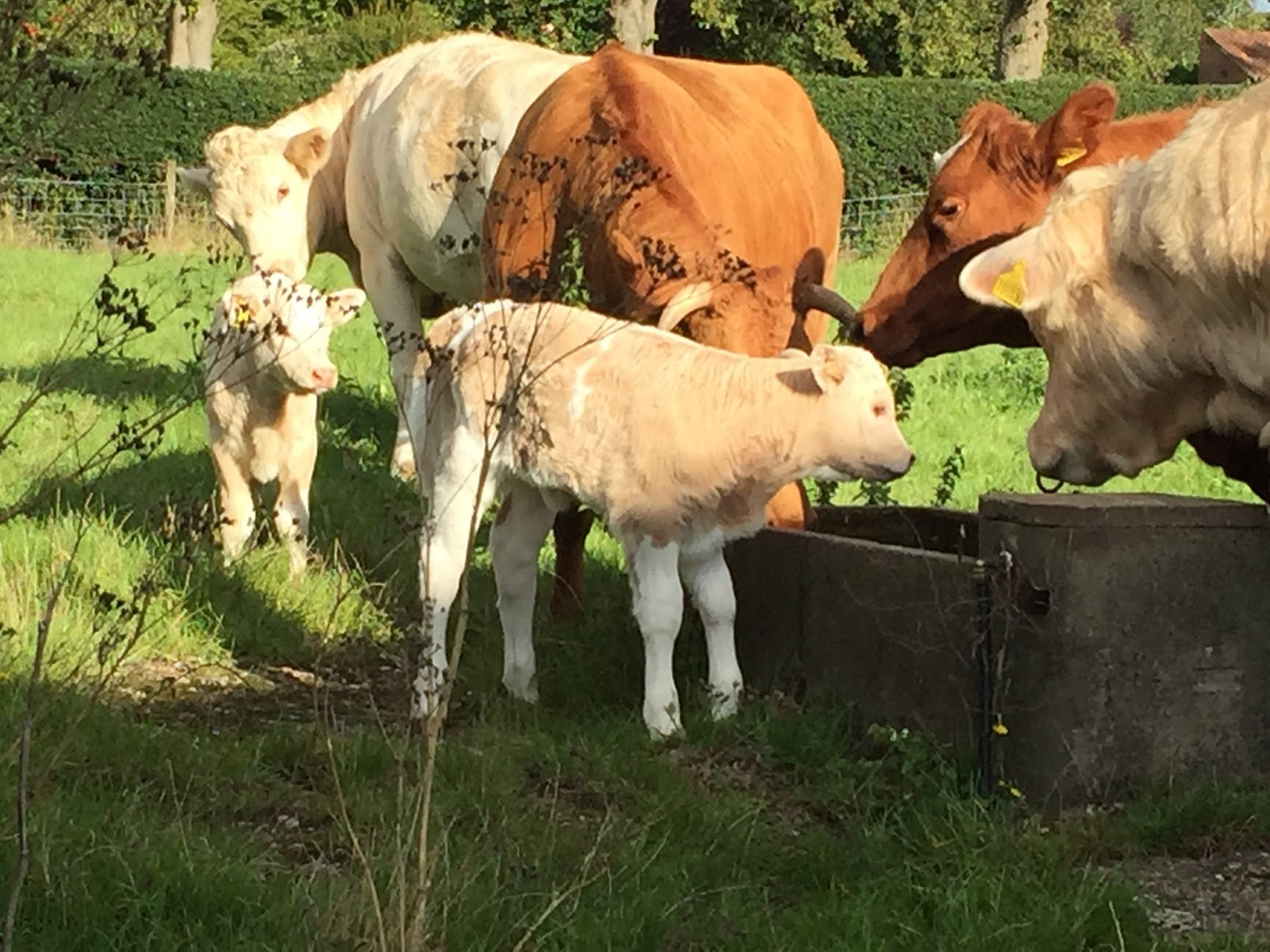
I also passed Marigold in the field. She was giving birth while on all fours. (I hasten to add that Marigold isn't the publican's wife.) She's a cow. (again, I don't mean the publican's wife is...) Moving on.
The calves hooves were protruding, so I hung about to see what would happen. (A bit like the orthopaedic surgeon's take on life.) Meanwhile a handful of hens had decided to make an entrance (not from the cow) and proceeded to walk in a hen-like manner, onto the field. Luckily I had my Brittany spaniel on a lead because she's the Hannibal Lecter of dogs when it comes to small creatures. My Springer is a wimp. I'm sure she wouldn't mind me calling her that because...well, she's too much of a wimp to disagree with me. She's frightened of the wind. She's frightened of snails. She's frightened of her shadow. Little did I know that my wimp had "grown a pair" (as my daughter so succinctly put it when I returned home). She chased these hens (*sigh* not my daughter), making them squawk and flap while the cow pushed and groaned. I was running around in wellies that were a size too big while trying to catch my Springer. This farce ended with two blushing hens with their butts on show, a dog with a mouthful of feathers and a labouring cow who was now stressed and anxious.
The following day I found a safely-delivered calf.
But we can all learn a lesson from this. That is, where to place your punctuation when using brackets! (Neatly done, if I do say so myself.)
Parentheses are words enclosed in brackets, that clarify information given in a sentence.
Example 1: My spaniel (although usually a wimp), chased the hens. In most cases, punctuation isn't used directly before the opening bracket of a sentence, they are placed after the closing bracket.
Example 2: The orthopaedic surgeon decided to leave Paul's arm broken (for over a week). Because the parenthesis ends the sentence, the full stop is placed after the bracket.
Example 3: The hens scrambled back in to the coop to hide their embarrassment. (and I ran home to hide mine.) As the parenthesis is an entire sentence, the full stop is placed inside the brackets. Even though the parenthetical element is a complete sentence, capital letters aren't used at the beginning or a full stop at the end because the element is placed within another complete sentence.
Friday, 17 July 2015
All The Light We Cannot See
This 523-page novel is a winner of the Pulitzer prize for fiction. The story is set in Paris during World War 2 and its primary focus is about what warfare does to ordinary people, not their leaders. At the age of six, Marie-Laure becomes blind. Her father, who works at the Museum of Natural History, builds her a model of Paris so she is able to navigate her way around the city. The Jardin des Plantes is their favourite place, and here Marie-Laure familiarises herself by counting drain covers and trees and streets, memorising routes and recognising the scents of trees and flowers. But when the Nazis occupy Paris, they're driven from their home.
In a parallel story, Werner, a young orphaned boy in Germany, comes to the notice of the Nazis for his astonishing skill at fixing radios. This leads to his relocation to an elite school aimed at providing skills for the Reich. Young Werner proves his worth and survives, even though the school is brutal and unrelenting. I liked the idea that we see into the minds and feel the emotions of both Germans and French. Some of the Germans are evil but you also come to understand how living in those times shaped you. To stand up against the Nazi regime was almost impossible. There are some who tried in this book, but they didn't succeed.
When the Nazis arrive in Paris they demand the keys from Marie's father and begin to investigate the museum. He makes plans for himself and his daughter to move to his uncle’s house in Saint-Malo. Despite her blindness, Marie is able to visualise the layout of this new town when her father makes another small and detailed model of it.
Months pass and Werner is stationed closer to the front as the Germans want experts who can pick up radio transmissions from the allies. For Marie, life in Saint-Malo becomes increasingly difficult as the Germans take full control. Her father is investigated and taken away, ending up in a German camp. Marie joins the Resistance and carries messages in baguettes. Of course, as I read the dual narrative, I wondered how soon it would be before Marie-Laure and Werner were going to meet.
Through using flash forwards and flash backs, Anthony Doerr's novel follows the course of Marie and Werner's lives as they struggle to find out wether it is possible to truly own your life when it's smothered by the the events of history. Werner is driven by a deep love of science while Marie struggles with life in darkness. Occasionally the sudden changes in the story's timeline were confusing. At times I found myself checking back to see what year I was reading about, but not frequently enough to detract from the story.
This novel is a war story and a coming-of-age story. In the midst of the rise of German fascism and the founding of the French Resistance, how do these two individuals survive? The novel constantly turns between the moral uncertainties of life and the beautiful precision of the natural world; between the political complications of war and the wonders of nature and the human brain.
I found this novel deeply moving but it is Doerr's prose that gave it five stars from me. The descriptions of objects, nature, places, a particular grip of a hand, the movement of a body and the characters' dialogue, are wonderful. I think the overall message for me, having read this book, is that mankind continues to see beauty and good in the world, despite experiencing harrowing, devastating and cruel situations.
'December sucks light from the castle. The sun hardly clears the horizon before sinking away. Snow falls once, twice, then stays locked over the lawns. Has Werner ever seen snow this white, snow that was not fouled immediately with ash and coal dust? The only emissaries from the outside world are the occasional songbird who lands in the lindens beyond the quadrangle, blown away by distant storm,or battle, or both...'
Friday, 5 June 2015
Writing Historical Fiction
I'm writing the second book of a trilogy set in France during World War 2. As LP Hatley says in The Go Between, 'The past is a foreign country; they do things differently there.'
Not only did I need to become a virtual back-packer and learn the cultural differences of another country, but I also had to become a time traveller, re-setting and familiarising my world to the early 1940's. A writer of historical fiction must be accurate because the reader will not be fooled by guesswork. It only takes one inaccurate fact for the reader to close the book with a tut (or worse) and never buy another novel by that writer again. The first book of my trilogy, The Midday Moon, is set in rural France and tells the story of a farmer's daughter during the five years of WW2. My protagonist, Arlette Blaise, takes her grandmother back home to Oradour-sur-Glane on the day of the massacre. So apart from imagination, how do I strive to write exact historical fiction?
1. I couldn’t have placed Arlette in such a traumatic situation without visiting the martyred village first hand. I have walked the roads of this once quaint village and absorbed the atmosphere. I’ve seen the aftermath of brutality. As a writer, I feel a weight of responsibility in telling a story about a fictional character living through what was an actual genocide. I’ve endeavoured to honour the villagers' last hours with respect and accuracy, to choose the right words and not to glamourize this horrendous crime. Charles de Gaulle declared that the ruins must stay as a permanent national monument to the townspeople’s suffering, so I found Oradour-sur-Glane just as it had been left on the day of the massacre; frozen in time. What better way to write about factual surroundings and infrastructure.
2. I've read numerous novels set in the era. This is a great starting point for cultural immersion. I attuned myself to the writers' rhythm, nuances and the tone of the language used back then. Picking up a few extra details is always a bonus - which of course must be placed in my novel in my own way. For example, I learned through reading one book that the French folded their Metro tickets into V shapes, for Victory during the war. It was a small way to show contempt towards the invading Germans.
3. Non-fiction books are also invaluable. Pages and pages of facts and photographs build up a past world to write about.
4. Speaking to people who lived during the war highlights some rare treasures of information. Obviously this is only possible if your story is set during the past seventy-eighty years, but the older generation are full of stories they love to share.
5. The Internet! What did we do before the Internet? There are archives, interviews, photographs, paintings, stories and newspaper articles out there, all waiting to be discovered.
6. Magazines are also a hive of information. One which has been an enormous help to me is World War 2 Magazine. The description of tanks and writing about accurate weaponry is vital to make a scene sound authentic.
7. Television films and documentaries pull you into the screen making it easy to absorb the atmosphere, the fear, the horror and the bravery of many ordinary people. Here are just a few I've watched with notepad and pen in hand!
'Colditz,' 'Thunderbolt,' 'World War Two - The Lost Colour Archives,' 'The War' by Ken Burns, 'World of War: The Complete set,' narrated by Sir Lawrence Olivier, 'Band of Brothers,' 'Holocaust,' mini series and 'The Architects of Doom,' documentary.
Here is my blog post about my visit to the devastated remains of Oradour-sur-Glane and a excerpt from that particular chapter of The Midday Moon. Arlette and her grandmother have been ordered to the village green by the Nazis. Blogspot doesn't allow me to indent speech or change the layout but I hope it sounds authentic to you and thank you for reading this post.
Although there wasn’t any panic among the gathering, Arlette could feel a mounting anxiety. The air was heavy with anticipation and a low murmuring of conversation spread between the villagers. How long would they be delayed? She didn’t need this hold up if she was going to make it back home today. Perhaps she would be staying overnight after all.
Lines of people continued to scurry along the main road towards them. Mademoiselle Petit, a schoolteacher, ushered a group of children in front of her and joined the congregation of villagers. The click-clacking of their small wooden clogs was silenced by the grass.
‘It’s Saturday. Why are the children at school today?’ asked Arlette.
The schoolteacher sounded impatient. ‘They’re attending an immunisation programme and this nonsense is very disruptive.’ She shook her head with irritation and turned to count her pupils.
Arlette looked into the sky hoping to see white clouds that might give them respite from the relentless intensity of the sun’s rays. The sky was cloudless but a single buzzard soared in a wide circular pattern, its wings outstretched and static.
Grandma Blaise held her lower back and spoke to Berthe, an acquaintance who had worked in the hairdresser’s for more than twenty years. ‘Goodness, I do ache.’
‘Hopefully they won’t be too much longer,’ said Berthe. ‘I’m dying of thirst.’
‘I hope they’re being careful with my ornaments.’
‘Look, grandma.’ Arlette pointed to a lorry convoy that had parked in the lower part of Oradour. Soldiers wearing flecked waterproof clothing in yellow and green, swarmed out of the back of the trucks and through the streets.
‘Why are there so many Germans?’ asked Grandma Blaise. She slipped her arm through her granddaughter’s. ‘The village is already swarming with them.’
Arlette shook her head. She didn’t have an answer.
Everyone was watching and waiting in a dignified silence. Soldiers continued to empty surrounding houses and shops of their occupants. They were being herded in groups towards the green. The crowd was now so large that it was spreading out towards a covered well. A woman stumbled towards them with her hair in curlers. A half-dressed child was held in his mother’s arms. Still with his jaw covered in shaving foam, a man had been ordered out of the barber’s. Worried mothers clutched the tiny fingers of their children or pushed prams towards the assembly point, its numbers growing by the minute. Next the grocer and another teacher arrived, accompanied by a larger group of children. The priest arrived, followed by a man carrying an elderly woman on his back.
The throng began to move. Arlette looked around in confusion. ‘What’s happening?’
A voice in the crowd answered. ‘They’re separating the women and children from the menfolk.’
‘Why?’
The question went unanswered. Arlette took hold of her grandmother’s hand and moved closer to the front of the crowd.
From where they were now standing, Arlette could see and hear the SS officer more clearly. He was a solid man whose uniform was decorated with emblems and badges. The letters SS were zig-zagged like two lightning strikes on his collar. He demanded that the elders of the village reveal the hiding place of the ammunition. Arlette heard the mayor respond by denying any knowledge of the presence of arms. The officer turned to another German soldier and spoke out of earshot, no doubt translating.
‘The mayor’s just offered to be held hostage with his sons so the elderly and children can get out of the sun,’ said Arlette.
‘How brave,’ said Grandma Blaise.
Arlette felt a trickle of sweat run down her spine. The sun was sweltering. Her mouth was dry and she was worried for her grandmother. Why had they decided to come here today? If only they had made the journey the following day.
She immediately became more alert. Commands were being shouted to the gathered men. They were ordered to walk away from the fairground en masse. At gunpoint.
‘Where are they taking them?’ asked Berthe. ‘My son is with them.’
‘We don’t know,’ Arlette shrugged. ‘Try not to worry. They won’t hurt them because they haven’t done anything wrong.’ She realised how naïve she sounded. Hadn’t little Maurice only been trying to keep warm? Hadn’t the Jewish people only been trying to work hard and settle into a community?
Arlette watched several men turn to look back at the women. She recognised them: the ticket-seller at the tram station from when she used to travel to sell her silk cocoons, the owner of her favourite café, her grandmother’s elderly neighbour, Jean-Philippe. The men’s eyes searched for glimpses of their wives and children. They were led away. Their faces drawn with fear. They looked confused, many trying to dodge the pushing and shoving of Germans fists. Next the SS officer turned his attention to the remaining women and children.
‘What’s he saying?’ asked Grandma Blaise. ‘I do wish he would speak up.’
‘We’ve got to go to the church,’ said Arlette. ‘Maybe they realise that we need to sit down in some shade.’ She patted her grandmother’s hand for reassurance and helped her along the main street towards the village’s place of worship at the southern end of town. In front of the church grew a tall tree in full leaf. They walked beneath its dappled shade. Several women close by sighed audibly at the momentary respite from the sun’s rays as they were shepherded towards Oradour’s church entrance.
German voices grew more frenzied. Women and children were hurried along and pushed inside. An old lady fell at the doorway. Arlette recognised her as her grandmother’s friend, Jeanne. She didn’t mention it to her grandmother who was anxious enough. There was momentary turmoil when the women behind helped her to stand. People behind were bumping into each other. Arlette stumbled but she steadied herself and her eyes began to adjust to the dim light inside the church. Looking down, she saw flowers being trampled underfoot. They looked like the same flowers that Jeanne had been carrying. She reached for a pew for balance, smelling the familiar aroma of incense and candle smoke. It comforted her a little. She grasped Grandma Blaise’s hand and pushed to the back of the church. In seconds they were next to the altar.
Arlette didn’t let go of her grandmother’s hand despite the bumping and jostling from others. They were ordered deeper inside. The cool interior was a welcome relief from the fierce heat outside and many women and children settled themselves on the wooden benches. She helped her grandmother to sit on a stool beside the altar but as more women were herded inside, the crowd pushed Arlette a short way from the old lady. Helpless to stop the momentum, she was thrust to the opposite side of the altar.
A cough. A baby’s whimper. A child’s voice calling for maman. But still the women remained calm, their ears straining for any communication or sign of what was going to happen next.
Then it came.
Distant machine gun fire could be heard through the open church door. It continued for a long minute until it slowed. Then just occasional short bursts.
‘What are they firing at?’ someone whispered.
‘Perhaps they’re destroying something.’
‘The men…you don’t think…’
The woman didn’t finish her sentence and no one answered. Arlette sought out her grandmother’s face. They exchanged worried glances. A commotion at the entrance of the church made everyone turn and look. Two German soldiers were carrying a large chest into the building. They struggled under its weight.
‘Perhaps they’ve brought us water,’ someone suggested.
A soldier attached a thin rope to the chest and laid it on the ground. He walked backwards out of the door. An orange glow could be seen in his hand. He bent to the ground. The doors were slammed shut.
Monday, 20 April 2015
My visit to The London Book Fair 2015
This year's London Book Fair moved from Earl's Court Exhibition Centre to Olympia. Although Olympia was more difficult to get to, involving taking a tube and then an overground bus, the new venue was perfect. With natural lighting and a balcony view of events and stands, it was an altogether more pleasant internal space than Earl's Court. There was a huge amount that could be discovered at The London Book Fair. There were companies that could convert your book to digital, seminars that showed different approaches to marketing, a future-gazing presentation that could change your strategy. The exciting thing is that there just be a chance meeting that leads to future success.
The variety of topics covered and the number of stands was huge. It gave visitors access to an incredible line-up of educational seminars, interviews, workshops and demonstrations. The first talk I was interested in listening to was Introduction To Publishing - The Roles Of Publisher And Literary Agent. This took place in the Author HQ and consisted of conversation between the audience and David Shelley, CEO of Little Brown and Lizzy Kremere, Literary Agent.
At the Children's Hub a couple of hours later, there was a talk about The Power Of Reading: Developing Reading For Pleasure In Schools. Having three ideas for children's books that are only scribbles in notebooks at the moment, I found this very helpful.
I met a couple of fellow writers in the cafe and we became engrossed in conversation, swapping notes and simply enjoying the company of other writers who'd come to explore. We had to sneak into the back of a seminar that had already started but which turned out to be an excellent question/answer session. Questions were asked from the audience about writing a synopsis, how important a 'hook' is in the first chapter (not always was a surprising answer), how publishing has changed and how too much description should be avoided. I always find these sessions the most useful because the questions are so varied, as opposed the talks about one particular aspect of writing.
There were lots of books for sale and literary gifts to buy. This is the pile I brought back from London with me. (Note to self; they were heavy - take a shopping trolley next year!)
Oh, I nearly forgot - I also found a little something else in Harrods!
Friday, 27 February 2015
A Review of The Rosewood Guitar by Mariam Kobras
Twenty four year old Jon Stone writes songs and works in a bookstore in New York. He’s not chasing Hollywood fame but dreams of a successful music career. Sadly his girlfriend, Jenny, doesn’t share his enthusiasm. When Jon is given the opportunity to move to Los Angeles to form a band and sign a recording contract, Jenny declines the offer to go with him. In LA, Jon is cossetted and treated like royalty, but something’s missing; someone to share his life. When something happens that shocks him to the core, he begins to rethink his future as a rock star.
When I’d read The Rosewood Guitar, I felt as if I’d just returned from holiday. So vivid and colourful are Mariam’s descriptions of New York and Los Angeles, that I’d visited them in my mind’s eye.
New York’s ‘rain-washed streets,’ ‘the glittering skyline of Manhattan,’ ‘the constant song of the big city on its island; the horns of the ships, the thrum of traffic from the bridge.’
Mariam Kobras's writing is so beautifully observational that she can paint a picture with words. Occasionally it can read like poetry, but if it’s well written, this doesn’t detract from the tension or action.
‘The sun was beginning to set as they reached Santa Monica, and driving down to the beach, Jon felt reconciled. He took off his sneakers and walked along the sand to the water, feeling the warmth of a sunny day under his feet. The sky was immense. ( ) Wide slow waves moved towards the shore, only to break in the tiniest whisper of foam at his feet.’
Mariam’s characters are believable. They have flaws and make mistakes, but they also show a warmth and humour that makes the reader relate to them and care what will happen to them as the story unfolds. The pace of The Rosewood Guitar flows as smoothly and effortlessly as the Hudson. Each chapter moves the storyline along but the reader doesn’t feel rushed. Time is taken to smell, hear, taste and see the big cities and what they have to offer. Occasionally Jon’s thoughts on missing his family repeat themselves, but I imagine feelings of homesickness do reappear depending on how we’re feeling. I liked the descriptions of the changes in weather between LA and New York. It helped to underline the two halves of Jon’s life.
‘Snow had begun to fall. The flakes were tiny. They looked like confectioner’s sugar drifting on the air, doing intricate dances over the subway grates, gathering in corners and nooks instead of covering surfaces. Jon notes how people looked skyward before turning up the collars of their coats, most of them with smiles on their faces.’
I enjoyed this feel-good, page-turner of a book and the only downside was that I wished it could have been longer…but that’s where the Stone trilogy comes in! (Published by Buddhapuss Ink.)
Subscribe to:
Posts (Atom)